


Engineering Guide to 5 Micron Filter Mesh Size in Industrial Applications
In the field of industrial precision filtration, the selection of an appropriate pore size is critical to balancing fluid throughput with contaminant retention. Among the various specifications used by engineers, the 5 micron filter mesh size represents a significant threshold where filtration transitions from general particulate removal to fine-scale clarification. Achieving consistent 5-micron performance using stainless steel media requires a deep understanding of weave types, material properties, and structural integrity.
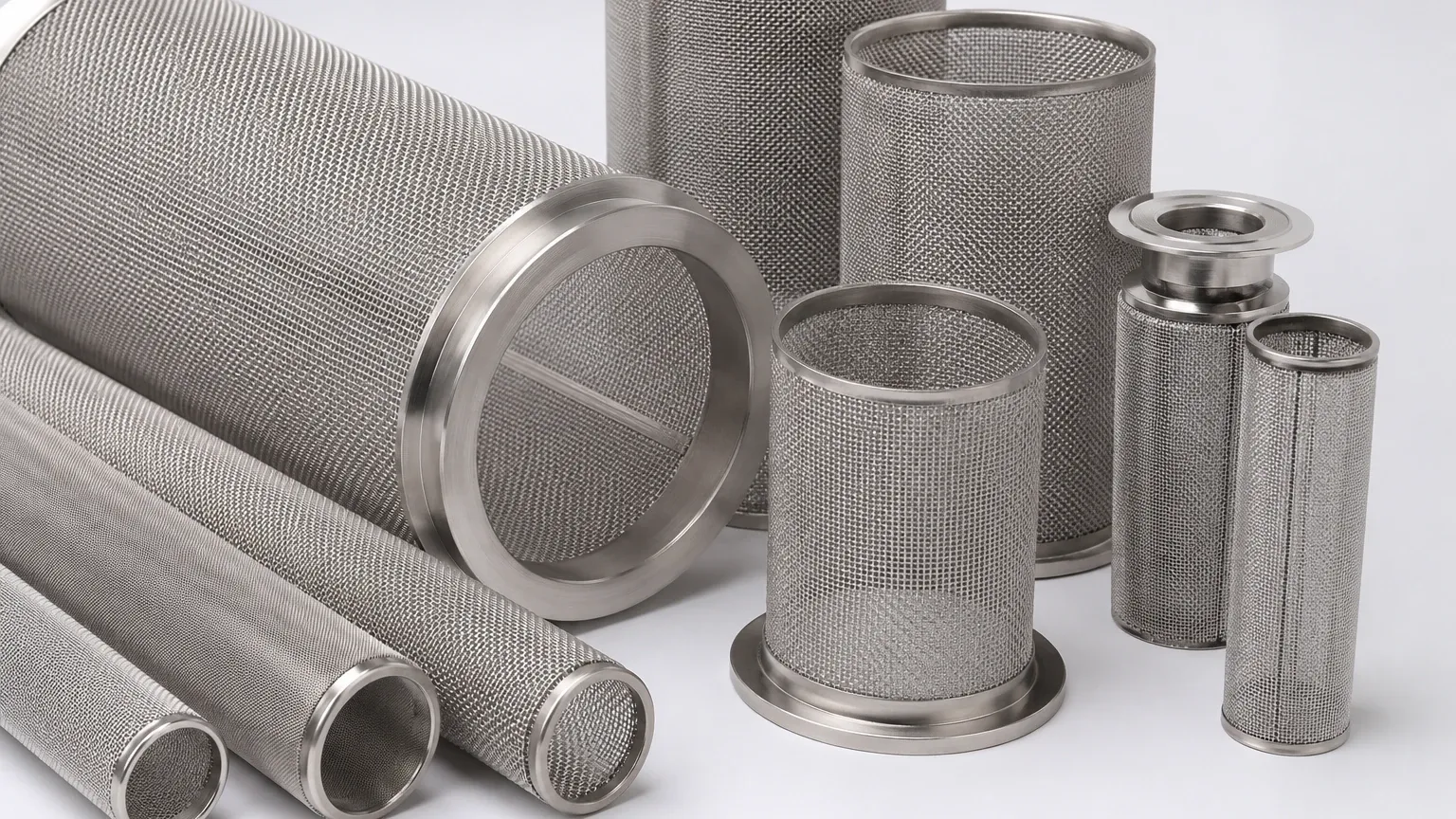
For technical professionals and purchasing teams, specifying Wire Mesh Filter Cylinders & Tubes with a 5-micron rating involves more than just selecting a catalog number. It requires an evaluation of how the mesh is woven, how it is supported, and how it will behave under the specific thermal and chemical conditions of the application environment.
Understanding the 5 Micron Filter Mesh Size
A micron (micrometer) is one-millionth of a meter. To put a 5 micron filter mesh size into perspective, a human hair is approximately 50 to 70 microns in diameter, and the smallest particle visible to the naked eye is roughly 40 microns. Filtration at the 5-micron level is designed to capture fine silt, large bacteria, yeast cells, and microscopic metal debris that can cause wear in high-precision hydraulic components or contaminate pharmaceutical batches.
In stainless steel wire mesh, achieving a 5-micron opening is not possible through a standard plain weave. In a plain square weave, the wire diameter required to create such a small opening would be so thin that the mesh would lack the mechanical strength to survive industrial pressures. Instead, 5-micron filtration is typically achieved through specialized weaving patterns known as Dutch Weaves.
Dutch Weave Technology
Dutch weaves use a combination of heavy warp wires and fine, closely packed shute (weft) wires. This creates a dense, multi-layered structure where the fluid must pass through a tortuous path. The "pore" is not a simple square hole but a triangular or curved opening formed by the overlap of wires.
* Plain Dutch Weave (PDW): Provides a relatively high flow rate with good strength, often used for primary filtration stages.
* Twilled Dutch Weave (TDW): This weave allows for the tightest packing of wires. By passing each shute wire over and under two warp wires, manufacturers can use finer wires to achieve an absolute 5-micron rating while maintaining a robust fabric thickness.
Nominal vs. Absolute Filtration Ratings
When specifying a 5 micron filter mesh size, engineers must distinguish between nominal and absolute ratings. This distinction is often the source of performance failures in the field.
Nominal Rating
A nominal rating indicates the ability of the mesh to retain a majority (typically 60% to 90%) of particles of a specific size. Because wire mesh is a geometric structure, some particles larger than 5 microns—particularly elongated or needle-like contaminants—may pass through if they align perfectly with the pore. Nominal filters are generally used in non-critical applications or as pre-filters to extend the life of more expensive secondary filters.
Absolute Rating
An absolute rating implies that 99.9% (Beta 1000) of particles larger than the specified micron size will be captured. For a 5-micron absolute filter, the manufacturing process must be tightly controlled to ensure no single opening exceeds the 5-micron limit. This is verified through bubble point testing or glass bead challenge tests. In critical sectors like aerospace hydraulics or sterile pharmaceutical processing, absolute ratings are the industry standard.
Engineering Considerations for Wire Mesh Filter Cylinders & Tubes
Transitioning from a flat sheet of 5-micron mesh to functional Wire Mesh Filter Cylinders & Tubes introduces several mechanical engineering challenges. The filtration media must be formed, joined, and supported to withstand differential pressures without deforming.
1. Structural Support and Pleating
At 5 microns, the mesh is relatively dense and creates higher resistance to flow than coarser meshes. To prevent the mesh from collapsing under pressure, it is often combined with coarser support layers.
* Sintered Mesh Construction: One of the most reliable methods is vacuum sintering. Multiple layers of mesh—including the 5-micron filtration layer, drainage layers, and heavy-duty support layers—are bonded together at a molecular level. This creates a single, rigid plate that can be rolled into cylinders without shifting the pore structure.
* Pleating: To compensate for the reduced flow area of fine mesh, the media can be pleated. Pleating increases the effective surface area of the cylinder by 3 to 10 times, significantly reducing the flux (flow per unit area) and extending the time between cleaning cycles.
2. Seam Integrity
The longitudinal seam of a filter tube is a potential point of bypass. For 5-micron applications, plasma welding or TIG welding is preferred over mechanical overlapping. A high-quality weld must ensure that the heat-affected zone does not distort the 5-micron pores adjacent to the seam.
3. End Cap Configuration
Filter cylinders must be integrated into a housing. Whether using DOE (Double Open End), SOE (Single Open End) with an O-ring, or threaded NPT fittings, the seal must be absolute. Any bypass at the gasket or O-ring renders the 5-micron mesh irrelevant.
Material Selection: 304 vs. 316L Stainless Steel
Industrial filters are frequently exposed to aggressive cleaning chemicals, high temperatures, and corrosive fluids. Selecting the right alloy is essential for long-term durability.
* AISI 304: Suitable for general industrial use, water filtration, and mildly corrosive environments. It offers good weldability and cost-effectiveness.
* AISI 316L: The "L" stands for low carbon, which improves corrosion resistance after welding. 316L contains molybdenum, making it much more resistant to pitting and crevice corrosion in chloride-rich environments (such as seawater or brine) and acidic chemical processing. It is the preferred choice for the food, beverage, and pharmaceutical industries.
Performance Expectations and Pressure Drop
Engineers must account for the Clean Pressure Drop ($ΔP$) when integrating a 5-micron filter into a system. Because the openings are small, the initial resistance is higher than that of a 20 or 40-micron filter.
Factors affecting pressure drop include:
1. Fluid Viscosity: High-viscosity oils require much larger filter surface areas to maintain a 5-micron rating without triggering bypass valves.
2. Flow Velocity: Higher velocities increase turbulence and pressure drop. Reducing the velocity through the media (by increasing the cylinder diameter or length) improves filtration efficiency.
3. Contaminant Loading: As the 5-micron pores capture particles, they begin to "cake." While this cake can actually improve filtration fineness, it also causes an exponential rise in pressure drop.
Maintenance, Cleaning, and Total Cost of Ownership
One of the primary advantages of stainless steel 5 micron filter mesh size components over disposable polymer cartridges is cleanability. In many B2B industrial settings, the ability to reuse a filter element significantly reduces the total cost of ownership (TCO).
Cleaning Methods
* Backwashing: Reversing the flow of clean fluid through the mesh to dislodge particles. This is most effective if the particles are caught on the surface of the mesh rather than deep within a Dutch weave.
* Ultrasonic Cleaning: Using high-frequency sound waves in a detergent bath to create cavitation bubbles. These bubbles reach deep into the mesh structure to remove microscopic contaminants that backwashing cannot reach.
* Chemical Cleaning: Using acids or alkalis to dissolve organic or mineral scale, provided the mesh material (316L) is compatible with the cleaning agent.
Replacement Cycles
While stainless steel filters are durable, they are not infinite. Repeated cleaning cycles and pressure shocks can eventually lead to "wire fatigue." Engineers should monitor the "dirty" pressure drop after cleaning; if the baseline pressure drop remains high even after thorough cleaning, the element has reached the end of its service life and should be replaced to prevent media migration.
Procurement Checklist: What to Confirm with the Manufacturer
Before finalizing a purchase order for 5-micron filtration components, technical buyers should verify the following data points with the manufacturer:
1. Validation Method: How is the 5-micron rating verified? Request a bubble point test report or a certificate of conformance.
2. Effective Filtration Area (EFA): Ensure the EFA is sufficient for the intended flow rate to avoid excessive initial pressure drop.
3. Maximum Differential Pressure ($ΔP$): What is the collapse pressure of the cylinder? Ensure it exceeds the system's maximum pump pressure or bypass setting.
4. Operating Temperature: Will the filter operate at cryogenic temperatures or extreme heat? This affects the choice of gaskets (Viton, PTFE, EPDM) and the welding technique.
5. Fluid Compatibility: Confirm that all components, including the mesh, support core, and end caps, are compatible with the process fluid and cleaning chemicals.
Conclusion
Specifying a 5 micron filter mesh size is a strategic decision that impacts the purity of the final product and the protection of downstream equipment. By selecting high-quality Wire Mesh Filter Cylinders & Tubes, engineers can achieve a balance of precision, mechanical strength, and reusability. Whether the application involves protecting sensitive hydraulic valves or ensuring the clarity of a chemical intermediate, understanding the nuances of weave types and structural support is essential for optimizing filtration performance and minimizing operational downtime.
