


In industrial water treatment and fluid processing, the precision of a filtration system determines the longevity of downstream equipment and the quality of the final product. A 5 micron mesh water filter represents a critical threshold in fine filtration, often serving as the final barrier against microscopic suspended solids, silt, and biological matter. Unlike coarser strainers, achieving a reliable 5-micron rating requires sophisticated engineering of stainless steel wire cloth and structural support to ensure the filter can withstand industrial pressures without compromising its aperture integrity.
For engineers and procurement specialists, selecting a 5-micron solution involves more than just identifying a pore size. It requires an understanding of weave dynamics, material science, and the mechanical configuration of Wire Mesh Filter Cylinders & Tubes. This guide examines the technical considerations necessary for implementing high-performance 5-micron filtration in demanding industrial environments.
Engineering Principles of 5 Micron Mesh Filtration
At the 5-micron level, the physical properties of standard square weave wire mesh are typically insufficient. A standard square weave with a 5-micron opening would require wires so thin that they would lack the mechanical strength to survive even moderate flow velocities. Consequently, a 5 micron mesh water filter is almost exclusively manufactured using specialized weaving patterns or sintered multi-layer structures.
Dutch Weave and Twilled Dutch Weave
To achieve a 5-micron rating, manufacturers utilize Dutch Weave patterns. In these designs, the warp wires (running lengthwise) are heavier, while the shute wires (running crosswise) are smaller and driven closely together. This creates a dense, tortuous path for the fluid. For a 5-micron absolute rating, Twilled Dutch Weave is often employed, where the shute wires pass over and under two warp wires, allowing for an even tighter packing of wires. This results in a filter medium that provides high-pressure resistance and precise particle retention.
Sintered Wire Mesh Technology
In many industrial applications, a single layer of fine mesh is too fragile. Sintered wire mesh involves laminating multiple layers of stainless steel wire cloth together using a vacuum heat-treatment process. A typical 5-layer sintered structure might include a 5-micron filtration layer protected by finer buffer layers and reinforced by heavy-duty support layers. This process fuses the wires at every contact point, ensuring that the 5-micron apertures remain fixed even under high differential pressure (ΔP).
Structural Integrity: Wire Mesh Filter Cylinders & Tubes
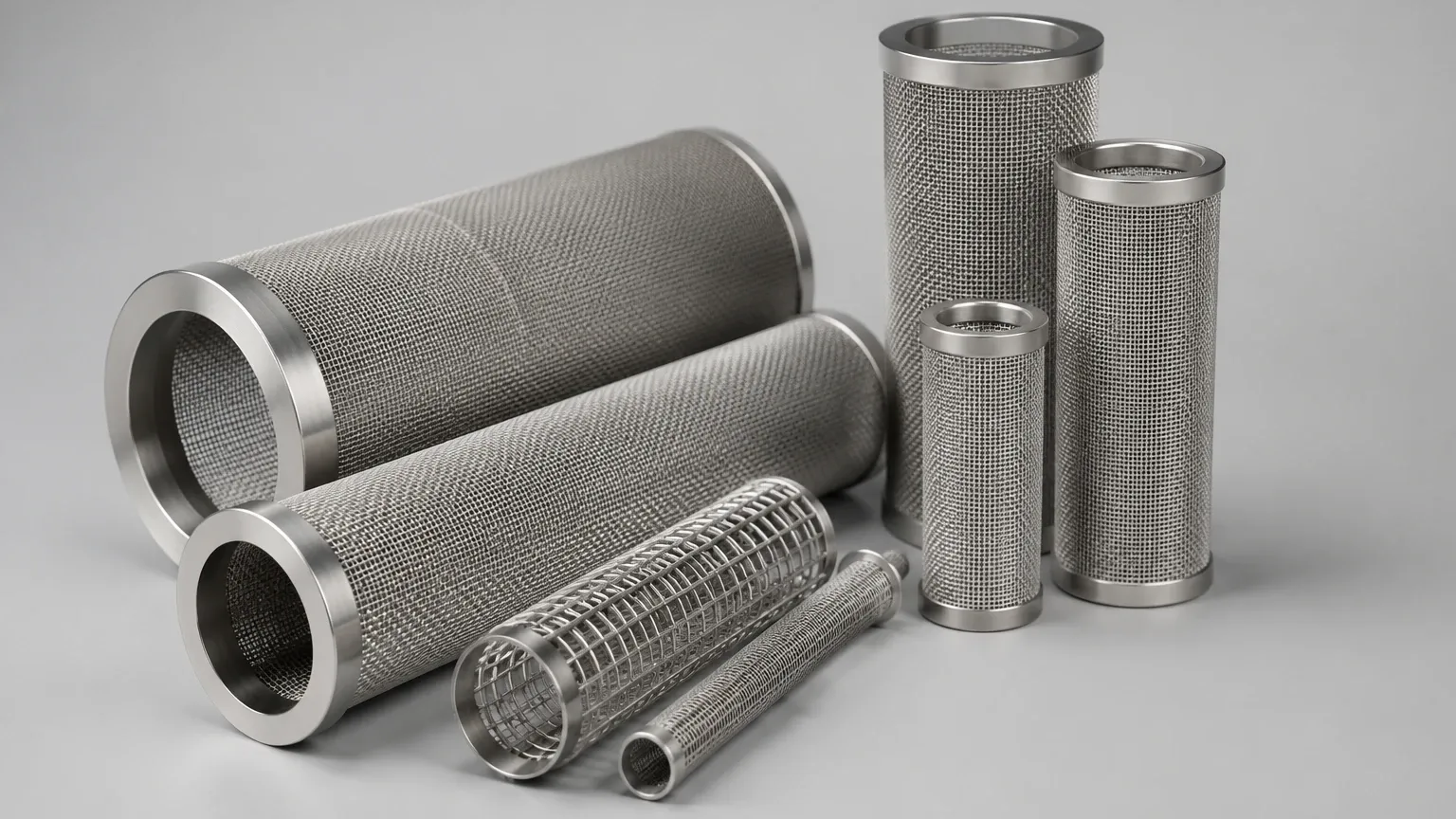
The geometry of the filter element is as vital as the mesh itself. In high-flow water treatment systems, the 5 micron mesh water filter is usually configured into Wire Mesh Filter Cylinders & Tubes. This cylindrical shape offers the best balance between surface area and structural rigidity.
Internal vs. External Support
Because a 5-micron mesh is susceptible to deformation, industrial cylinders often incorporate a perforated metal core. Depending on the flow direction (outside-to-inside or inside-to-outside), this core provides the necessary backbone to prevent the mesh from collapsing or bursting. For high-viscosity fluids or high-pressure water injection systems, an outer shroud may also be added to protect the fine mesh from mechanical damage during installation or backwashing.
Pleated vs. Cylindrical Designs
While a standard smooth cylinder is easier to clean, a pleated design can significantly increase the effective filtration area within the same footprint. For a 5 micron mesh water filter, pleating allows for lower flux rates (flow per unit area), which reduces the velocity of particles hitting the mesh and extends the time between cleaning cycles. However, the pleating process must be executed with precision to ensure that the 5-micron pores are not stretched or compromised at the folds.
Material Selection and Chemical Compatibility
Industrial water is rarely pure H2O. It often contains dissolved salts, chemicals, and varying pH levels that can lead to corrosion. Selecting the correct alloy for a 5 micron mesh water filter is essential for long-term ROI.
1. Stainless Steel 304: Suitable for general water filtration where cost is a primary concern and the environment is non-corrosive.
2. Stainless Steel 316L: The industry standard for water treatment. The addition of molybdenum provides superior resistance to pitting and crevice corrosion, particularly in water with high chloride content (such as brackish water or treated process water).
3. Specialty Alloys: For highly aggressive environments, such as those found in chemical processing or offshore applications, alloys like 904L, Hastelloy, or Monel may be required to maintain the integrity of the 5-micron apertures over time.
Performance Metrics: Flow Rate and Pressure Drop
A common challenge with a 5 micron mesh water filter is the inherent resistance to flow. As the pore size decreases, the initial clean pressure drop increases. Engineers must calculate the "Clean ΔP" to ensure the pump system can handle the resistance while maintaining the required flow rate.
Calculating Surface Area
To mitigate high pressure drops, the total surface area of the Wire Mesh Filter Cylinders & Tubes must be optimized. If the flow velocity is too high, particles can be "forced" through the mesh, or they may become deeply embedded, making the filter difficult to clean. A lower flux rate (typically measured in gallons per minute per square foot) is recommended for 5-micron applications to ensure efficient surface filtration.
Dirt Holding Capacity
Unlike depth filters (like melt-blown cartridges), wire mesh filters primarily operate on the principle of surface filtration. This means the dirt-holding capacity is limited to the surface area of the mesh. Once the surface is covered with a cake of contaminants, the pressure drop will rise sharply. Monitoring this ΔP is critical for determining the cleaning or backwash schedule.
Maintenance, Cleaning, and Longevity
One of the primary advantages of using a stainless steel 5 micron mesh water filter over disposable alternatives is cleanability. In B2B industrial settings, the ability to reuse filter elements significantly reduces the total cost of ownership (TCO).
Backwashing and Ultrasonic Cleaning
For automated systems, backwashing (reversing the flow) can dislodge the filter cake from the surface of the mesh. However, at the 5-micron level, some particles may become wedged in the weave. In such cases, periodic ultrasonic cleaning is the most effective method. The high-frequency waves create cavitation bubbles that reach deep into the Dutch weave to remove microscopic debris that standard backwashing cannot reach.
Chemical Cleaning (CIP)
In food, beverage, or pharmaceutical water systems, Clean-in-Place (CIP) procedures using caustic or acidic solutions are common. The stainless steel construction of Wire Mesh Filter Cylinders & Tubes allows them to withstand these harsh chemicals, which would degrade polymer-based filters.
Procurement Checklist for International Buyers
When sourcing a 5 micron mesh water filter from a manufacturer like Kaifil, providing precise technical specifications is necessary to ensure the component performs as expected in the field. International buyers should confirm the following details before finalizing an order:
* Micron Rating Type: Is the 5-micron rating "Absolute" (100% retention) or "Nominal" (usually 60-90% retention)?
* Construction Method: Is the mesh single-layer, multi-layer, or sintered? Sintered mesh is preferred for high-pressure industrial water applications.
* End Cap Configuration: Specify the interface required for your housing (e.g., Double Open End (DOE), 222 O-ring, 226 Bayonet, or NPT/BSP threaded connections).
* Operating Conditions: Provide the maximum operating temperature and the maximum allowable differential pressure before the element requires cleaning or replacement.
* Certification Requirements: For pharmaceutical or food-grade applications, ensure the materials meet FDA or relevant international standards for food contact.
Conclusion
Implementing a 5 micron mesh water filter is a sophisticated engineering task that requires balancing filtration precision with mechanical durability. By utilizing high-quality Wire Mesh Filter Cylinders & Tubes, industrial facilities can achieve reliable, repeatable filtration results while benefiting from the longevity and cleanability of stainless steel. Whether for protecting high-pressure pumps, ensuring the purity of process water, or serving as a pre-filter for RO membranes, the correct 5-micron mesh solution is a cornerstone of efficient industrial fluid management.
