


8 Mesh Filter
In industrial filtration, selecting the appropriate mesh size is a critical engineering decision that directly impacts system efficiency, equipment longevity, and process throughput. An 8 mesh filter represents a specific grade of coarse filtration widely utilized across chemical processing, water treatment, and food production. While often categorized under "coarse" or "pre-filtration," the technical nuances of an 8 mesh specification—including wire diameter, aperture size, and open area percentage—determine its suitability for demanding B2B environments.
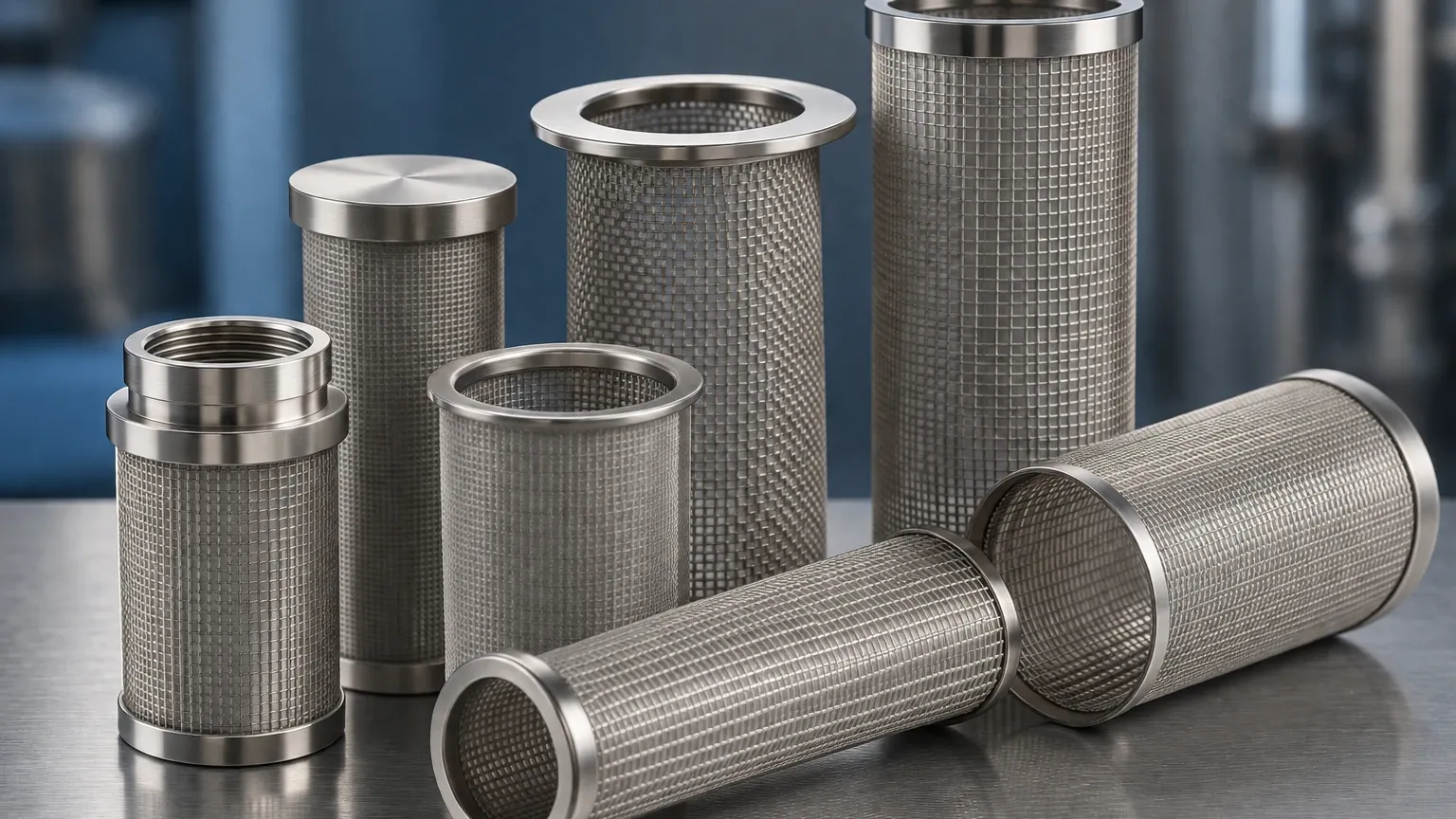
This guide examines the technical parameters of 8 mesh filtration, the engineering considerations for incorporating it into Wire Mesh Filter Cylinders & Tubes, and the procurement criteria essential for technical buyers and plant engineers.
Understanding the Technical Specifications of 8 Mesh
The term "mesh" refers to the number of openings per linear inch of the wire cloth. Therefore, an 8 mesh filter contains eight openings and eight wires per inch in both the warp and weft directions. However, the mesh count alone does not define the filtration capability; the wire diameter is the secondary variable that determines the actual aperture (the clear opening between wires).
Aperture and Micron Rating
For a standard industrial 8 mesh filter, the wire diameter typically ranges from 0.7mm to 1.0mm (0.028" to 0.039"). If we assume a standard wire diameter of 0.8mm (0.032"), the calculation for the aperture is as follows:
1. Linear Pitch: 25.4 mm / 8 = 3.175 mm
2. Aperture: 3.175 mm – 0.8 mm = 2.375 mm
In terms of micron rating, an 8 mesh filter with a 2.375 mm aperture equates to approximately 2375 microns. This makes it ideal for removing large particulates, scale, and debris that could damage downstream sensitive equipment like high-pressure pumps or fine-mesh membrane systems.
Open Area Percentage
The open area is the ratio of the area of the openings to the total area of the mesh. For an 8 mesh filter with 0.8mm wire, the open area is approximately 56%. A high open area is advantageous for minimizing pressure drop (ΔP) and maintaining high flow rates, which are critical in high-volume industrial fluid handling.
Material Selection for Corrosive and High-Temperature Environments
Industrial 8 mesh filters are rarely manufactured from carbon steel due to oxidation risks. Stainless steel is the industry standard, but the specific grade must be selected based on the chemical composition of the filtrate and the operating temperature.
* Stainless Steel 304: The most common grade for general industrial applications. It offers excellent mechanical strength and good corrosion resistance for water treatment and non-acidic food processing.
* Stainless Steel 316L: Contains molybdenum, providing superior resistance to chlorides and pitting. This is the preferred choice for marine environments, pharmaceutical manufacturing, and chemical processing where aggressive solvents are present.
* Duplex Stainless Steel: Used in specialized cases where high mechanical stress and extreme corrosion resistance are required simultaneously, such as in offshore oil and gas filtration.
Fabrication of Wire Mesh Filter Cylinders & Tubes
While 8 mesh is available in flat sheets, most industrial applications require it to be formed into Wire Mesh Filter Cylinders & Tubes. The fabrication process involves several engineering steps to ensure structural integrity under pressure.
Welding and Seaming
For coarse 8 mesh, plasma welding or TIG (Tungsten Inert Gas) welding is typically used to create a robust longitudinal seam. Unlike finer meshes that might require overlapping, an 8 mesh cylinder is often butt-welded to maintain a consistent diameter and prevent bypass. The weld must be fully penetrated to ensure the cylinder does not burst under high differential pressure.
Structural Reinforcement
Because an 8 mesh filter has relatively large openings, it is often used as a "support mesh" or "drainage layer" in multi-layer filter elements. In a pleated filter construction, the 8 mesh provides the mechanical skeleton that prevents a finer inner mesh from collapsing under the force of the fluid flow. In standalone cylinder applications, perforated metal cores may be added inside the 8 mesh tube if the system operates at high pressure drops.
End Fittings and Customization
Standard configurations include plain ends, flanged ends, or threaded fittings. For OEM applications, custom-machined end caps are often TIG-welded to the 8 mesh cylinder to ensure a leak-proof seal within the filter housing.
Engineering Performance: Flow Rate and Pressure Drop
One of the primary reasons engineers specify an 8 mesh filter is to achieve high flow volumes with minimal energy loss. The pressure drop across a clean 8 mesh screen is negligible compared to finer 100 or 200 mesh variants. However, engineers must account for the "dirt-holding capacity."
As particles accumulate on the surface of the 8 mesh, the effective open area decreases, leading to an exponential increase in differential pressure. In automated systems, a differential pressure sensor should be calibrated to trigger a cleaning cycle or replacement before the ΔP reaches a critical point that could cause the mesh to deform or the pump to cavitate.
Primary Applications in B2B Sectors
1. Pump and Valve Protection
In hydraulic systems and large-scale water distribution, an 8 mesh filter acts as a "trash strainer." It prevents rocks, metal shavings, and large biological matter from entering the intake of centrifugal pumps, which could otherwise cause catastrophic impeller failure.
2. Chemical and Petrochemical Processing
During the initial stages of chemical synthesis, 8 mesh tubes are used to capture catalyst pellets or large undissolved solids. The durability of stainless steel ensures that the filter can withstand the thermal expansion and contraction typical of batch processing.
3. Food and Beverage Industry
Used in the processing of juices, syrups, and dairy products to remove skins, seeds, or coagulated solids. Because 8 mesh is easy to clean (CIP – Clean-In-Place), it is highly valued in hygienic environments where bacterial growth must be prevented.
4. Cooling Water Systems
In power plants and manufacturing facilities, 8 mesh screens are installed in cooling towers to prevent debris from clogging heat exchanger tubes. This maintains the thermal efficiency of the entire plant.
Maintenance and Cleaning Protocols
The longevity of an 8 mesh filter is one of its greatest B2B advantages. Unlike disposable synthetic filters, stainless steel 8 mesh is reusable.
* Backwashing: Many automated systems use a backwash cycle where the flow is reversed to dislodge particles from the mesh surface.
* Ultrasonic Cleaning: For stubborn contaminants, especially in chemical applications, the filter cylinders can be removed and placed in an ultrasonic bath to vibrate particles out of the wire intersections.
* Chemical Cleaning: 316L filters can be cleaned with mild acids or caustic solutions to remove scale or organic buildup, provided the chemical compatibility is verified.
Procurement Checklist for International Buyers
When sourcing 8 mesh filters for industrial projects, engineers and purchasing teams should confirm the following technical details with the manufacturer to ensure application compatibility:
1. Exact Wire Diameter: Do not rely on "standard" mesh alone; specify the wire gauge required for your pressure environment.
2. Alloy Certification: Request material test reports (MTRs) to verify the grade of stainless steel (e.g., 304 vs 316L).
3. Tolerance Levels: Define the acceptable tolerance for the cylinder diameter and length to ensure a proper fit in existing housings.
4. Welding Standards: Specify if the application requires sanitary-grade welds (common in food/pharma) or if standard industrial welds are sufficient.
5. Operating Limits: Confirm the maximum allowable differential pressure (PSID) and maximum operating temperature.
Conclusion
The 8 mesh filter is a foundational component in industrial filtration, offering a balance of high flow capacity and robust mechanical protection. Whether used as a standalone strainer or as a structural support in complex Wire Mesh Filter Cylinders & Tubes, its performance depends on precise engineering and material selection. By understanding the relationship between mesh count, wire diameter, and aperture, technical professionals can optimize their filtration systems for maximum reliability and lower total cost of ownership.
