


Industrial Air Filter with Wire Mesh: Engineering and Selection Guide
In industrial environments, the integrity of air intake and exhaust systems is critical to the longevity of machinery and the purity of process outputs. An air filter with wire mesh serves as a robust solution for capturing particulate matter while maintaining structural stability under high-velocity airflow and fluctuating temperatures. Unlike synthetic or paper-based media, stainless steel wire mesh provides a reusable, high-strength alternative capable of withstanding corrosive atmospheres and mechanical stress.
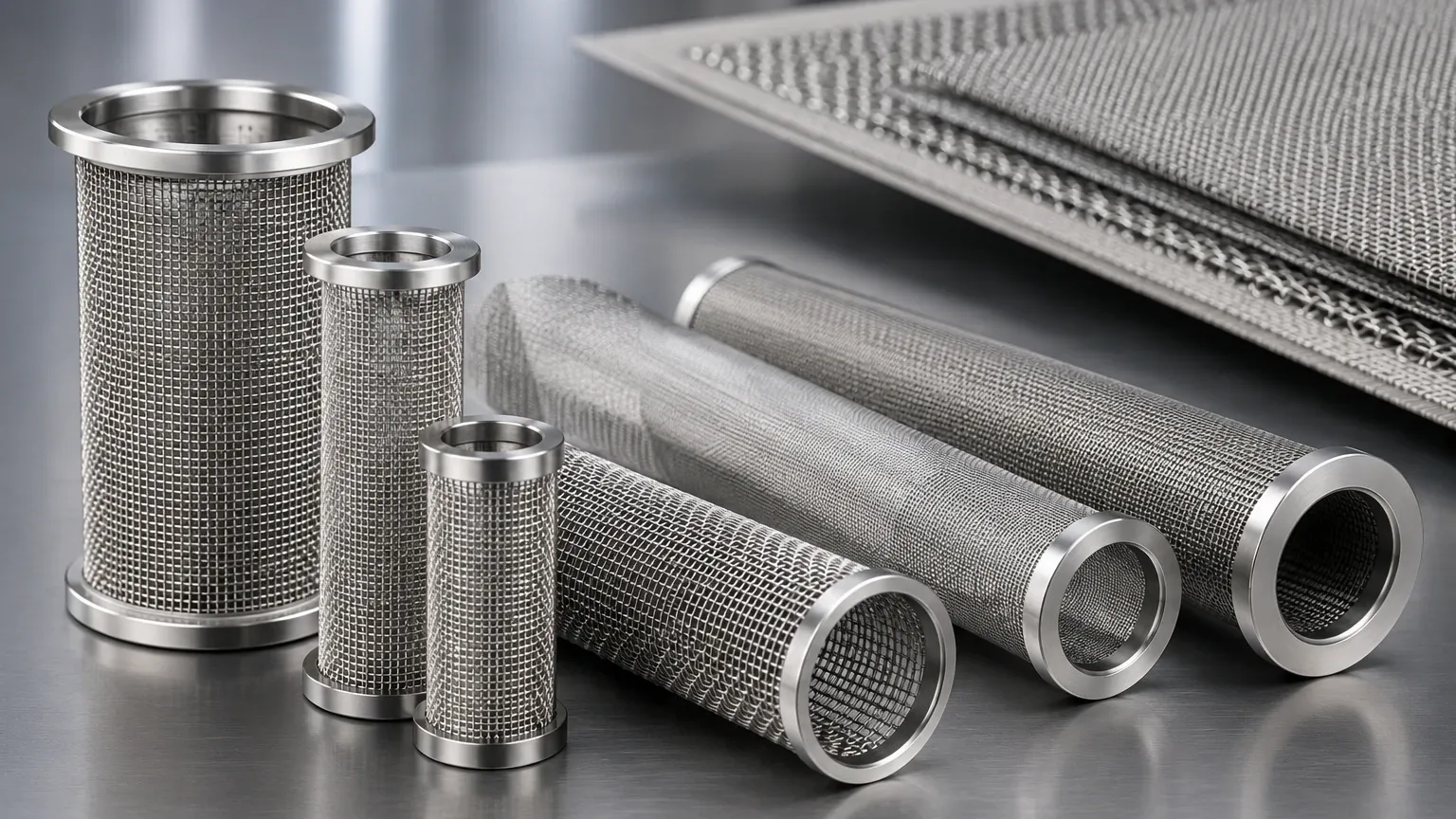
Selecting the appropriate filtration component requires a deep understanding of fluid dynamics, material science, and the specific mechanical requirements of the application. This guide explores the technical considerations for Wire Mesh Filter Cylinders & Tubes and how they function within industrial air filtration systems.
Technical Principles of Air Filtration with Wire Mesh
Air filtration using metallic mesh relies on several physical mechanisms to separate solids from the gas stream. While synthetic filters often rely on electrostatic attraction, a wire mesh filter functions primarily through mechanical entrapment. The efficiency of an air filter with wire mesh is determined by the weave pattern, wire diameter, and the resulting pore size.
Mechanisms of Particle Capture
1. Inertial Impaction: Larger particles, possessing higher momentum, fail to follow the air streamlines as they curve around the wires. These particles collide with the wire surface and are captured.
2. Interception: Smaller particles that follow the streamline may come within one particle radius of a wire. When the distance between the streamline and the wire is less than the particle's radius, the particle makes contact and is retained.
3. Diffusion: For sub-micron particles, Brownian motion causes them to deviate from streamlines, increasing the likelihood of contact with the mesh fibers. While wire mesh is typically used for coarser filtration (above 5–10 microns), specialized Dutch weaves can capture significantly finer particles.
In industrial air systems, the primary goal is often the protection of downstream components like compressors, turbines, or sensitive pneumatic valves. The mechanical rigidity of wire mesh ensures that the pore geometry remains constant even under high differential pressure, preventing "unloading"—a phenomenon where captured particles are forced through the media due to pressure spikes.
Material Science: Stainless Steel and Alloy Selection
The performance of an air filter with wire mesh is heavily dependent on the alloy used in its construction. Industrial environments often present challenges such as high humidity, chemical vapors, or extreme temperatures that would degrade standard carbon steel or polymer filters.
Stainless Steel 304 vs. 316L
* Type 304: The most common grade used for general industrial air filtration. It offers excellent strength and basic corrosion resistance, making it suitable for indoor air intakes and standard machinery protection.
* Type 316L: Contains molybdenum, which significantly enhances resistance to chlorides and pitting. This is the preferred choice for offshore applications, chemical processing plants, and pharmaceutical environments where the filter may be exposed to aggressive cleaning agents or salt-laden air.
High-Temperature Alloys
For exhaust gas filtration or high-heat industrial processes, specialized alloys like Inconel or Monel may be utilized. These materials maintain their tensile strength and oxidation resistance at temperatures exceeding 800°C, where standard stainless steels would begin to scale or lose structural integrity.
Structural Configurations: Wire Mesh Filter Cylinders & Tubes
The geometry of the filter element is as important as the mesh itself. Wire Mesh Filter Cylinders & Tubes are the standard configuration for industrial air systems due to their inherent structural strength and ease of integration into housing assemblies.
Single-Layer vs. Multi-Layer Construction
* Single-Layer Cylinders: Best suited for low-pressure applications or as a coarse pre-filter. They are easy to clean and provide high open area for maximum flow.
* Multi-Layer Sintered Mesh: For high-pressure air systems, multiple layers of mesh are sintered together. This process uses heat and pressure to fuse the wires at their contact points without the use of binders. The result is a composite structure that combines a fine filtration layer with thicker, protective support layers. This prevents the fine mesh from deforming under the force of the air stream.
Support Cores and End Caps
To prevent the collapse of the cylinder under high differential pressure, internal perforated metal cores are often required. These cores provide the necessary hoop strength. Furthermore, the method of attaching end caps—typically through TIG (Tungsten Inert Gas) or plasma welding—is critical. Proper welding ensures a leak-proof seal, preventing air bypass which would compromise the entire filtration system.
Performance Metrics: Flow Rate, Pressure Drop, and Micron Rating
Engineers must balance three competing factors when specifying an air filter with wire mesh: filtration accuracy (micron rating), flow capacity, and pressure drop (ΔP).
Understanding Pressure Drop
Pressure drop is the loss in air pressure as it passes through the filter media. In air systems, a high ΔP translates directly to increased energy consumption by the blower or compressor. The pressure drop is influenced by:
* Mesh Velocity: The speed of the air as it passes through the open area of the mesh.
* Open Area Ratio: The percentage of the mesh surface that is not obstructed by wire. A higher open area reduces initial ΔP but may reduce the structural strength of the mesh.
* Contaminant Loading: As particles accumulate, the effective open area decreases, leading to a non-linear increase in pressure drop.
Micron Rating: Absolute vs. Nominal
When reviewing specifications for Wire Mesh Filter Cylinders & Tubes, it is vital to distinguish between nominal and absolute ratings. A nominal rating indicates the ability of the filter to retain a majority of particles of a certain size. An absolute rating, achieved through precision weaves like Plain Dutch Weave (PDW) or Twilled Dutch Weave (TDW), guarantees that no particle larger than the specified micron size can pass through the mesh.
Industrial Applications and Environment Compatibility
Wire mesh filters are utilized across diverse sectors where reliability and reusability are prioritized over low-cost disposability.
1. Compressor Air Intakes
Large industrial compressors require massive volumes of clean air. An air filter with wire mesh acts as a primary defense against dust and debris that could cause catastrophic wear on internal rotors or pistons. The ability to wash and reuse these filters significantly reduces long-term maintenance costs in dusty environments like cement plants or mines.
2. Pneumatic Systems
In automated manufacturing, pneumatic lines must be free of particulates to prevent valve sticking. Small-diameter Wire Mesh Filter Cylinders & Tubes are integrated into the lines to provide point-of-use protection for sensitive actuators.
3. Food and Pharmaceutical Processing
In these industries, air is often used for drying or conveying products. The filter must not only capture contaminants but also be made of materials that do not shed fibers (as fiberglass or paper might). Stainless steel wire mesh is non-toxic, non-shedding, and can be sterilized using steam-in-place (SIP) or autoclaving methods.
Maintenance and Cleaning Protocols for Reusable Elements
One of the primary advantages of stainless steel filtration is the ability to restore the element to a "like-new" condition through professional cleaning. This eliminates the recurring cost of purchasing and disposing of single-use cartridges.
Cleaning Methods
* Ultrasonic Cleaning: The most effective method for fine mesh. High-frequency sound waves create cavitation bubbles that dislodge deeply embedded particles from the mesh intersections.
* Backwashing: For coarse mesh cylinders, reversing the flow of air or a compatible liquid can flush out surface-loaded contaminants.
* Chemical Cleaning: In cases where the mesh is fouled by oils or organic polymers, solvent baths or caustic washes may be used, provided the chemical is compatible with the stainless steel grade (e.g., 316L).
Engineers should establish a cleaning cycle based on the monitored pressure drop. Waiting too long to clean the filter can lead to "permanent fouling," where particles become so wedged into the weave that they cannot be removed without damaging the mesh.
Engineering Selection and Procurement Considerations
When sourcing Wire Mesh Filter Cylinders & Tubes from a manufacturer like Kaifil, providing precise technical data is essential for ensuring the component meets the application's demands. International buyers and engineers should confirm the following parameters before procurement:
1. Operating Environment: Is the air humid, acidic, or high-temperature? This dictates the alloy (304, 316L, or specialty alloys).
2. Flow Dynamics: What is the maximum cubic feet per minute (CFM) or cubic meters per hour (m³/h)? This determines the required surface area of the cylinder to keep the face velocity within acceptable limits.
3. Filtration Target: What is the specific particle size that must be excluded? This determines the weave type and micron rating.
4. Mechanical Interface: What are the exact dimensions (OD, ID, Length) and connection types (NPT, flange, or O-ring seal)? Customization is often necessary to fit existing filter housings.
5. Total Cost of Ownership (TCO): While the initial investment in a stainless steel air filter with wire mesh is higher than a disposable alternative, the TCO is often lower due to the multi-year lifespan and reduced waste disposal costs.
By focusing on these technical boundaries, engineers can specify a filtration solution that optimizes air quality while minimizing operational downtime. Whether for heavy industrial intake or precision pharmaceutical air processing, the use of high-quality metallic mesh ensures a level of durability and performance that synthetic media cannot match.
