


Filter with Wire Mesh: An Engineering Guide to Industrial Selection and Application
In industrial process engineering, the efficiency of fluid and gas separation directly impacts equipment longevity, product purity, and operational costs. A filter with wire mesh serves as a primary mechanical barrier, utilizing a precise geometric arrangement of metallic wires to retain particles while allowing the filtrate to pass with minimal resistance. Unlike disposable media, stainless steel wire mesh provides a rigid, heat-resistant, and chemically stable solution suitable for the most demanding B2B environments.
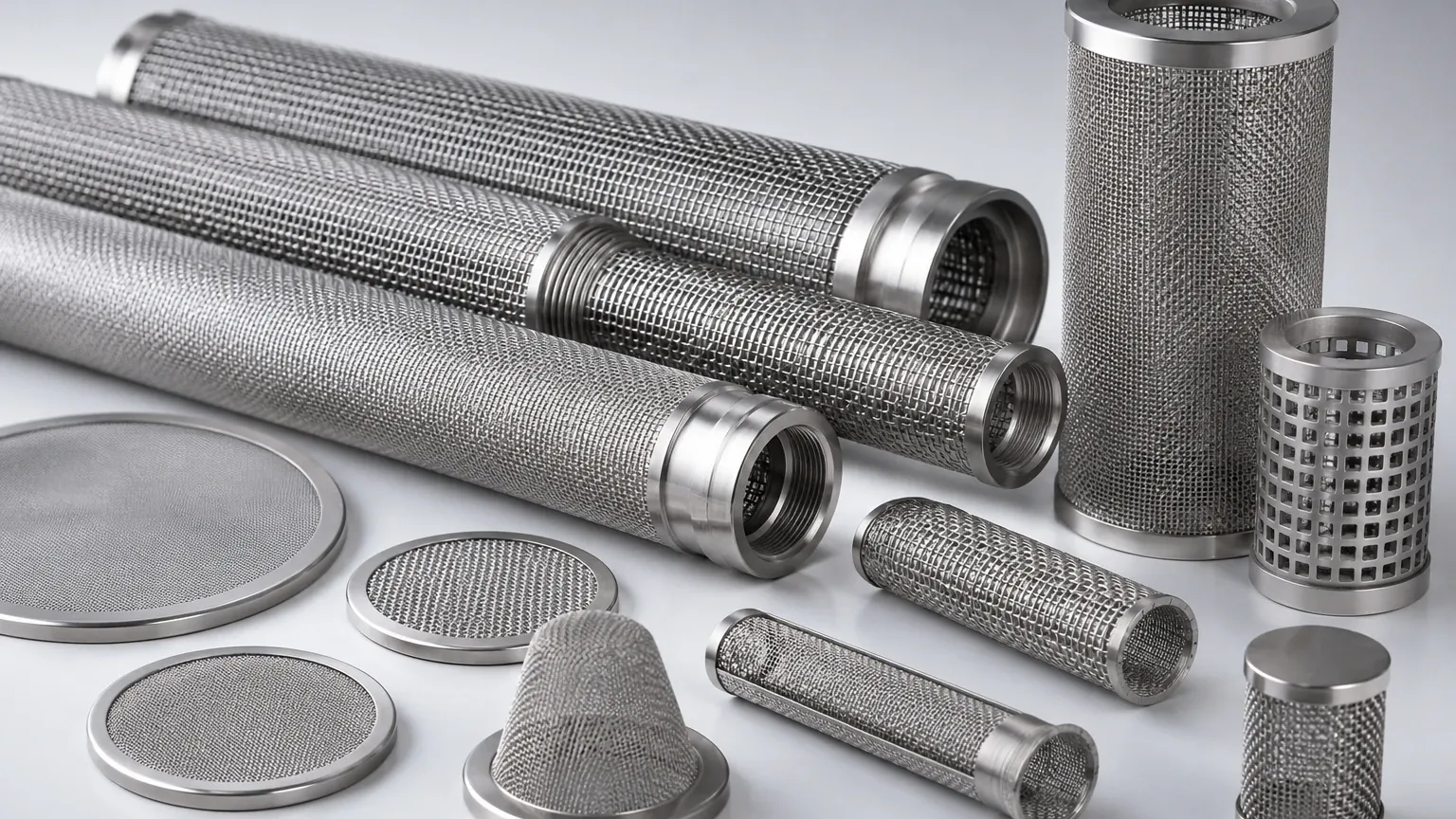
Selecting the correct filtration component requires a deep understanding of fluid dynamics, material science, and mechanical design. This guide examines the technical considerations for Wire Mesh Filter Cylinders & Tubes, providing engineers and procurement teams with the factual data needed to optimize their filtration systems.
1. Engineering Principles of Wire Mesh Filtration
The fundamental operation of a wire mesh filter is based on surface filtration. Unlike depth filters (such as sand or fibrous cartridges) that trap particles within a thick medium, a wire mesh filter stops contaminants at the surface of the weave. This mechanism offers several distinct advantages in industrial settings:
* Predictable Aperture Size: The weaving process ensures that the openings (pores) are uniform across the entire surface. This allows for an "absolute" filtration rating, where no particle larger than the specified pore size can pass through.
* Low Pressure Drop: Because the filter medium is relatively thin, it presents less resistance to flow compared to depth media of the same micron rating. This reduces the energy requirements for pumps and compressors.
* Cleanability: Since particles are trapped on the surface, they can be easily removed through backwashing, ultrasonic cleaning, or chemical soaking, making the filter reusable and reducing the total cost of ownership.
In complex systems, the performance of a filter with wire mesh is governed by the relationship between the open area of the mesh and the velocity of the fluid. A higher open area percentage generally correlates with a lower initial pressure drop (Delta P), which is critical for maintaining system efficiency.
2. Structural Anatomy of Wire Mesh Filter Cylinders & Tubes
Industrial filters are rarely just a piece of mesh; they are engineered components designed to withstand mechanical stress. Wire Mesh Filter Cylinders & Tubes are typically constructed using one or more layers of stainless steel mesh, often reinforced to prevent collapse under high differential pressure.
Single-Layer vs. Multi-Layer Construction
Single-layer tubes are used in low-pressure applications or as strainers for coarse filtration. For finer filtration tasks, multi-layer designs are employed. These often include:
* The Filtration Layer: The fine mesh that determines the micron rating.
* The Support Layer: A coarser mesh or perforated metal sheet that provides structural rigidity.
* The Drainage Layer: Placed between the filtration and support layers to ensure even flow distribution across the surface.
Welding and Assembly
To ensure the integrity of the cylinder, the longitudinal seam must be joined using advanced welding techniques such as TIG (Tungsten Inert Gas) or plasma welding. These methods create a fusion bond that is as strong as the parent material, ensuring no bypass of unfiltered fluid occurs at the seam. End caps, flanges, or threaded connectors are then integrated to match the specific housing requirements of the machinery.
3. Material Science: Selecting the Right Alloy
The choice of material is the most critical factor in determining the chemical compatibility and lifespan of the filter. In the majority of industrial applications, stainless steel is the standard due to its balance of cost and performance.
* AISI 304 Stainless Steel: The most common grade, offering excellent strength and basic corrosion resistance. It is suitable for water treatment, food processing, and general industrial oils.
* AISI 316L Stainless Steel: Contains molybdenum, which significantly enhances resistance to chlorides and pitting. This is the preferred material for pharmaceutical production, chemical processing, and marine environments. The "L" denotes low carbon content, which improves weldability and prevents intergranular corrosion in the heat-affected zones of the filter seams.
* High-Temperature Stability: Unlike polymer-based filters, stainless steel Wire Mesh Filter Cylinders & Tubes can operate in environments exceeding 300°C (and significantly higher depending on the specific alloy and mounting), making them indispensable for steam filtration and hot gas polymer processing.
4. Weave Patterns and Their Impact on Performance
The way the wires are interlaced—the weave pattern—determines the filter's pore shape, strength, and flow characteristics. Engineers must select the weave based on the specific nature of the contaminant.
Plain Weave
The simplest pattern where each warp wire crosses over and under each shute wire. It provides the highest open area and is ideal for high-flow, low-pressure applications. However, it is limited in how fine the micron rating can go while maintaining structural stability.
Twill Weave
Each shute wire passes over and under two warp wires. This allows for the use of heavier wires in a given mesh count, resulting in a stronger mesh that can achieve finer filtration than plain weave.
Dutch Weave (Plain and Twilled)
Dutch weaves use a larger diameter for the warp wires and a smaller diameter for the shute wires, which are driven close together to create a dense, wedge-shaped pore. This is the standard for high-pressure hydraulic systems and precision liquid filtration, as it offers superior strength and extremely fine micron ratings (down to 5-10 microns).
5. Sizing and Selection: A Guide for Purchasing Teams
When procuring a filter with wire mesh, technical buyers must provide specific parameters to ensure the component meets the application's demands. Failure to account for these variables can lead to premature filter failure or downstream equipment damage.
1. Micron Rating (Absolute vs. Nominal): Specify whether you require an absolute rating (no particles larger than X pass) or a nominal rating (most particles of size X are retained). For critical pharmaceutical or hydraulic applications, absolute ratings are mandatory.
2. Flow Rate and Viscosity: The fluid's viscosity significantly impacts the pressure drop across the mesh. High-viscosity fluids (like heavy oils or syrups) require a larger surface area to maintain a manageable Delta P.
3. Operating Pressure and Differential Pressure (Delta P): Engineers must define the maximum pressure the filter will encounter and the "terminal Delta P"—the point at which the filter is considered blinded and must be cleaned or replaced.
4. Contaminant Type: Are the particles hard and angular, or soft and deformable? This influences whether a standard mesh or a sintered mesh (where wires are fused at contact points) is required to prevent pore migration.
6. Installation, Cleaning, and Maintenance Protocols
The longevity of Wire Mesh Filter Cylinders & Tubes is one of their primary value propositions. However, realizing this value requires proper maintenance.
Installation Best Practices
Ensure that the seals (O-rings or gaskets) are compatible with the process fluid. Common materials include Viton, EPDM, and PTFE. During installation, the filter must be seated squarely in the housing to prevent bypass. For large cylinders, internal supports or "spiders" may be necessary to prevent vibration-induced fatigue.
Cleaning Methods
* Backwashing: Reversing the flow of fluid to dislodge surface contaminants. This is often automated in continuous process systems.
* Ultrasonic Cleaning: Using high-frequency sound waves in a cleaning solvent to remove fine particles trapped deep within Dutch weave patterns.
* Chemical Cleaning: Using acids or alkalis to dissolve organic or mineral scaling. The chemical compatibility of the stainless steel grade must be verified before this process.
7. Procurement Considerations for Custom Filtration Solutions
Standard off-the-shelf filters often fail to meet the specific spatial or performance constraints of specialized industrial machinery. This is where custom manufacturing becomes essential. When working with a manufacturer like Kaifil, providing a detailed technical drawing or a sample of the existing component allows for precise OEM replication or improvement.
Key details to confirm before ordering include:
* Exact Dimensions: Outer diameter (OD), inner diameter (ID), and overall length.
* End Configuration: Is it an open double end (DOE), or does it have a closed end with a specific fitting (e.g., NPT thread, flange, or bayonet mount)?
* Reinforcement Requirements: Does the application involve high-pressure surges that require an internal perforated core?
By focusing on these factual engineering requirements, procurement teams can ensure they receive a filter with wire mesh that provides reliable service, reduces downtime, and maintains the integrity of the industrial process. For high-performance applications, investing in precision-engineered Wire Mesh Filter Cylinders & Tubes is a strategic decision that supports both operational efficiency and long-term cost management.
