


Metal Mesh Coffee Filter vs Paper: An Industrial Engineering Perspective
In the landscape of industrial beverage processing and commercial-scale brewing, the selection of filtration media is a critical engineering decision that impacts product consistency, operational costs, and equipment longevity. While the consumer-level debate often focuses on flavor profiles, the technical comparison of metal mesh coffee filter vs paper involves a complex analysis of fluid dynamics, particle retention, and material science.
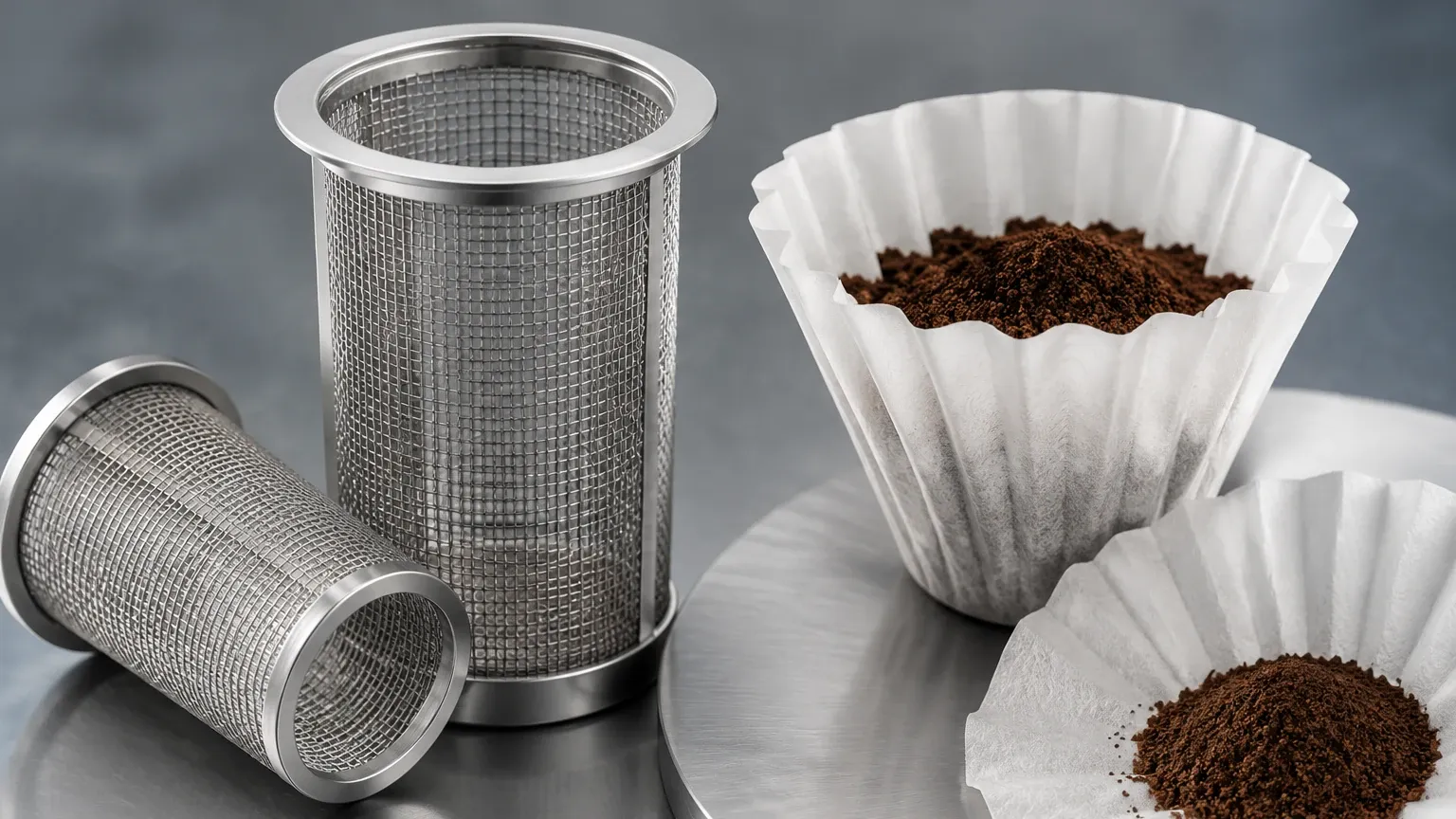
For engineers and procurement specialists designing large-scale extraction systems or cold brew facilities, understanding the mechanical differences between these media is essential. This guide examines the performance characteristics of stainless steel Wire Mesh Filter Cylinders & Tubes compared to traditional cellulose-based paper filters, focusing on the technical parameters that drive industrial efficiency.
1. Operating Principles: Surface vs. Depth Filtration
The fundamental difference between metal mesh and paper lies in the mechanism of particle separation. This distinction dictates how the filter handles flow rates and pressure differentials over time.
Metal Mesh: Surface Filtration
Stainless steel wire mesh operates primarily as a surface filter. The precision-woven apertures—whether in plain, twill, or Dutch weave—act as a mechanical barrier that stops particles larger than the mesh opening. In industrial applications, these filters are often configured as cylinders or tubes to maximize surface area within a compact footprint.
The advantage of surface filtration is predictability. Because the openings are fixed, the micron rating remains constant under varying pressures. Furthermore, the cake (the layer of solids that builds up on the filter surface) can often be removed through backwashing or mechanical scraping, allowing for continuous or semi-continuous operation.
Paper: Depth Filtration
Paper filters are a form of depth filtration media. They consist of a random mat of cellulose fibers. Particles are trapped not just on the surface, but within the tortuous paths through the thickness of the paper. While paper can achieve very fine filtration (often down to sub-10 micron levels), it is prone to blinding. As oils and fine particulates saturate the fiber matrix, the pressure drop increases exponentially, eventually requiring the media to be discarded.
2. Material Engineering and Chemical Compatibility
In a B2B manufacturing context, the material composition of the filter must withstand rigorous Cleaning-in-Place (CIP) protocols and high-temperature environments.
Stainless Steel (SS304/SS316L)
Industrial metal filters, such as those manufactured by Kaifil, typically utilize Grade 304 or 316L stainless steel. These materials offer:
- Corrosion Resistance: Essential for handling the acidic nature of coffee (pH 4.8–5.1) and the caustic chemicals used in industrial cleaning.
- Thermal Stability: Metal mesh maintains structural integrity at temperatures exceeding 200°C, far beyond the requirements of brewing, ensuring no warping or degradation during sterilization.
- Zero Leaching: Unlike some low-grade polymers or treated papers, high-quality stainless steel is chemically inert, ensuring that no unwanted flavors or chemical compounds are introduced into the filtrate.
Cellulose Paper
Paper filters are generally single-use and biodegradable, but their industrial application is limited by their physical fragility. When saturated, paper loses significant tensile strength. In high-pressure extraction systems, paper media requires heavy-duty support structures to prevent rupturing. Additionally, the manufacturing of paper involves bleaching agents (like oxygen or chlorine) and binders, which can introduce trace chemical variables into a strictly controlled process.
3. Comparing Filtration Efficiency and Micron Ratings
When evaluating metal mesh coffee filter vs paper, engineers must look at the specific particle size distribution (PSD) of the coffee grounds and the desired clarity of the final extract.
| Feature | Stainless Steel Wire Mesh | Cellulose Paper |
| :— | :— | :— |
| Micron Range | 20μm to 500μm (Customizable) | 5μm to 20μm (Typical) |
| Oil Retention | Low (Allows lipids/colloids) | High (Absorbs most oils) |
| Flow Rate | High and consistent | Decreases as pores clog |
| Structural Rigidity | High (Self-supporting) | Low (Requires housing/support) |
| Durability | Multi-year lifespan | Single-use |
In industrial coffee concentrate production, a 100-micron stainless steel mesh is often used as a primary stage to remove the bulk of the grounds, followed by finer secondary filtration if necessary. The ability of Wire Mesh Filter Cylinders & Tubes to allow coffee oils (lipids) to pass through results in a different chemical profile—often described as having more "body"—which is a critical consideration for the final product's mouthfeel and shelf-stability.
4. Total Cost of Ownership (TCO) and ROI Analysis
For a purchasing department, the initial capital expenditure (CAPEX) must be weighed against the long-term operational expenditure (OPEX).
The Case for Metal Mesh
The initial cost of a custom-engineered stainless steel filter cylinder is significantly higher than a box of paper filters. However, the ROI is realized through:
1. Zero Recurring Media Costs: A well-maintained metal filter can last for several years of continuous operation.
2. Reduced Waste Disposal: Eliminating thousands of pounds of wet paper waste reduces disposal fees and aligns with corporate sustainability goals.
3. Increased Uptime: Metal filters designed for backwashing reduce the downtime associated with manual filter changes.
The Case for Paper
Paper filters are advantageous in low-volume specialty applications or where the absolute removal of cafestol and kahweol (coffee oils) is a specific health or flavor requirement. However, the logistical burden of ordering, storing, and disposing of paper media at an industrial scale often outweighs the lower upfront cost.
5. Engineering Constraints and Installation Considerations
Integrating Wire Mesh Filter Cylinders & Tubes into an industrial brewing system requires careful consideration of the housing and flow dynamics.
- Pressure Drop ($ΔP$): Engineers must calculate the clean pressure drop across the mesh to size pumps correctly. Because wire mesh has a high percentage of open area, it typically offers lower resistance than paper.
- Sealing and Gasketing: To prevent bypass (where liquid bypasses the filter media), metal cylinders must be fitted with precision-machined end caps and food-grade gaskets (such as EPDM or Viton).
- Customization: Unlike standardized paper sizes, metal mesh filters can be fabricated to exact specifications. Kaifil provides options for reinforced layers, perforated metal cores for added strength, and specific flange connections to match existing piping.
6. Maintenance, Cleaning, and Longevity
The longevity of a metal mesh filter is dependent on the effectiveness of the cleaning cycle. In the coffee industry, the primary challenge is the buildup of coffee oils and fine "fines" that can wedge into the mesh openings.
Industrial Cleaning Methods for Metal Mesh:
1. Backpulsing: Reversing the flow of the filtrate to dislodge particles from the surface.
2. Ultrasonic Cleaning: Using high-frequency sound waves in a cleaning solution to remove microscopic debris from the weave intersections.
3. Chemical Soaking: Using enzymatic or caustic cleaners to dissolve organic oil buildup.
In contrast, paper filters offer no maintenance path; once they are blinded, the process must stop for replacement. For 24/7 manufacturing operations, this interruption is often the deciding factor in moving toward permanent metal filtration solutions.
7. Application Risks and Quality Control
When selecting between metal mesh coffee filter vs paper, one must consider the risks of media migration. In low-quality paper, fibers can occasionally break off and enter the filtrate. With stainless steel mesh, the risk is related to mechanical damage or fatigue.
To mitigate these risks, industrial buyers should confirm the following with their supplier:
- Material Certification: Ensuring the steel is genuine 304 or 316L with mill test reports.
- Weld Integrity: In cylindrical filters, the longitudinal seam must be perfectly welded (often using TIG or plasma welding) to ensure no gaps exist.
- Mesh Stability: Ensuring the weave will not shift under high-pressure pulses.
Conclusion: Making the Data-Driven Choice
For industrial coffee processing, the transition from paper to metal mesh is usually driven by the need for process intensification and cost reduction. While paper provides excellent clarity for niche applications, the durability, reusability, and precision of Wire Mesh Filter Cylinders & Tubes make them the standard for modern B2B beverage production.
When evaluating your filtration requirements, consider the particle size of your grind, the desired lipid content in your final extract, and the mechanical constraints of your extraction vessel. By choosing a high-performance stainless steel solution, manufacturers can achieve a more sustainable, controllable, and cost-effective production cycle.
