


Introduction to 6×6 Woven Wire Mesh
In industrial filtration and material separation, the specification of a mesh screen determines its efficiency, throughput, and service life. Among the various configurations available, 6×6 woven wire stands as a versatile, medium-coarse grade used across diverse sectors. The term "6×6" refers to the mesh count, indicating six openings per linear inch in both the warp and shute directions.
For engineers and procurement specialists, selecting the correct Woven Wire Mesh involves more than just identifying the mesh count. It requires a technical understanding of wire diameter, open area percentages, and material compatibility. This guide provides a factual breakdown of 6×6 mesh specifications, engineering considerations, and industrial applications to support informed decision-making in high-demand environments.
Technical Specifications of 6×6 Woven Wire
The performance of a 6×6 mesh is dictated by the relationship between the mesh count and the wire diameter. Because the mesh count is fixed at six wires per inch, the size of the opening (aperture) varies significantly depending on the thickness of the wire used.
Wire Diameter and Aperture Calculation
In a standard 6×6 configuration, the pitch (the distance from the center of one wire to the center of the next) is approximately 0.1667 inches (4.23 mm). To determine the clear opening, the wire diameter must be subtracted from this pitch. Common wire diameters for 6×6 mesh include:
* 0.035" (20 Gauge): Results in an opening of approximately 0.1317" (3.34 mm).
* 0.047" (18 Gauge): Results in an opening of approximately 0.1197" (3.04 mm).
* 0.063" (16 Gauge): Results in an opening of approximately 0.1037" (2.63 mm).
Open Area Percentage
The "open area" is a critical metric for engineers calculating flow rates or light transmission. A 6×6 mesh with 0.035" wire offers a high open area (approx. 62%), which is ideal for high-flow filtration. Conversely, using a 0.063" wire reduces the open area to roughly 38%, significantly increasing the structural strength of the mesh at the cost of throughput. Selecting the right balance is essential for optimizing system pressure and filtration efficiency.
Material Selection for Industrial Environments
Material science plays a pivotal role in the longevity of 6×6 woven wire. While carbon steel and galvanized options exist, stainless steel is the industry standard for most B2B applications due to its mechanical properties and resistance to environmental degradation.
Stainless Steel 304
SS304 is the most common grade for general industrial use. It provides excellent corrosion resistance against most oxidizing acids and is frequently used in food processing, architectural panels, and general screening. It is cost-effective for environments where extreme chemical exposure or high saline levels are not present.
Stainless Steel 316L
For more demanding applications, such as chemical processing or marine environments, SS316L is preferred. The addition of molybdenum enhances resistance to pitting and crevice corrosion, particularly in chloride-rich environments. The "L" denotes low carbon content, which improves weldability and prevents sensitization during fabrication, ensuring the mesh remains durable after being integrated into filter cartridges or frames.
Specialty Alloys
In high-temperature or highly corrosive settings, 6×6 mesh can be manufactured from alloys like Monel, Inconel, or Hastelloy. These are typically reserved for specialized petrochemical or aerospace applications where standard stainless steels would fail prematurely.
Key Performance Metrics: Flow Rate and Structural Integrity
When integrating 6×6 woven wire into an industrial system, engineers must evaluate how the mesh interacts with the fluid or material stream.
Pressure Drop and Flow Resistance
The resistance a mesh offers to a fluid stream is directly proportional to its open area and the velocity of the fluid. In liquid filtration, a 6×6 mesh is often used as a primary strainer to remove large particulates. Because the openings are relatively large, the initial pressure drop is low. However, as the mesh captures debris, the effective open area decreases, leading to a rise in differential pressure. Monitoring this curve is vital for determining maintenance and cleaning cycles.
Mechanical Strength and Support
Due to its relatively thick wire diameters compared to fine micron meshes, 6×6 woven wire is often used as a "support mesh" or "backing mesh." In multi-layer filter elements, a fine mesh (e.g., 200 mesh) provides the actual filtration, while the 6×6 layer provides the structural rigidity required to withstand high-pressure differentials without collapsing. This prevents the finer media from pleating or deforming under stress.
Common Industrial Applications for 6×6 Mesh
The versatility of 6×6 mesh allows it to serve multiple functions across various industries. Its specific aperture size makes it ideal for the following applications:
* Food and Beverage Processing: Used in large-scale sifting of grains, nuts, or pulses. The stainless steel construction ensures compliance with hygiene standards and allows for high-temperature sterilization.
* Chemical and Petrochemical: Acts as a catalyst support or a primary strainer in piping systems to protect downstream pumps and valves from large scale or debris.
* Security and Safety Guards: Due to its robust nature, 6×6 mesh is often used for machine guards and protective screens where airflow is required but physical barriers are necessary to prevent contact with moving parts.
* Architectural and Construction: Used in infill panels and ventilation grilles where a specific aesthetic is required alongside functional durability and airflow.
* Hydraulic Systems: Serves as a coarse suction strainer to prevent large contaminants from entering hydraulic reservoirs.
Customization and Fabrication Options
Industrial applications rarely use mesh in its raw roll form. Customization is often necessary to meet specific equipment dimensions and performance requirements.
Weave Types
While Plain Weave (one wire over, one wire under) is the standard for 6×6 mesh, other weaves can be utilized for specific needs. However, at a 6-mesh count, plain weave offers the most consistent opening size and is the most economical to produce.
Edge Treatments and Framing
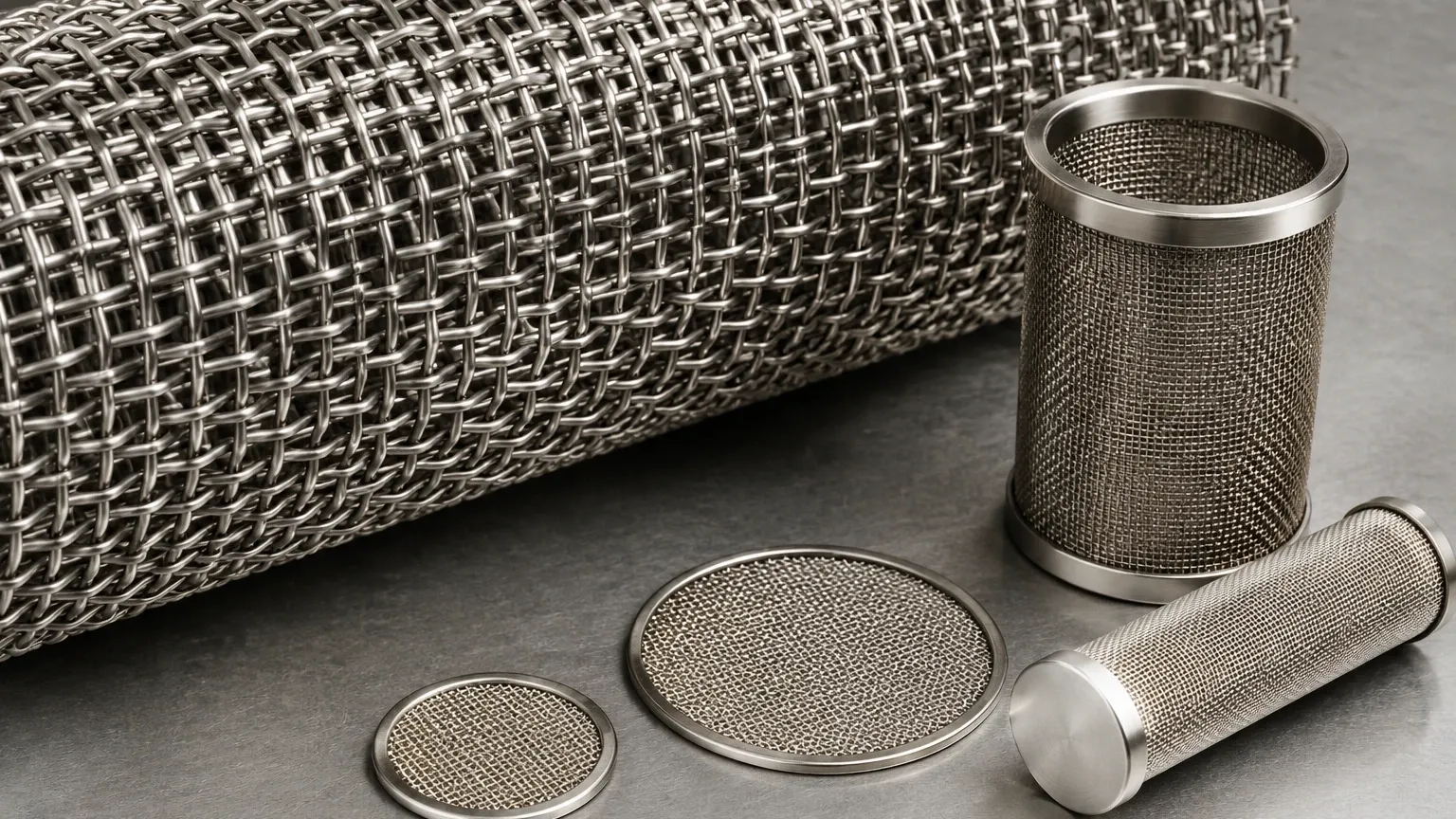
To prevent fraying and to facilitate installation, 6×6 mesh can be supplied with various edge treatments. This includes welded edges, hemmed edges, or the inclusion of a U-channel frame. For filtration components, the mesh is often cut into precise discs or cylinders using laser or waterjet cutting to ensure dimensional accuracy.
Multi-Layer Sintering
For extreme pressure environments, 6×6 mesh can be sintered with other layers of wire mesh. Sintering bonds the wires at their contact points through heat and pressure, creating a rigid, porous plate that maintains its pore geometry even under intense mechanical stress.
Procurement Checklist: What Engineers Must Confirm
Before finalizing a purchase order for 6×6 woven wire, technical teams should verify several factors to ensure the product meets the intended application’s requirements and provides the best total cost of ownership.
1. Exact Wire Diameter: Do not rely on "standard" gauges alone. Confirm the decimal inch or millimeter diameter, as this directly impacts the aperture size and open area.
2. Material Certification: Request Mill Test Reports (MTRs) to verify the chemical composition of the stainless steel, ensuring it meets ASTM or ISO standards for the specific grade (e.g., 304 vs 316L).
3. Tolerances: Define the allowable variance in mesh count and wire diameter. For precision screening, tight tolerances are required to ensure consistent particle separation.
4. Cleaning and Passivation: For food-grade or pharmaceutical applications, confirm if the mesh has undergone ultrasonic cleaning or chemical passivation to remove manufacturing oils and enhance corrosion resistance.
5. Quantity and Format: Specify whether the material is required in bulk rolls, cut-to-size pieces, or fully fabricated components like framed panels or filter baskets.
Conclusion
Selecting the right 6×6 woven wire involves a balance of mechanical strength, filtration capability, and environmental resistance. As a medium-coarse mesh, it excels in both primary filtration and as a structural support for finer media. By understanding the technical relationship between wire diameter and open area, and by selecting the appropriate material grade, engineers can ensure their filtration systems operate with maximum efficiency and minimal downtime.
For those requiring specialized configurations or high-performance alloys, Kaifil provides comprehensive OEM and customized filtration solutions. Our expertise in manufacturing precision Woven Wire Mesh ensures that every component is engineered to meet the rigorous demands of industrial processing, from material selection to final fabrication.
