


Carbon Steel Woven Wire Mesh: An Engineering Guide to Material Selection and Industrial Application
In the landscape of industrial filtration and separation, material selection is a critical determinant of both performance and operational cost. While stainless steel is often the default choice for corrosive environments, carbon steel woven wire mesh remains a vital component in numerous industrial sectors. Known for its high tensile strength, abrasion resistance, and cost-effectiveness, carbon steel serves as a foundational material for heavy-duty sifting, structural support, and filtration in non-corrosive media.
For engineers and procurement professionals, understanding the technical nuances of carbon steel mesh—ranging from alloy composition to weave geometry—is essential for optimizing equipment lifespan and filtration efficiency. This guide examines the engineering properties, manufacturing standards, and application criteria for carbon steel wire cloth within a B2B context.
Understanding Carbon Steel Material Grades
Carbon steel woven wire mesh is typically manufactured from low-carbon steel, often referred to in the industry as "bright wire" or "black wire" cloth. The carbon content significantly influences the mechanical properties of the finished mesh, particularly its ductility and weldability.
Low Carbon Steel (AISI 1006, 1008, 1010)
Most industrial woven wire mesh utilizes low-carbon steel grades. These alloys contain approximately 0.06% to 0.10% carbon. The primary advantage of low carbon steel is its high ductility, which allows the wire to be drawn to fine diameters and woven into intricate patterns without becoming brittle. It offers excellent weldability, making it an ideal candidate for fabricated filter components, such as pleated cartridges or reinforced cylinders.
High Carbon Steel (Spring Steel)
In applications requiring extreme abrasion resistance or structural rigidity, high-carbon steel (often referred to as mandolin or spring steel) is utilized. These meshes are harder and have higher tensile strength than low-carbon variants, making them suitable for vibrating screens and heavy-duty sifting of abrasive minerals or aggregates. However, the increased carbon content makes the material more difficult to weld and less flexible.
Weave Types and Geometric Configurations
The performance of woven wire mesh is dictated not only by the material but by the weave architecture. The method by which the warp (lengthwise) and shute (crosswise) wires intersect determines the mesh's stability, aperture precision, and flow characteristics.
Plain Weave
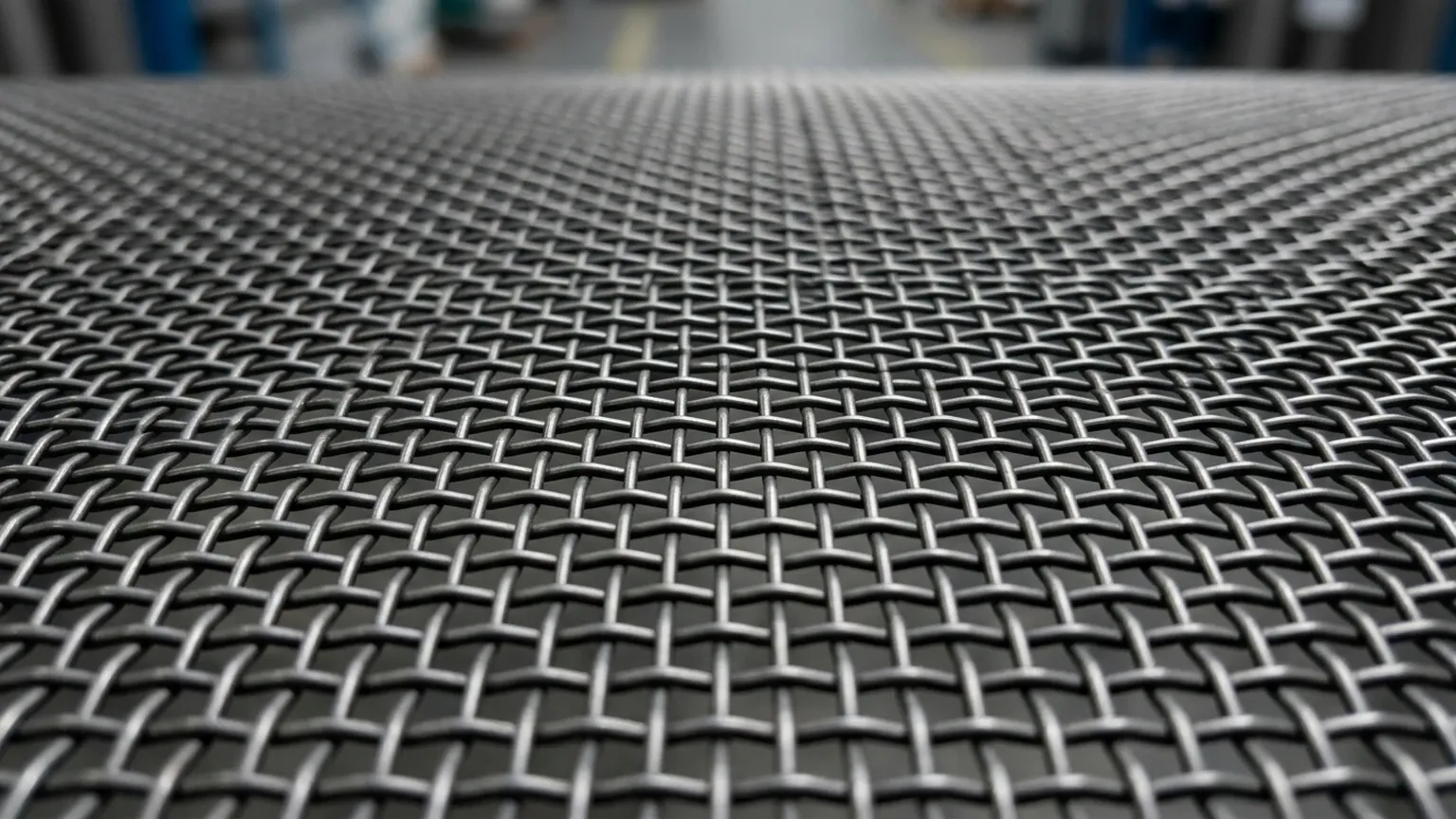
The plain weave is the most common configuration. Each shute wire passes alternately over and under each warp wire. This results in a stable structure with square openings. It is the standard for general-purpose sifting and filtration where high precision is required in relatively coarse mesh counts.
Twill Weave
In a twill weave, each shute wire passes over and under two warp wires in a staggered pattern. This technique allows for the use of heavier wires in relation to the mesh count, resulting in a stronger and more durable cloth. Twill weaves are often employed when the mesh must withstand higher pressures or when a finer filtration rating is required than what is possible with a plain weave of the same wire diameter.
Dutch Weave (Plain and Twill)
Dutch weaves utilize different wire diameters for the warp and shute. Typically, the warp wires are heavier, while the shute wires are smaller and driven closely together. This creates a "zero-aperture" mesh where the filtration path is tortuous, allowing for high-pressure resistance and very fine micron ratings. In carbon steel applications, Dutch weaves are frequently used as support layers for finer media or in high-pressure hydraulic filtration where the fluid is non-corrosive.
When evaluating high-performance filtration requirements, engineers often compare these materials against Plain, twill and dutch woven wire mesh in SS304/316L — rolls, cut mesh and framed panels. Send mesh count or micron target for a technical quote. to determine the most cost-effective solution for their specific chemical environment.
Technical Specifications: Mesh Count and Micron Rating
To ensure precise performance, engineers must specify the geometric properties of the mesh accurately. The two primary metrics used are mesh count and aperture size (micron rating).
1. Mesh Count: This refers to the number of openings per linear inch. A 40-mesh screen has 40 openings per inch in both directions. As the mesh count increases, the aperture size decreases, provided the wire diameter remains constant.
2. Wire Diameter: The thickness of the wire used in the weave. Increasing the wire diameter improves the structural integrity and lifespan of the mesh but reduces the "open area" percentage, which can increase pressure drop across the filter.
3. Aperture (Opening Size): The clear distance between two adjacent wires. This is the most critical factor for particle retention.
4. Open Area Percentage: Calculated as $(Aperture / (Aperture + Wire Diameter))^2 imes 100$. A higher open area allows for higher flow rates and lower initial pressure drop, but may compromise the mesh's resistance to mechanical deformation.
Surface Treatments and Corrosion Mitigation
The primary limitation of carbon steel woven wire mesh is its susceptibility to oxidation (rust). Unlike stainless steel, which forms a passive chromium oxide layer, carbon steel requires surface treatment if it is to be exposed to moisture or atmospheric oxygen for extended periods.
* Oiling: For many industrial applications, carbon steel mesh is supplied with a light coating of oil to prevent flash rusting during transport and storage. This is suitable for systems where the mesh will be submerged in oil, such as hydraulic or lubrication systems.
* Galvanizing: Electro-galvanizing or hot-dip galvanizing applies a zinc coating to the steel. This provides sacrificial protection against corrosion. Galvanized carbon steel mesh is widely used in construction, agriculture, and outdoor filtration where stainless steel would be cost-prohibitive.
* Epoxy and Plastic Coating: For specialized chemical or aesthetic applications, carbon steel can be coated with epoxy resins or PVC. This provides a barrier against moisture and can also improve the mesh's resistance to certain chemicals.
Carbon Steel vs. Stainless Steel: Selection Criteria
Choosing between carbon steel and stainless steel involves a trade-off between initial capital expenditure and long-term durability. Engineers should consider the following factors:
Chemical Compatibility
Carbon steel should be avoided in applications involving water-based fluids, acids, or high-humidity environments unless properly treated. In contrast, stainless steel (SS304 or SS316L) is essential for food processing, pharmaceuticals, and chemical manufacturing where contamination from rust is unacceptable.
Temperature Resistance
Carbon steel maintains its structural integrity at moderately high temperatures, but it scales and oxidizes rapidly at temperatures exceeding 450°C (842°F). If the application involves high-temperature gas filtration, stainless steel or high-nickel alloys are generally required.
Mechanical Stress
Carbon steel often provides superior tensile strength and hardness compared to annealed stainless steel. In heavy-duty sifting of dry aggregates, carbon steel may actually outlast stainless steel due to its superior abrasion resistance, provided corrosion is not a factor.
Total Cost of Ownership
While carbon steel has a lower upfront cost, the total cost of ownership includes replacement frequency and maintenance. In a corrosive environment, the frequent replacement of carbon steel mesh can quickly exceed the one-time cost of a stainless steel solution. However, in closed-loop oil systems, carbon steel provides a highly economical and reliable filtration medium.
Industrial Applications of Carbon Steel Mesh
Carbon steel woven wire mesh is utilized across a broad spectrum of industries where its specific mechanical properties are advantageous:
* Hydraulic and Lubrication Systems: Used as the primary filtration media or as a support layer for synthetic media in oil filters. Since the fluid is non-corrosive, carbon steel offers excellent performance at a lower cost.
* Plastic and Rubber Extrusion: Carbon steel "extruder screens" are used to remove impurities from molten polymers. The high strength of the mesh allows it to withstand the extreme pressures of the extrusion process.
* Machine Guarding and Safety: Due to its impact resistance, carbon steel mesh is frequently used for safety partitions, fan guards, and protective enclosures in manufacturing facilities.
* Agricultural Sifting: Used in grain cleaning and seed sorting equipment where the material is dry and the primary wear mechanism is abrasion rather than corrosion.
* Support for Pleated Media: In many air or oil filter cartridges, a coarse carbon steel mesh provides the structural skeleton that supports a finer, more delicate paper or synthetic filter medium.
Procurement and Quality Verification
When sourcing carbon steel woven wire mesh for B2B applications, it is critical to verify the manufacturer's quality control processes. Key points to confirm before purchase include:
* Material Certification: Ensure the wire used meets the specified AISI or international standards for carbon content and tensile strength.
* Dimensional Accuracy: Verify that the mesh count and wire diameter are within the allowable tolerances (e.g., ASTM E2016 standards).
* Flatness and Tension: For sifting applications, the mesh must be woven with consistent tension to ensure it remains flat and provides uniform aperture sizes across the entire roll or panel.
* Edge Treatment: Depending on the application, the mesh may require specialized edging (e.g., welded edges, hemmed edges, or hooked strips for vibrating screens) to prevent fraying and facilitate installation.
Conclusion
Carbon steel woven wire mesh remains an indispensable material in the industrial toolkit. By balancing mechanical strength with cost-efficiency, it provides a viable solution for filtration and separation tasks where corrosion is not the primary concern. For engineers, the key to success lies in matching the specific grade of steel and weave architecture to the mechanical demands of the application. When environmental conditions demand higher resistance, transitioning to stainless steel components ensures the longevity and purity required for sensitive industrial processes.
