


Installing Woven Wire Fence on Uneven Ground: An Engineering and Industrial Guide
In industrial and agricultural environments, the installation of perimeter security, containment systems, or specialized screening often encounters the challenge of non-linear topography. When managing projects that require Woven Wire Mesh for fencing or enclosure purposes, engineers and facility managers must account for the physical limitations of the material when applied to slopes, dips, and rises.
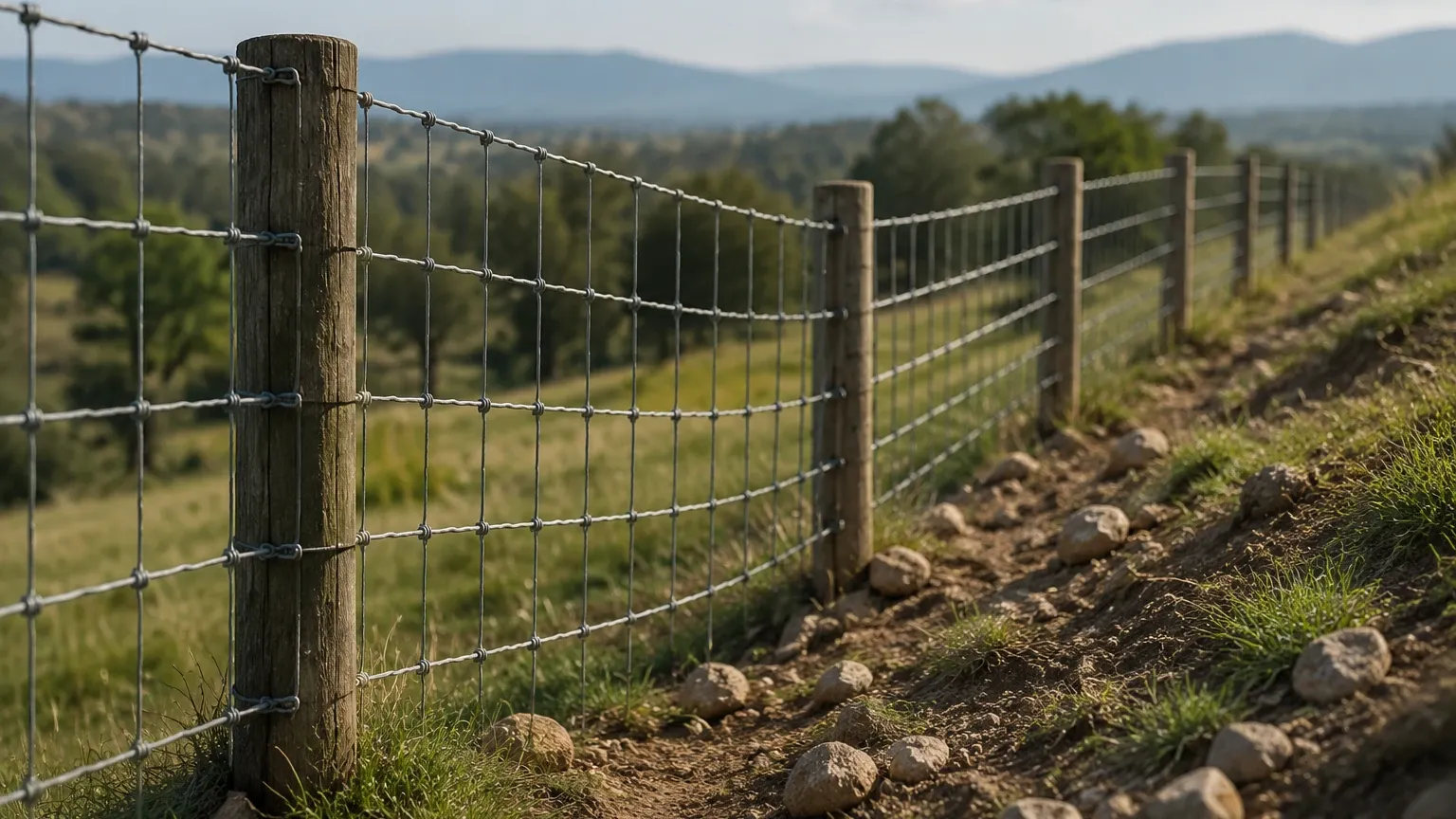
Installing woven wire fence on uneven ground requires a strategic approach to tensioning and structural alignment. Unlike rigid panel systems, woven wire provides a degree of flexibility, but improper installation on uneven terrain can lead to sagging, structural failure, or gaps that compromise the integrity of the enclosure. This guide examines the technical considerations, material properties, and installation methodologies necessary to achieve a professional-grade result on complex landscapes.
Understanding the Mechanical Properties of Woven Wire Mesh
Before addressing the complexities of uneven terrain, it is essential to understand how the construction of the mesh influences its performance. Woven wire mesh is manufactured by weaving individual wires over and under one another in various patterns—most commonly plain weave, twill weave, or dutch weave.
For fencing and containment applications, the tensile strength of the wire and the stability of the weave are paramount. Stainless steel alloys, such as SS304 and SS316L, are preferred in industrial settings due to their superior corrosion resistance and mechanical durability. When tension is applied to a roll of woven wire, the intersections of the wires provide resistance. However, when the ground is not level, the mesh must either "rack" (deform slightly to follow a slope) or be cut and adjusted to maintain a professional appearance and functional security.
Material Selection: SS304 vs. SS316L
Selecting the right material is the first step in ensuring long-term performance on uneven ground.
- SS304: Suitable for most industrial environments where standard corrosion resistance is required.
- SS316L: Recommended for coastal areas, chemical processing sites, or applications where the mesh will be in contact with corrosive agents. The lower carbon content in 316L also improves weldability if the mesh needs to be secured to custom-fabricated frames on-site.
Site Assessment and Topographical Planning
Successful installation begins with a thorough site assessment. Engineers should identify the degree of the slope and the frequency of elevation changes. There are generally two types of uneven ground encountered:
1. Constant Slopes: A steady incline or decline over a long distance.
2. Rolling Terrain: Frequent changes in elevation, including peaks and valleys.
For constant slopes, the mesh can often be installed using the "contouring" method. For rolling terrain, more complex techniques like "stepping" or "cut-and-splice" may be necessary. Measuring the "rise and run" of the slope allows the procurement team to calculate the exact amount of Plain, twill and dutch woven wire mesh in SS304/316L — rolls, cut mesh and framed panels. Send mesh count or micron target for a technical quote. required, accounting for the extra length needed when following a curve rather than a straight line.
Primary Methods for Installing Woven Wire Fence on Uneven Ground
There are three primary engineering approaches to managing elevation changes during the installation process. Each has specific implications for tension and structural load.
1. The Contouring Method (Racking)
Contouring involves pulling the woven wire mesh so that it follows the natural grade of the land. This is the most common method for moderate slopes. Because woven wire mesh has a degree of flexibility at the weave points, it can be "racked"—meaning the rectangular openings of the mesh become slightly diamond-shaped as the mesh is pulled parallel to the slope.
* Technical Consideration: When contouring, the line posts must be installed perpendicular to the ground, or in some high-load industrial cases, plumb (perfectly vertical). If the posts are plumb, the mesh will need to be adjusted at every attachment point to ensure the top of the fence remains consistent with the ground level.
* Risk: Over-racking can weaken the weave stability of certain mesh types. It is vital to consult with the manufacturer to ensure the specific mesh count and wire diameter can handle the intended deformation.
2. The Stepping Method
The stepping method treats the fence as a series of individual levels. Instead of following the slope, the mesh is installed in level sections, with each subsequent section placed lower or higher than the previous one, creating a "stair-step" appearance.
* Technical Consideration: This method is ideal for very steep slopes where racking the mesh would cause too much distortion. It requires longer posts at the "step" points, as one side of the post will support a section of mesh at a higher elevation than the other side.
* Risk: The primary drawback of stepping is the gap created at the bottom of the fence on the downhill side of each step. In security or containment applications, these gaps must be filled with additional mesh panels or custom-fabricated stainless steel inserts.
3. The Cut-and-Splicing Method
For industrial applications requiring maximum security and aesthetic precision, the mesh is cut at every major change in grade. Each section is then tensioned independently and secured to terminal posts.
* Technical Consideration: This method provides the highest level of structural integrity because it prevents tension imbalances across the entire run of the fence. By using high-quality Woven Wire Mesh, installers can ensure that each segment is perfectly tensioned to withstand environmental loads.
Engineering Considerations for Tension and Bracing
Tension is the most critical factor when installing woven wire on uneven ground. On a flat surface, tension is distributed evenly across the horizontal wires (line wires). On a slope, the tension becomes uneven. The "top" wires on a downhill slope may carry more load than the "bottom" wires, leading to sagging or "fish-mouthing" (where the mesh bulges outward).
Terminal Post Anchoring
Terminal posts (end posts, corner posts, and gate posts) on uneven ground must be anchored more deeply than on flat ground. Because they act as the primary anchor points for the tensioning equipment, any movement in these posts will cause the entire fence line to fail. In industrial settings, these posts should be set in concrete with a depth exceeding the local frost line.
Bracing Requirements
When installing woven wire fence on uneven ground, additional bracing is required at every point where the slope changes significantly. An "H-brace" or "N-brace" configuration should be used at the top and bottom of every hill. This prevents the tension of the mesh from pulling the posts over toward the center of the incline.
Common Risks and How to Mitigate Them
Installing mesh on difficult terrain introduces several risks that can impact the total cost of ownership and the lifespan of the filtration or containment system.
| Risk | Cause | Mitigation Strategy |
| :— | :— | :— |
| Mesh Sagging | Uneven tensioning across slopes. | Use tensioning bars to pull the mesh evenly from top to bottom. |
| Ground Gaps | Stepping the fence on steep grades. | Install a "bottom wire" or secondary mesh apron buried 6-12 inches underground. |
| Post Leaning | Inadequate bracing at grade changes. | Implement H-brace assemblies at every significant peak and valley. |
| Corrosion at Stress Points | Micro-cracks in coating during racking. | Utilize high-grade stainless steel (SS316L) which does not rely on surface coatings for protection. |
Customization and OEM Solutions for Complex Terrains
In many industrial B2B scenarios, standard off-the-shelf fencing rolls are insufficient for the precision required. Customization allows for the production of mesh with specific wire diameters and aperture sizes that are optimized for the tensioning requirements of a specific site.
As a professional manufacturer, Kaifil provides customized filtration and mesh solutions that address these engineering challenges. Whether the application involves a complex hydraulic containment system or an industrial perimeter, the selection of the correct mesh count and material grade is essential. For instance, a heavier gauge wire may be required for the perimeter of a chemical processing plant to ensure that the Woven Wire Mesh maintains its shape even when subjected to the mechanical stresses of uneven ground installation.
Maintenance and Long-Term Performance
Once the installation is complete, a regular inspection cycle should be established. Uneven ground puts constant, non-symmetrical stress on the mesh and the posts. Over time, soil erosion or frost heave can shift the posts, leading to a loss of tension.
1. Annual Tension Checks: Use a tension gauge to ensure the line wires remain within the manufacturer's recommended specifications.
2. Debris Removal: On slopes, debris tends to accumulate at the bottom of the fence. This can trap moisture and accelerate corrosion, even in stainless steel, if not cleared regularly.
3. Connection Inspections: Check the clips, ties, or welds that secure the mesh to the posts. These are the points most likely to fail under the shifting loads of uneven terrain.
Conclusion: Selecting the Right Partner for Industrial Mesh
Installing woven wire fence on uneven ground is an engineering task that demands high-quality materials and precise execution. By understanding the relationship between topography and mesh tension, and by selecting superior materials like SS304 or SS316L, organizations can ensure a durable and effective solution.
Kaifil specializes in providing high-performance Woven Wire Mesh tailored to the specific needs of industrial clients. From material selection to customized designs, our expertise ensures that your filtration and containment components meet the most demanding environmental and structural requirements. When planning your next project on challenging terrain, focus on the technical specifications that will guarantee long-term stability and performance.
Download Installing Woven Wire Fence on Uneven Ground as a PDF
