


Mechanically Woven Double Twisted Hexagonal Wire Mesh Gabions: An Engineering and Procurement Guide
In the sectors of civil engineering, erosion control, and industrial containment, the structural integrity of wire mesh components is paramount. Among the various configurations available, mechanically woven double twisted hexagonal wire mesh gabions stand out as a specialized solution designed for high-stress environments where flexibility, durability, and non-raveling characteristics are required.
For engineers and procurement professionals, understanding the technical nuances of these structures is essential for ensuring long-term performance in hydraulic and geotechnical applications. This guide examines the manufacturing standards, material considerations, and mechanical advantages of double-twisted hexagonal mesh, while situating it within the broader context of industrial Woven Wire Mesh technologies.
The Engineering Logic of Double-Twisted Hexagonal Structures
The primary distinction of mechanically woven double twisted hexagonal wire mesh gabions lies in their construction method. Unlike welded wire mesh, which relies on rigid intersection points, the double-twisted method involves intertwining pairs of wires through a series of three half-turns (a "double twist").
This specific mechanical configuration provides two critical engineering advantages:
1. Non-Raveling Properties: The double twist ensures that if a single wire is cut or breaks due to abrasion or impact, the resulting tension release does not cause the entire mesh panel to unzip or unravel. The structural integrity remains localized, allowing the gabion to continue functioning until repairs can be made.
2. Flexibility and Stress Distribution: The hexagonal aperture allows the mesh to deform slightly under pressure without fracturing. In geotechnical applications, where soil settlement or hydraulic shifts are common, this flexibility allows the gabion to conform to the changing contours of the earth, maintaining contact and stability where rigid structures might crack.
When sourcing these components, it is vital to specify the mesh type according to international standards such as ASTM A975 or EN 10223-3, which define the mechanical properties required for heavy-duty industrial use.
Manufacturing Standards and Material Selection
The performance of a gabion is only as reliable as the wire used in its construction. In industrial and marine environments, the choice of material determines the replacement cycle and total cost of ownership. While carbon steel with various coatings (Zinc, Galfan, or PVC) is common for standard civil works, demanding industrial applications often require the superior corrosion resistance of stainless steel.
Stainless Steel Options
For projects involving chemical processing, wastewater treatment, or high-salinity coastal environments, stainless steel alloys are the preferred choice.
* SS304: Suitable for general industrial environments where moisture is present but chemical exposure is moderate.
* SS316L: The "L" denotes low carbon, providing enhanced resistance to intergranular corrosion and superior performance in chloride-rich environments.
At Kaifil, we emphasize the importance of precision in the weaving process. Whether providing Plain, twill and dutch woven wire mesh in SS304/316L — rolls, cut mesh and framed panels. Send mesh count or micron target for a technical quote., the focus remains on material purity and dimensional accuracy. For gabion structures, the wire diameter typically ranges from 2.0mm to 4.0mm, depending on the volume of the basket and the density of the fill material.
Performance in Hydraulic and Geotechnical Environments
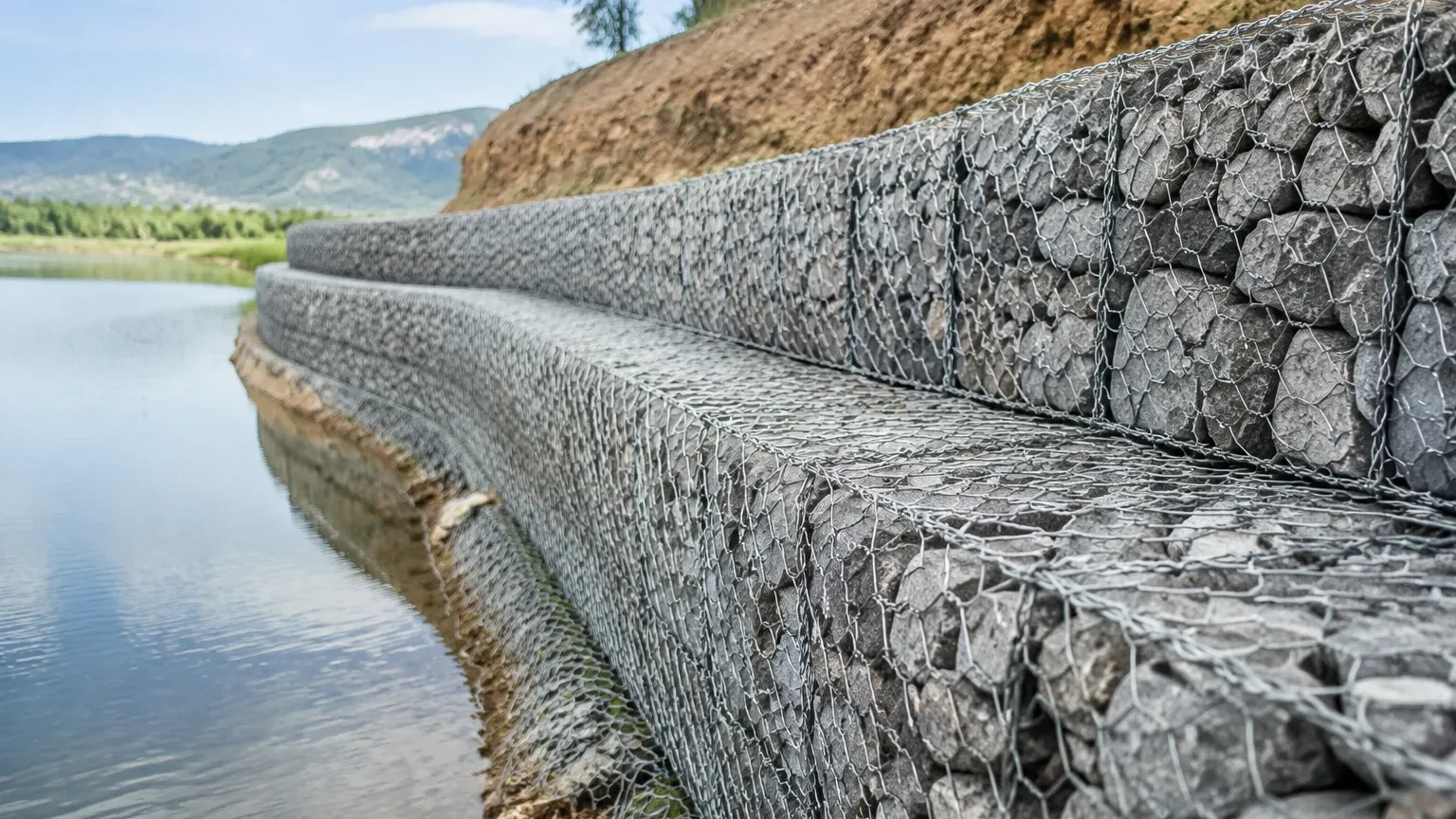
Mechanically woven double twisted hexagonal wire mesh gabions are primarily utilized for their hydraulic efficiency and geotechnical stability. Unlike solid concrete walls, gabion structures are permeable. This permeability is a critical engineering feature that manages hydrostatic pressure.
Hydrostatic Pressure Relief
In retaining wall applications, water buildup behind the wall can lead to structural failure. The porous nature of a rock-filled gabion allows water to pass through freely, eliminating the buildup of pore water pressure. This makes them ideal for riverbank protection, culvert headwalls, and bridge abutments.
Erosion Control and Scour Protection
In hydraulic engineering, the double-twisted mesh acts as a containment skin for stone riprap. When used as "mattresses" (thinner, broader versions of gabions), they protect the beds of channels and rivers from the scouring forces of high-velocity water. The mechanical weaving ensures that the mesh can withstand the constant vibration and impact of suspended solids in the water column.
Comparative Analysis: Woven vs. Welded Gabions
Engineers often face a choice between woven and welded wire mesh for gabion construction. While both have their place, the mechanically woven double-twisted variety is generally superior in the following scenarios:
* Differential Settlement: In areas with poor soil bearing capacity, the ground may settle unevenly. Woven mesh can twist and bend to accommodate this movement. Welded mesh, being rigid, is prone to weld-point failure under the same conditions.
* High-Velocity Water: The flexibility of woven mesh allows it to dissipate the energy of moving water more effectively than a rigid structure.
* Longevity in Dynamic Loads: If the structure is subject to frequent vibration or shifting loads, the mechanical twists act as small hinges, reducing the fatigue stress on the metal compared to the fixed joints of a welded panel.
However, welded gabions are often preferred for architectural applications where perfectly straight lines and a "basket" that maintains its shape without internal bracing are required. For industrial filtration and heavy civil engineering, the mechanical weave remains the standard for reliability.
Procurement Checklist for Industrial Engineers
When moving from the design phase to procurement, several technical parameters must be confirmed to ensure the product meets the project’s safety factors. Before finalizing an order for mechanically woven double twisted hexagonal wire mesh gabions, verify the following:
1. Wire Gauge and Tensile Strength: Ensure the wire diameter meets the load-bearing requirements. Standard tensile strength for gabion wire typically falls between 350 to 500 MPa.
2. Mesh Aperture Size: The "8×10" or "10×12" designations refer to the nominal dimensions of the hexagonal opening (in centimeters). The stone fill must be sized significantly larger than the mesh opening to prevent migration.
3. Coating Weight and Adherence: If using galvanized wire, the weight of the zinc coating (measured in g/m²) must comply with standards like ASTM A641. The coating must be able to withstand the twisting process without cracking or flaking.
4. Diaphragm Placement: For larger gabion baskets, internal diaphragms (mesh partitions) should be spaced at 1-meter intervals to prevent stone migration and maintain the basket's shape during filling.
5. Edge Wire (Selvedge): The edges of the mesh panels should be reinforced with a heavier gauge wire than the mesh itself. This "selvedge wire" provides a robust point for lacing or stapling baskets together.
Customization and Precision in Industrial Filtration
While gabions represent the large-scale application of woven wire, the same principles of mechanical integrity apply to precision filtration. At Kaifil, we leverage our expertise in Woven Wire Mesh to provide customized solutions that bridge the gap between heavy-duty containment and fine particle separation.
In many industrial settings, gabion-like structures are used as primary intake screens or debris filters in water treatment plants. These require a higher level of precision in material selection—often utilizing SS316L to combat the corrosive effects of chemicals or brackish water. Our manufacturing capabilities allow for the production of mesh that meets specific micron ratings while maintaining the structural robustness required for industrial environments.
Total Cost Considerations and Maintenance
The initial purchase price of mechanically woven double twisted hexagonal wire mesh gabions is only one component of the total project cost. Engineers must also account for:
* Installation Labor: Woven gabions are typically shipped flat (collapsed) and require assembly on-site. The ease of lacing and the quality of the selvedge wire significantly impact labor time.
* Fill Material Availability: The cost-effectiveness of gabions often depends on the proximity of suitable stone fill.
* Maintenance Cycles: A properly specified stainless steel or heavy-galvanized woven mesh structure can have a design life of 50 to 100 years. Choosing a lower-grade mesh often results in premature corrosion, requiring expensive structural stabilization later.
By focusing on high-quality mechanical weaving and rigorous material standards, facilities can ensure that their erosion control and containment systems remain functional under the most demanding conditions. Whether you are designing a large-scale retaining wall or a specialized industrial filtration component, the choice of mesh construction is the foundation of the system's success.
Download Mechanically Woven Double Twisted Hexagonal Wire Mesh Gabions as a PDF
