


Woven Wire Earbud Mesh: A Technical Guide for Acoustic and Protective Applications
In the design and manufacture of high-performance consumer electronics, specifically in-ear monitors (IEMs) and earbuds, the choice of protective materials is a critical engineering decision. The component often referred to as the woven wire earbud mesh serves as the final barrier between the sensitive internal driver components and the external environment.
While seemingly a simple part, this mesh must balance conflicting requirements: it must provide robust physical protection against earwax, dust, and moisture while remaining acoustically transparent. For engineers and procurement teams, understanding the technical nuances of Woven Wire Mesh is essential to ensuring product longevity and sound quality. This guide examines the specifications, material considerations, and manufacturing standards required for precision earbud mesh applications.
The Role of Woven Wire Mesh in Acoustic Engineering
In the context of audio hardware, the primary function of a mesh screen is protection. However, every material placed in the sound path introduces acoustic impedance. Woven wire mesh is preferred over non-woven or plastic alternatives in premium audio applications due to its predictable geometry and structural stability.
Debris Prevention and Hygiene
The most immediate threat to an earbud’s internal components is the ingress of cerumen (earwax) and skin oils. Without a fine mesh barrier, these substances can migrate into the acoustic chamber, dampening the diaphragm's movement or causing permanent damage to the driver. Stainless steel woven wire mesh provides a high-strength barrier that resists the acidic nature of human sweat and oils, maintaining its integrity over thousands of hours of use.
Acoustic Impedance and Tuning
Engineers use the physical properties of the mesh to fine-tune the frequency response of the earbud. The "open area" of the mesh—the percentage of the total surface area that is not obstructed by wire—directly correlates with acoustic resistance. By selecting specific mesh counts and wire diameters, manufacturers can subtly dampen high-frequency peaks or adjust the bass response by controlling the airflow (venting) within the earbud housing.
Technical Specifications and Evaluation Criteria
When specifying woven wire earbud mesh, technical professionals must look beyond simple dimensions. The performance of the mesh is defined by its weave type, material grade, and precision of the aperture.
Mesh Count and Micron Rating
The mesh count refers to the number of wires per linear inch. For earbud applications, extremely high mesh counts are often required to prevent microscopic particles from entering the device.
* Plain Weave: The most common type, where each shute wire passes over and under one warp wire. This provides a consistent pore size and is easy to clean.
* Twill Weave: Used when a heavier wire is required for a specific mesh count, or when a finer mesh is needed than plain weave can provide. Each wire passes over two and under two wires.
* Dutch Weave: Often used for high-pressure filtration, though less common in earbuds unless specific acoustic damping properties are required through a staggered, tighter pore structure.
For most earbud applications, a micron rating between 20µm and 100µm is standard, depending on whether the mesh is used for the primary sound output or as a secondary vent filter.
Open Area Calculations
The percentage of open area is calculated using the formula:
$$Open Area \% = (Aperture / (Aperture + Wire Diameter))^2 \times 100$$
In acoustic design, a higher open area generally results in lower acoustic resistance. However, as the open area increases, the structural rigidity of the mesh decreases. Finding the equilibrium between these two factors is a key part of the prototyping phase.
Material Selection: Why Stainless Steel Dominates
While synthetic meshes (like nylon or polyester) are used in low-cost consumer electronics, industrial-grade earbuds and professional IEMs almost exclusively utilize stainless steel. The material properties of stainless steel offer several advantages in the B2B manufacturing context.
Corrosion Resistance
Earbuds operate in a harsh environment characterized by high humidity and exposure to biological fluids. Plain, twill and dutch woven wire mesh in SS304/316L — rolls, cut mesh and framed panels. Send mesh count or micron target for a technical quote. provides the necessary resistance to oxidation.
* SS304: Offers excellent corrosion resistance for most consumer environments and is the standard for general-purpose electronic mesh.
* SS316L: Contains molybdenum, providing superior resistance to chlorides and salts. This is often specified for high-end or "sport" earbuds designed for heavy sweat exposure or use in coastal environments.
Structural Integrity and Formability
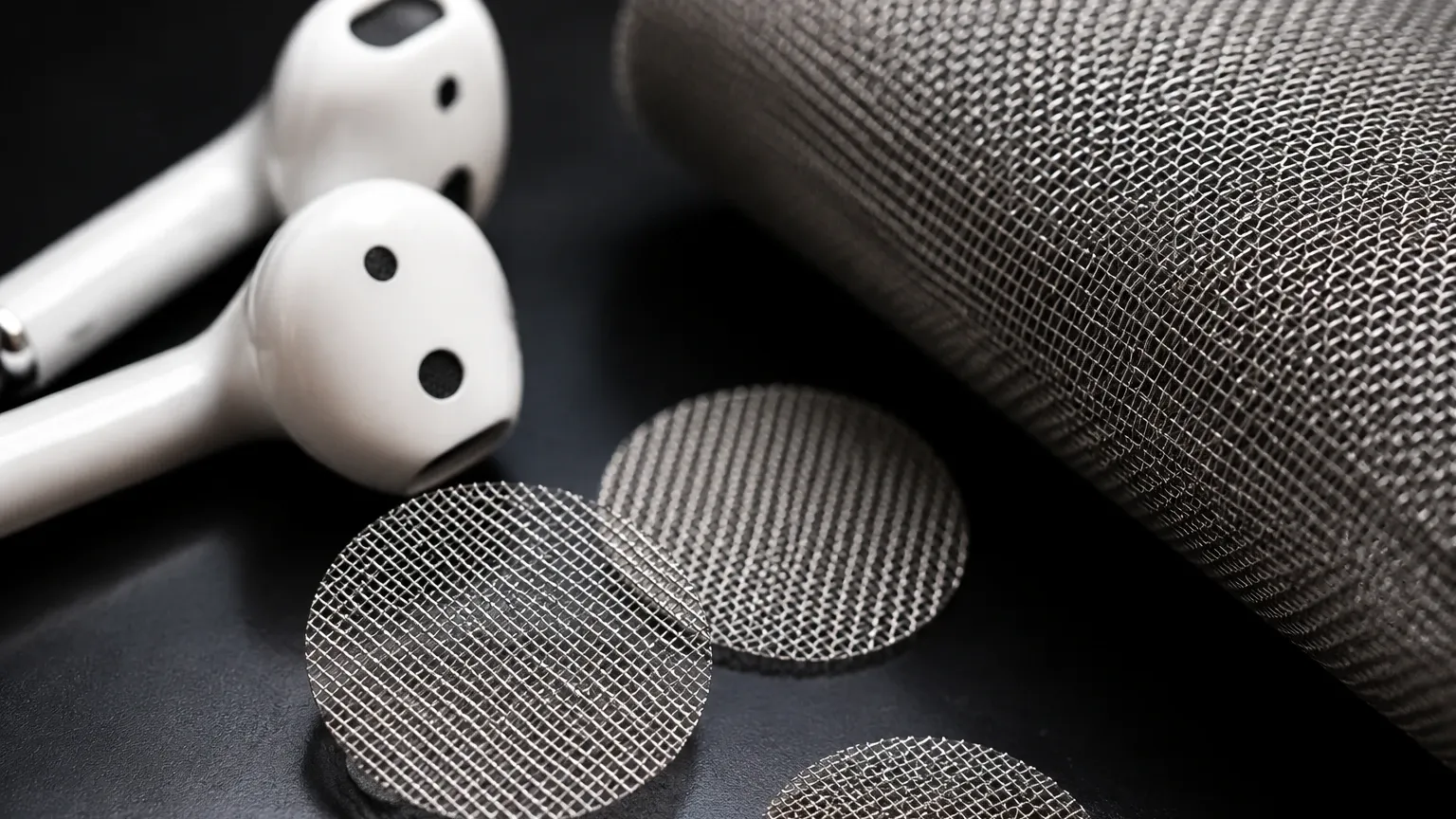
Stainless steel mesh can be precision-cut into tiny discs (often as small as 3mm to 5mm in diameter) without the edges fraying excessively, provided the correct cutting technology is used. It also maintains its shape under the pressure of cleaning or accidental contact, whereas synthetic meshes may stretch or tear.
Manufacturing and Customization Processes
For an OEM manufacturer like Kaifil, the production of woven wire earbud mesh involves more than just weaving. The post-weaving processes are what determine the final quality of the component.
Precision Die-Cutting and Laser Cutting
Because earbud components are diminutive, the tolerances for the mesh discs are extremely tight. Traditional mechanical die-cutting is efficient for high-volume production, but laser cutting is often used for high-precision or complex shapes. Laser cutting also has the advantage of "sealing" the edges of certain mesh types, reducing the risk of loose wire fragments (burrs) entering the driver assembly.
Ultrasonic Cleaning
In the electronics industry, cleanliness is paramount. After the mesh is woven and cut, it must undergo rigorous ultrasonic cleaning to remove any residual lubricants, metal dust, or environmental contaminants. This ensures that the mesh does not introduce any foreign objects into the sensitive acoustic chamber of the earbud.
Surface Treatments and Coatings
Some applications require the mesh to be hydrophobic (water-repellent) or oleophobic (oil-repellent). Specialized coatings can be applied to the stainless steel wire to prevent liquids from bridging the apertures, which would otherwise block sound and damage the internal electronics. Additionally, PVD (Physical Vapor Deposition) coating can be used to change the color of the mesh (e.g., to black or gold) for aesthetic purposes without significantly altering the acoustic properties.
Risks and Quality Control in Procurement
When sourcing Woven Wire Mesh for electronics, purchasing teams must be aware of common risks that can lead to high failure rates during assembly or in the field.
Aperture Inconsistency
In lower-quality mesh, the spacing between wires can vary. This leads to inconsistent acoustic performance across different units of the same product. Engineers should demand tight tolerances on the mesh count and wire diameter to ensure uniformity in sound damping.
Wire Shifting and Fraying
If the mesh is not properly tensioned during the manufacturing of the earbud housing, or if the cut edges are not clean, individual wires may shift. A single loose wire can vibrate against the housing, creating audible distortion or "rattle," which is a common cause of consumer returns.
Total Cost of Ownership (TCO) Considerations
While stainless steel mesh has a higher upfront material cost than plastic, its durability reduces the rate of warranty claims. Furthermore, metal mesh is often easier to integrate into automated assembly lines because it can be picked and placed with vacuum tools or magnetic systems more reliably than lightweight synthetic fabrics.
Information to Confirm Before Ordering
To receive an accurate quote and ensure the mesh meets the application requirements, technical buyers should confirm the following data points with their supplier:
1. Exact Alloy Grade: Confirm if SS304 is sufficient or if the application requires the higher corrosion resistance of SS316L.
2. Micron or Mesh Count: Provide either the desired aperture size (in microns) or the mesh count per inch.
3. Dimensional Tolerances: Specify the diameter of the cut pieces and the allowable variance (e.g., +/- 0.05mm).
4. Acoustic Targets: If known, provide the target air permeability or acoustic impedance values.
5. Packaging Requirements: For automated assembly, mesh discs are often supplied on carrier tape or in specialized trays to prevent damage during transit and handling.
Conclusion
The woven wire earbud mesh is a small but vital component in the architecture of modern audio devices. By selecting high-quality Woven Wire Mesh, engineers can protect sensitive electronics from the rigors of daily use while maintaining the precise acoustic profile required for high-fidelity sound.
Kaifil specializes in providing customized stainless steel filtration and mesh solutions tailored to the exacting standards of the electronics and industrial sectors. From material selection to precision cutting, our engineering team supports the development of durable, high-performance components that meet the specific needs of demanding applications.
