


Woven Wire Fence Bracing: Engineering Structural Integrity for Industrial Mesh Systems
In industrial environments, the application of woven wire mesh extends far beyond liquid filtration and gas separation. High-grade stainless steel mesh is frequently utilized for perimeter security, machine guarding, and internal partitions within chemical processing plants, food production facilities, and pharmaceutical laboratories. However, the performance of these installations is not solely dependent on the quality of the mesh itself but on the structural framework that supports it. Woven wire fence bracing serves as the critical engineering component that ensures the mesh remains tensioned, stable, and capable of withstanding mechanical impact or environmental stressors.
For engineers and facility managers, understanding the technical nuances of bracing is essential for maintaining the longevity of the installation. Without proper bracing, even the highest quality SS316L mesh will eventually succumb to sagging, deformation, or structural failure at the attachment points. This guide examines the engineering principles, material considerations, and selection criteria for implementing effective bracing in industrial woven wire systems.
The Fundamentals of Woven Wire Mesh in Industrial Barriers
Woven wire mesh is manufactured by weaving individual wires over and under one another to create a stable, precise grid. In industrial fencing and partitioning, this material is selected for its high open-area ratio, which allows for ventilation and visibility, and its superior tensile strength compared to expanded metal or plastic alternatives.
When deploying Woven Wire Mesh in a structural capacity, the mesh acts as a continuous membrane. To function correctly, this membrane must be held under constant tension. Unlike rigid welded wire, woven mesh has a degree of inherent flexibility. This flexibility is an advantage for impact resistance but requires a robust bracing system to prevent the mesh from pulling the support posts inward or losing its shape over time.
Structural Load Distribution
In an industrial fence or partition, loads are typically categorized as static (the weight of the mesh and hardware) or dynamic (wind loads, accidental impacts from machinery, or pressure differentials in HVAC-heavy environments). Bracing redistributes these loads from the mesh surface to the structural foundations, preventing localized stress concentrations that could lead to wire fatigue.
Engineering Principles of Woven Wire Fence Bracing
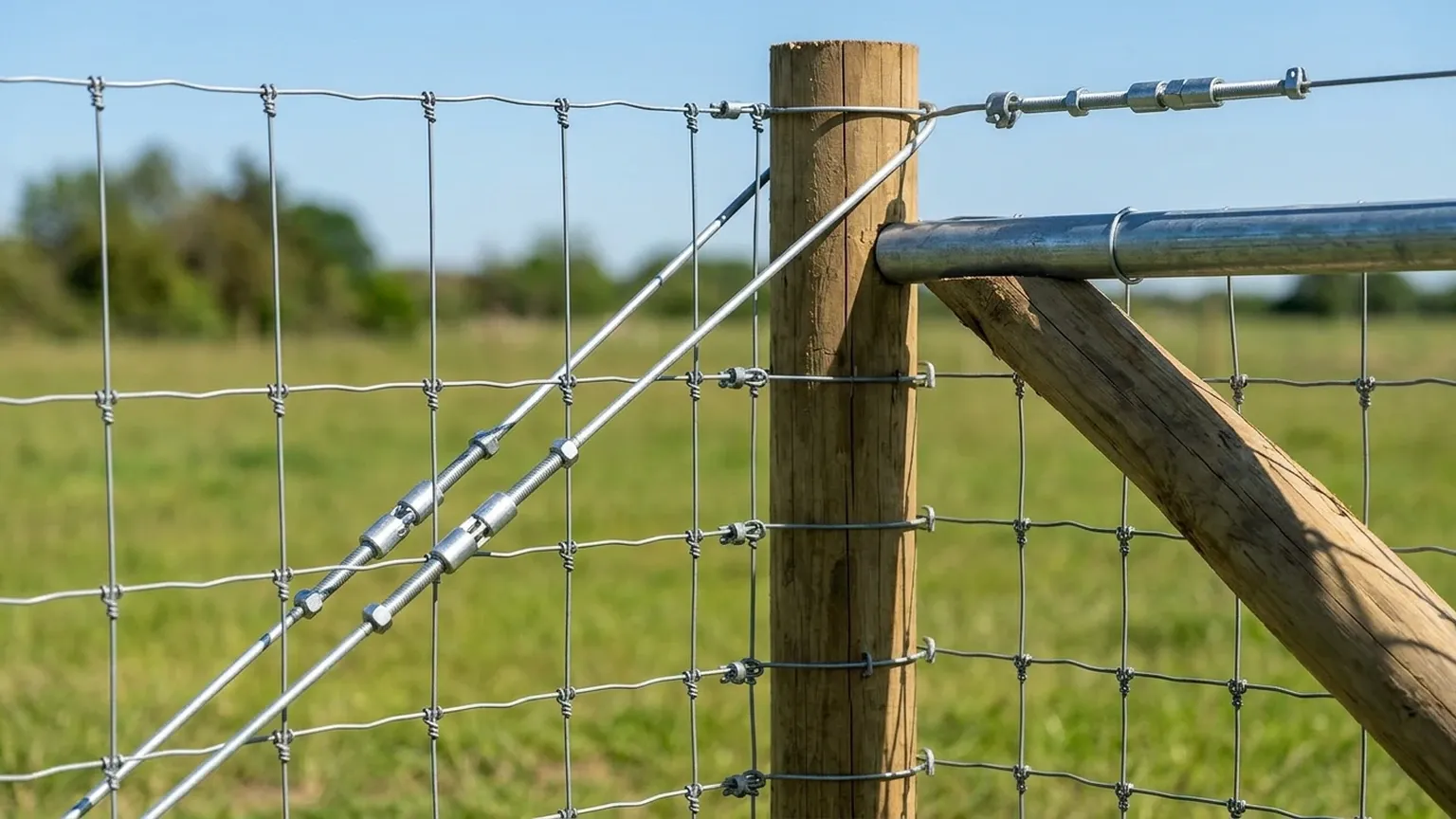
Woven wire fence bracing is the assembly of horizontal, vertical, or diagonal members designed to reinforce the terminal posts (end, corner, and gate posts) of a mesh system. Because these posts are the points where the mesh is tensioned, they bear the brunt of the lateral force.
The H-Brace and N-Brace Configurations
In industrial settings, two primary bracing configurations are utilized:
1. H-Braces: Consist of a horizontal rail placed between the terminal post and the first line post, reinforced by a tension wire running diagonally. This is the standard for high-tension industrial partitions where vertical space is constrained.
2. N-Braces: Utilize a diagonal solid member (often a stainless steel pipe or angle) between the top of one post and the bottom of the next. This provides superior compression resistance and is ideal for perimeter fencing where ground stability may vary.
Tensioning and Compression
The effectiveness of a brace relies on the balance between tension and compression. The horizontal member (the brace rail) acts in compression to keep the posts apart, while the diagonal tension wire or rod prevents the terminal post from leaning toward the mesh. For stainless steel mesh installations, the bracing components should ideally match the material grade of the mesh to prevent galvanic corrosion and ensure uniform thermal expansion rates.
Material Selection: Why Stainless Steel Grades Matter
For industrial applications, particularly in chemical processing or food and beverage sectors, the choice of material for both the mesh and the bracing is critical. While galvanized steel is common in agricultural fencing, it often fails to meet the hygiene and corrosion resistance standards required in B2B industrial environments.
SS304 vs. SS316L
* Type 304 Stainless Steel: This is the standard industrial grade, offering excellent durability and resistance to oxidation. It is suitable for most indoor partitions and machine guards where exposure to corrosive chemicals is minimal.
* Type 316L Stainless Steel: Containing molybdenum, 316L provides superior resistance to chlorides and acidic environments. In pharmaceutical cleanrooms or coastal industrial sites, using 316L for both the woven wire mesh and the bracing hardware is mandatory to prevent "tea staining" or pitting corrosion.
When specifying a system, engineers should ensure that the Plain, twill and dutch woven wire mesh in SS304/316L — rolls, cut mesh and framed panels. Send mesh count or micron target for a technical quote. is paired with bracing of an equivalent or higher grade to ensure the entire assembly shares the same lifecycle expectations.
Technical Specifications: Mesh Count and Wire Diameter
The requirements for woven wire fence bracing are directly influenced by the specifications of the mesh being supported. Two primary factors dictate the tension requirements:
1. Wire Diameter (Gauge): Heavier wire diameters (e.g., 2mm to 4mm) create a more rigid mesh that requires significantly higher tension to remain flat. This necessitates heavy-duty bracing with larger diameter support posts.
2. Mesh Count: A higher mesh count (more wires per inch) increases the total surface area of the material. In outdoor applications, this increases the wind load (drag coefficient), requiring the bracing to handle higher lateral forces during storm events.
Calculating Tension Requirements
Engineers must calculate the "pull" exerted by the mesh. For a standard industrial partition, the tension might range from 200 to 500 lbs of force per linear foot of height. The bracing must be engineered to withstand at least 1.5 times this calculated load to provide a safety margin for impact or environmental variables.
Installation Best Practices for Tensioned Mesh Systems
Proper installation of woven wire fence bracing is a sequential process that determines the final flatness and security of the mesh.
Post Anchoring
Before bracing can be installed, the terminal posts must be securely anchored. In a factory setting, this usually involves heavy-duty base plates bolted into the concrete slab. For exterior perimeter fencing, posts should be set in deep concrete footings, with the depth determined by the local frost line and soil load-bearing capacity.
Brace Placement
Braces should be located at approximately two-thirds the height of the fence. If the fence exceeds 8 feet in height, a double H-brace (one at the bottom third and one at the top third) is recommended to prevent post-bowing.
Tensioning the Mesh
Once the bracing is secure, the woven wire mesh is attached to the terminal post using a tension bar and bands. The mesh is then pulled toward the next terminal post using a come-along or specialized mesh puller. It is vital to apply tension evenly across the entire height of the mesh to avoid "waves" or distortion in the weave pattern.
Common Risks and Mitigation Strategies
Failure to correctly implement woven wire fence bracing leads to several common industrial issues:
* Mesh Fatigue: If the mesh is allowed to vibrate or flutter due to inadequate tension, the wires will eventually fatigue and snap at the attachment points.
* Post Failure: Without horizontal brace rails, the tension of the mesh can pull terminal posts out of alignment, causing gates to malfunction and creating gaps in security.
* Corrosion at Contact Points: In humid or chemical-heavy environments, moisture can trap between the mesh and the bracing members. Using stainless steel components and ensuring proper drainage at the base of the posts mitigates this risk.
To avoid these risks, technical teams should confirm the compatibility of their hardware with the specific weave type (plain, twill, or dutch) and the environmental conditions of the site.
Customization and OEM Solutions for Industrial Mesh
Every industrial facility has unique requirements, whether it is a custom-sized machine guard or a high-security partition for a chemical warehouse. Working with a specialized manufacturer like Kaifil allows for the development of customized filtration and mesh solutions that integrate seamlessly with structural bracing requirements.
Customization options often include:
* Framed Panels: Instead of rolls of mesh that require field tensioning, mesh can be supplied as pre-tensioned panels within a stainless steel frame. This simplifies installation and eliminates the need for traditional fence bracing in many indoor applications.
* Specific Alloy Selection: Beyond 304 and 316, specialized alloys can be used for extreme temperature or highly acidic environments.
* Precision Finishing: For food-grade applications, the mesh and bracing can be electropolished to ensure there are no burrs or crevices where bacteria can accumulate.
Conclusion: Selecting the Right Support for Your Mesh
Woven wire fence bracing is more than a secondary component; it is the structural foundation that allows woven wire mesh to perform its role effectively. Whether the goal is to protect sensitive equipment, secure a facility perimeter, or create a safe working environment, the interaction between the mesh and its bracing system must be carefully engineered.
When planning an installation, engineers should prioritize material consistency, calculate the specific load requirements based on wire gauge and mesh count, and select a bracing configuration that matches the environmental demands of the site. By adhering to these technical standards, purchasing teams can ensure a high-performance, low-maintenance filtration or barrier system that provides long-term value.
For those in the procurement or engineering phase, it is advisable to consult with manufacturers who understand the mechanical properties of stainless steel. Reviewing technical data on mesh counts and micron ratings can provide the necessary insight to select the correct material for both the mesh and its supporting structure.
