


Engineering Guide to Woven Wire Mesh and Fence Holder Systems
In industrial environments, the integrity of a barrier or filtration system is only as reliable as its weakest component. While the selection of high-quality Woven Wire Mesh is a critical first step, the method by which that mesh is secured—often referred to as a woven wire fence holder or framing system—determines the long-term durability and performance of the installation. For engineers and procurement teams in sectors such as chemical processing, food and beverage, and pharmaceuticals, understanding the technical synergy between the mesh and its mounting hardware is essential to preventing premature failure and ensuring safety.
Industrial fencing and partitions utilizing woven wire are distinct from standard commercial fencing. These systems are often exposed to corrosive chemicals, high-pressure washdowns, or mechanical stresses. Consequently, the holder must do more than just "hold" the mesh; it must provide tension, maintain structural alignment, and resist the same environmental challenges as the mesh itself.
The Role of Woven Wire Mesh in Industrial Infrastructure
Before evaluating the holder, one must understand the characteristics of the mesh being supported. Industrial woven wire is manufactured by weaving longitudinal (warp) and transverse (shute) wires over and under each other. The specific weave pattern determines the mesh's mechanical properties and its suitability for different applications.
For most industrial fencing and protective barriers, Plain, twill and dutch woven wire mesh in SS304/316L — rolls, cut mesh and framed panels. Send mesh count or micron target for a technical quote. are the industry standards.
* Plain Weave: The most common pattern, where each shute wire passes over and under one warp wire. It provides a stable aperture and is ideal for general-purpose guarding and fencing.
* Twill Weave: Each wire passes over two and under two, allowing for heavier wire diameters in a given mesh count. This is often used when higher impact resistance is required.
* Dutch Weave: Characterized by a denser weave that offers superior strength and fine filtration capabilities. In a fencing context, this might be used for specialized acoustic dampening or fine-particle containment.
Selecting the correct mesh involves balancing the wire diameter, aperture size (the clear opening between wires), and the material grade. For instance, SS304 offers excellent corrosion resistance for most indoor and mild outdoor applications, while SS316L is preferred for marine environments or chemical processing zones due to its molybdenum content, which prevents pitting corrosion.
Engineering the Woven Wire Fence Holder
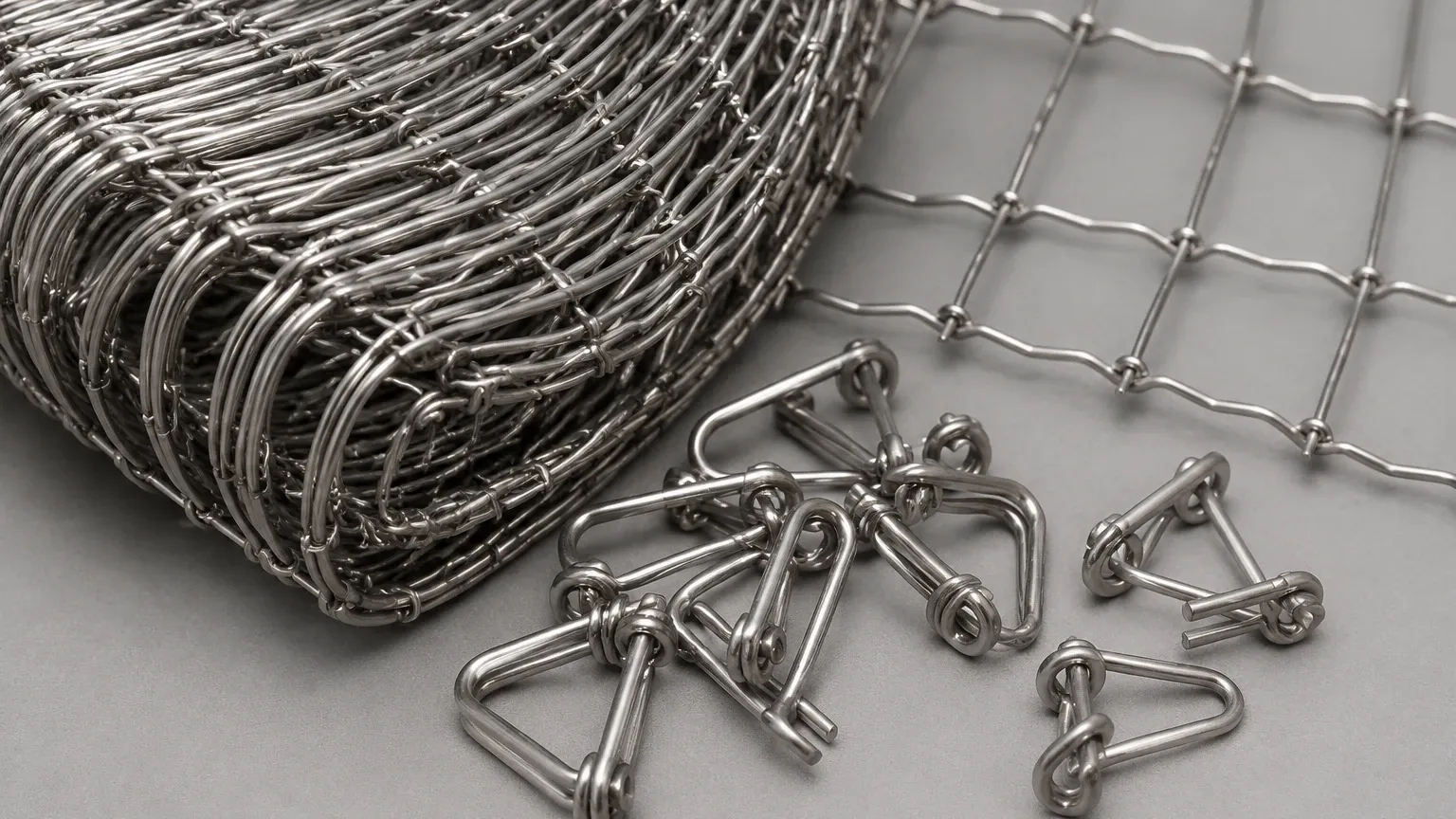
A woven wire fence holder is not a single product but a category of mounting solutions designed to interface with the mesh. The choice of holder depends on whether the mesh is intended to be a permanent structural fixture, a removable filter panel, or a flexible safety barrier.
1. U-Channel and L-Angle Frames
The most robust method for securing woven wire mesh is the use of perimeter frames. U-channels allow the mesh to be inserted into a groove and then welded or mechanically fastened. This provides a clean edge, preventing the wire ends from fraying or causing injury. L-angles are often used for larger panels where the mesh is bolted or spot-welded to the face of the angle.
2. Tensioning Bars and Bolts
In applications where the mesh covers large spans—such as perimeter fencing or large-scale machine guards—maintaining tension is critical. A woven wire fence holder system in this context often involves tensioning bars that slide through the mesh edge (often a hooked edge) and are pulled tight via J-bolts or tensioning nuts. Without proper tension, the mesh will sag, leading to vibration fatigue and reduced impact resistance.
3. Mounting Clips and Clamps
For lighter-duty applications or where the mesh must be frequently removed for cleaning (common in food processing), specialized clips or clamps are used. These holders must be designed to distribute the clamping force evenly to avoid crushing the wire or creating stress concentrations that lead to wire breakage.
Key Evaluation Criteria for Selection
When specifying a woven wire fence holder and mesh system, engineers should prioritize the following technical factors:
Material Compatibility
One of the most common causes of failure in industrial fencing is galvanic corrosion. This occurs when two dissimilar metals (e.g., a stainless steel mesh and a galvanized carbon steel holder) are in contact in the presence of an electrolyte (moisture or chemicals). To ensure a long service life, the holder material should match the mesh material. If Woven Wire Mesh in SS316L is selected for its corrosion resistance, the holder, fasteners, and welding consumables must also be SS316L.
Structural Load and Impact Resistance
The holder must be capable of transferring the loads applied to the mesh (such as wind loads, personnel impact, or pressurized spray) to the primary structure. This requires calculating the "pull-out" force—the amount of force required to strip the mesh out of the holder. For high-security or high-safety applications, deep-inset U-channels or continuous welding is often required.
Hygiene and Cleanability
In pharmaceutical and food-grade environments, the woven wire fence holder must be free of "dead zones" where bacteria or contaminants can accumulate. This means avoiding open threads, deep recesses, or overlapping joints that cannot be reached by cleaning agents. Smooth-welded frames with radiused corners are the preferred engineering solution in these sectors.
Common Risks and Failure Modes
Failure to properly integrate the mesh and the holder can lead to several operational risks:
* Wire Fraying: If the holder does not fully capture the cut ends of the wire mesh, the individual wires can unravel. This not only compromises the integrity of the fence but also creates sharp edges that pose a safety hazard.
* Vibration Fatigue: In environments with heavy machinery, a loose mesh within a holder will vibrate. Over time, this leads to work-hardening of the wire at the contact points, eventually causing the wires to snap.
* Thermal Expansion: In high-temperature applications (e.g., kiln guards or steam-heavy processing areas), the mesh and the holder may expand at different rates. If the holder is too rigid, it can cause the mesh to buckle or the welds to crack.
Customization and OEM Considerations
Standard off-the-shelf fencing solutions rarely meet the exacting requirements of specialized industrial processes. Customization is often necessary to achieve the desired balance of filtration, protection, and longevity.
As a professional manufacturer, Kaifil specializes in providing integrated solutions where the mesh and the holder are designed as a single unit. This includes:
* Custom Framed Panels: Delivering mesh already secured in custom-sized frames (U-channel or flat bar) to simplify on-site installation.
* Edge Treatments: Providing mesh with welded selvages, hooked edges for tensioning, or reinforced borders to interface perfectly with existing woven wire fence holder hardware.
* Precision Tolerances: Ensuring that the mesh count and wire diameter are consistent across the entire panel, which is vital for applications requiring specific airflow or light transmission.
Information to Confirm Before Procurement
To ensure the successful implementation of a woven wire system, procurement teams should confirm the following data points with their technical partners:
1. Environment Specifications: Will the system be exposed to chlorides, acids, or high-pressure steam? This dictates the grade of stainless steel (304 vs 316L).
2. Mechanical Requirements: What is the maximum expected impact force or pressure? This determines the wire gauge and the depth of the holder channel.
3. Dimensional Constraints: Precise measurements of the opening to be covered, including any necessary clearances for thermal expansion or mounting hardware.
4. Compliance Standards: Does the assembly need to meet specific industry standards, such as FDA requirements for food contact or OSHA standards for machine guarding?
Total Cost of Ownership (TCO)
While the initial cost of a high-grade stainless steel Woven Wire Mesh and matching holder system may be higher than galvanized or plastic alternatives, the total cost of ownership is significantly lower in industrial settings. Stainless steel systems require minimal maintenance, do not need painting or coating, and have a service life that often spans decades. By investing in a properly engineered holder system, facilities avoid the recurring costs of repairs, replacements, and potential downtime caused by barrier failure.
Conclusion
The effective use of Woven Wire Mesh in industrial fencing and partitions depends entirely on the engineering of the woven wire fence holder. By selecting compatible materials, ensuring proper tensioning, and designing for the specific environmental stresses of the application, engineers can create durable, safe, and efficient filtration and protection solutions. Whether for chemical containment, food safety, or industrial security, the synergy between the mesh and its frame is the foundation of a high-performance system.
