


Woven Wire Fence Installation: A Technical Guide for Industrial Applications
In industrial environments, the term "fence" often extends beyond simple perimeter security. For engineers and facility managers, a woven wire fence or partition serves as a critical component in machinery guarding, warehouse segregation, and the protection of sensitive processing equipment. Unlike standard agricultural fencing, industrial Woven Wire Mesh installations must meet stringent requirements for structural integrity, corrosion resistance, and precise aperture maintenance.
Proper woven wire fence installation is a multi-phase process that begins long before the first panel is secured. It requires a deep understanding of material science, mechanical tensioning, and the specific environmental stressors of the application site, whether it be a chemical processing plant, a food production line, or a pharmaceutical laboratory.
Understanding the Role of Woven Wire Mesh in Industrial Infrastructure
Before beginning an installation, it is essential to specify the correct mesh type for the intended function. Industrial woven wire is manufactured by weaving individual wires over and under one another in various patterns—most commonly plain weave, twill weave, or dutch weave.
For fencing and protective barriers, the primary considerations are the wire diameter and the mesh count (the number of openings per linear inch). In high-impact environments, a larger wire diameter is necessary to provide the required tensile strength. Conversely, in applications where visibility or airflow is prioritized alongside security, a higher mesh count with finer wire may be appropriate.
Kaifil specializes in providing high-performance solutions, including Plain, twill and dutch woven wire mesh in SS304/316L — rolls, cut mesh and framed panels. Send mesh count or micron target for a technical quote. Selecting the right weave and alloy is the foundation of a successful installation.
Material Selection and Specification for Durable Installation
The longevity of a woven wire fence installation depends heavily on the alloy selected. In industrial B2B contexts, two primary grades of stainless steel dominate the market:
1. Grade 304 Stainless Steel: This is the standard "18/8" stainless steel. It offers excellent corrosion resistance in most indoor industrial environments and is highly cost-effective for general machinery guarding and area segregation.
2. Grade 316L Stainless Steel: Containing molybdenum, 316L provides superior resistance to chlorides and acidic environments. This grade is mandatory for installations in chemical processing plants, marine environments, or facilities that undergo rigorous chemical cleaning protocols, such as those in the food and beverage sector.
When planning the installation, engineers must also consider the "open area" percentage. This calculation determines how much air or light can pass through the mesh, which is critical if the fence is being installed around equipment that requires ventilation to prevent overheating.
Engineering the Support Structure for Woven Wire Panels
A common failure point in industrial fencing is not the mesh itself, but the support structure. Because woven wire is inherently flexible, it requires a rigid frame to maintain its shape and tension.
Frame Design
For most industrial applications, mesh panels are integrated into frames made of angle iron, flat bars, or U-edging. The frame serves three purposes:
* Tensioning: It allows the mesh to be pulled taut, preventing sagging and ensuring the apertures remain uniform.
* Protection: It covers the sharp "selvage" or cut edges of the mesh, protecting personnel from injury.
* Attachment: It provides a solid surface for welding or bolting the partition to the floor, ceiling, or machine housing.
Post and Rail Considerations
In large-scale woven wire fence installation projects, such as warehouse partitions, the spacing of vertical posts is a critical engineering decision. Posts should typically be spaced no more than 8 to 10 feet apart to ensure lateral stability. In areas where the fence may be subject to impact from forklifts or other heavy machinery, floor-mounted gussets and heavier gauge steel posts are required.
The Step-by-Step Woven Wire Fence Installation Process
Executing a professional installation requires precision and the right tools. The following steps outline the standard procedure for installing framed woven wire panels in an industrial setting.
1. Site Preparation and Layout
Begin by marking the floor and walls where the fence will be situated. Use a laser level to ensure that all lines are perfectly straight and plumb. In industrial facilities, it is crucial to check for underground utilities or recessed floor drains before drilling for anchors.
2. Post Installation
Secure the vertical posts first. For concrete floors, heavy-duty expansion anchors or chemical anchors are recommended. Ensure that each post is perfectly vertical using a spirit level. If the installation is intended for high-security or high-load areas, the base plates should be oversized to distribute the mechanical stress.
3. Mesh Panel Attachment
Once the posts are set, the Woven Wire Mesh panels can be mounted. There are several methods for attachment:
* Bolting: Using high-strength bolts and washers to secure the panel frame to the post tabs. This allows for easier replacement if a panel becomes damaged.
* Welding: For permanent installations where maximum rigidity is required, the frames can be tack-welded directly to the posts. Note that all welds on stainless steel should be passivated afterward to prevent localized corrosion.
* Clamping: Specialized friction clamps can be used for modular systems where the layout may need to be adjusted in the future.
4. Tensioning and Alignment
If the installation involves bulk rolls of mesh rather than pre-framed panels, mechanical tensioning is required. This involves using a "come-along" or a specialized mesh stretcher to pull the wire taut before it is fastened to the terminal posts. Proper tensioning is vital to prevent the mesh from vibrating or humming in high-airflow environments.
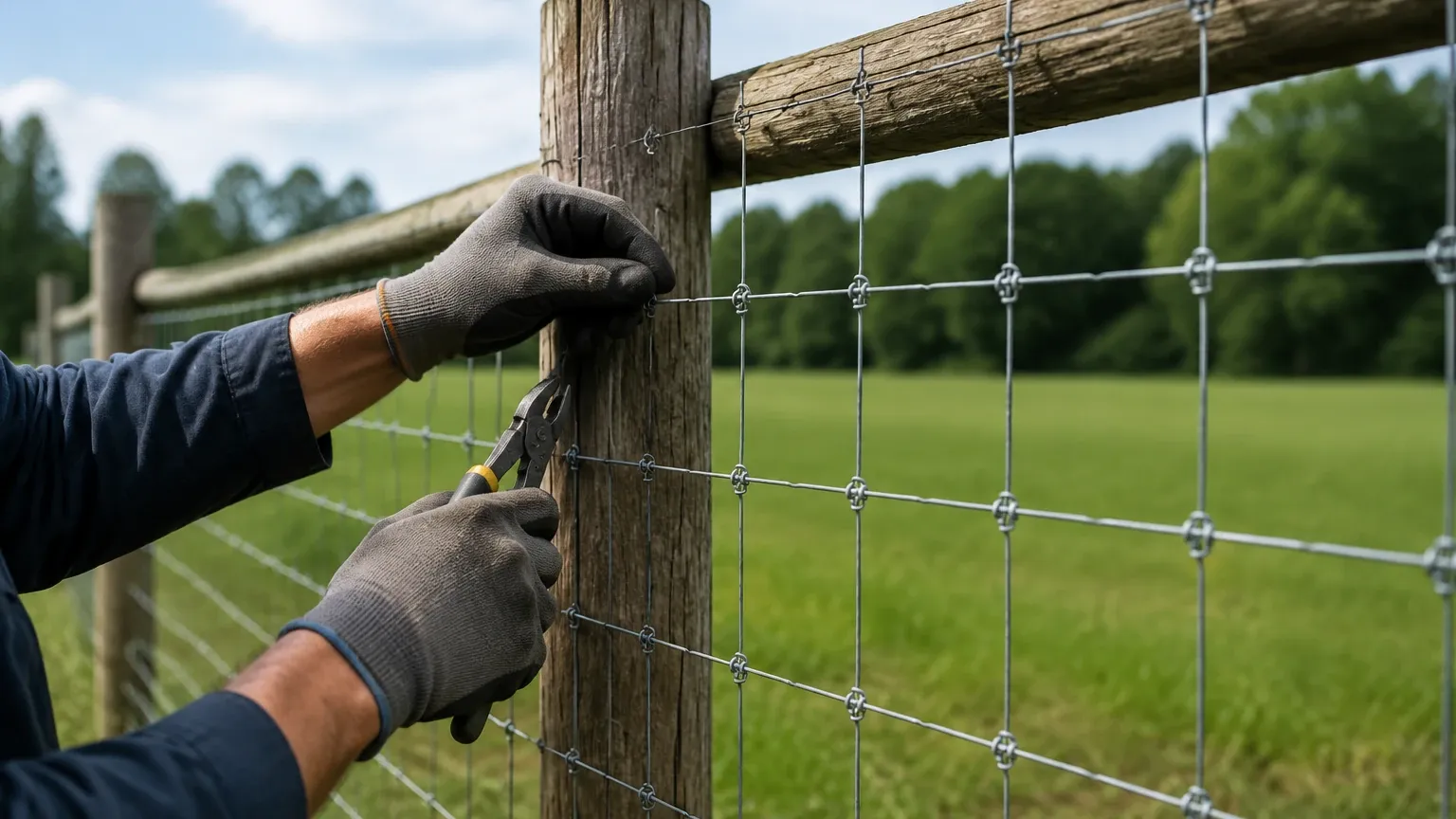
Addressing Common Installation Challenges: Tension and Alignment
One of the most frequent issues encountered during woven wire fence installation is the "oil canning" effect, where the mesh appears wavy or buckled. This is usually the result of uneven tensioning or thermal expansion.
In environments with significant temperature fluctuations, such as cold storage or high-heat processing zones, the installation must account for the expansion and contraction of the stainless steel. Using slotted bolt holes in the framing can allow for minor movement without compromising the structural integrity of the fence.
Another challenge is ensuring alignment across long runs. Even a 1-degree deviation at the start of a fence line can result in a significant offset 50 feet down the line. Continuous measurement and the use of string lines are essential to maintain a professional, functional result.
Maintenance and Longevity of Stainless Steel Mesh Installations
While stainless steel is exceptionally durable, the longevity of a woven wire fence installation is enhanced by a regular maintenance schedule. In industrial settings, dust, grease, and chemical residues can accumulate on the wire surfaces.
Cleaning Protocols
For 304 and 316L mesh, cleaning with a mild detergent and warm water is usually sufficient. In food-grade applications, high-pressure steam cleaning may be used. It is important to avoid using carbon steel brushes or steel wool for cleaning, as this can embed carbon steel particles into the stainless surface, leading to "tea staining" or localized rusting.
Inspection Cycles
Industrial fences should be inspected at least annually for:
* Fastener Integrity: Checking for loose bolts or failing welds caused by vibration.
* Structural Damage: Identifying any deformation in the mesh caused by accidental impacts.
* Corrosion Signs: Particularly at the joints and base plates where moisture may collect.
Technical Evaluation for Purchasing Teams
When sourcing materials for a woven wire fence installation, purchasing teams should look beyond the initial price per square foot. The total cost of ownership is influenced by the quality of the weave and the accuracy of the wire alloy. Substandard mesh may have irregular aperture sizes, which can compromise safety if the fence is used as a finger guard for moving machinery.
Requesting material test reports (MTRs) ensures that the stainless steel meets the required ASTM or ISO standards. Furthermore, working with a manufacturer like Kaifil, who understands the nuances of industrial filtration and metal fabrication, ensures that the mesh provided will withstand the specific rigors of your application.
Conclusion
A successful woven wire fence installation in an industrial B2B context is a marriage of precise engineering and skilled labor. By selecting the appropriate grade of Woven Wire Mesh, designing a robust support structure, and following a disciplined installation protocol, facilities can ensure long-term safety and operational efficiency. Whether the goal is to protect personnel from high-speed machinery or to secure high-value inventory, the technical details of the installation process are what ultimately determine the performance and durability of the barrier.
