


In the complex landscape of industrial procurement, the search for "woven wire mesh amazon" has become a common starting point for engineers, maintenance managers, and procurement specialists. While retail platforms offer a level of convenience and logistical speed that is attractive for rapid prototyping or minor facility repairs, the requirements of heavy-duty industrial filtration often exceed the capabilities of standard consumer-grade products. For those operating in high-stakes sectors such as chemical processing, pharmaceutical manufacturing, and hydraulic systems, understanding the technical boundary between a commodity hardware item and an engineered filtration component is essential for operational safety and efficiency.
Kaifil, as a specialized manufacturer of stainless steel filtration solutions, recognizes that while the accessibility of retail platforms is a modern reality, the technical nuances of Woven Wire Mesh require a deeper level of scrutiny. This article explores the technical considerations, material risks, and engineering requirements that professional buyers must evaluate when moving from a retail search to a dedicated industrial supply chain.
Understanding the Industrial Scope of Woven Wire Mesh
Woven wire mesh is a precision-manufactured material created by interlacing metallic wires on high-tension industrial looms. Unlike expanded metal or perforated sheets, woven mesh offers a unique combination of flexibility, high open area, and precise aperture control. In a B2B context, this material is not just a barrier but a calibrated filter medium designed to perform under specific thermal, mechanical, and chemical loads.
The manufacturing process involves precisely controlling the wire diameter and the spacing between wires (the pitch). For industrial applications, the consistency of the weave is paramount. A single irregular aperture in a filter used for catalyst recovery or fine chemical separation can lead to "bypass," where oversized particles contaminate the downstream product, potentially ruining entire batches or damaging sensitive machinery. Professional-grade mesh is subjected to rigorous tensioning during the weaving process to ensure that the wires do not migrate or shift when exposed to high-pressure flow rates.
The Search for "Woven Wire Mesh Amazon": Prototyping vs. Production
The intent behind searching for "woven wire mesh amazon" is usually driven by the need for immediate availability. For an engineer in the middle of a Research and Development (R&D) phase, ordering a 12×12 inch sheet of mesh with next-day delivery is a logical step for proof-of-concept testing. However, as a project transitions from a benchtop prototype to a full-scale industrial installation, the limitations of retail sourcing become apparent.
The Gap in Technical Documentation
Retail listings often lack the comprehensive data sheets required by industrial engineering departments. While an Amazon listing might specify "304 Stainless Steel 100 Mesh," it rarely provides the exact wire diameter, the percentage of open area, or the micron rating (the size of the largest spherical particle that can pass through the mesh). In industrial filtration, knowing that a mesh is "100 mesh" is insufficient; an engineer needs to know if the wire diameter is 0.10mm or 0.11mm, as this significantly impacts the flow resistance and the structural integrity of the filter element.
Minimum Order Quantities and Scalability
While retail platforms are ideal for small quantities, they are not designed for the consistent, high-volume supply chains required by Original Equipment Manufacturers (OEMs). Scaling a production line requires a partner who can guarantee material consistency across thousands of units and offer bulk pricing structures that retail platforms cannot match.
Technical Evaluation Criteria: Beyond the Retail Listing
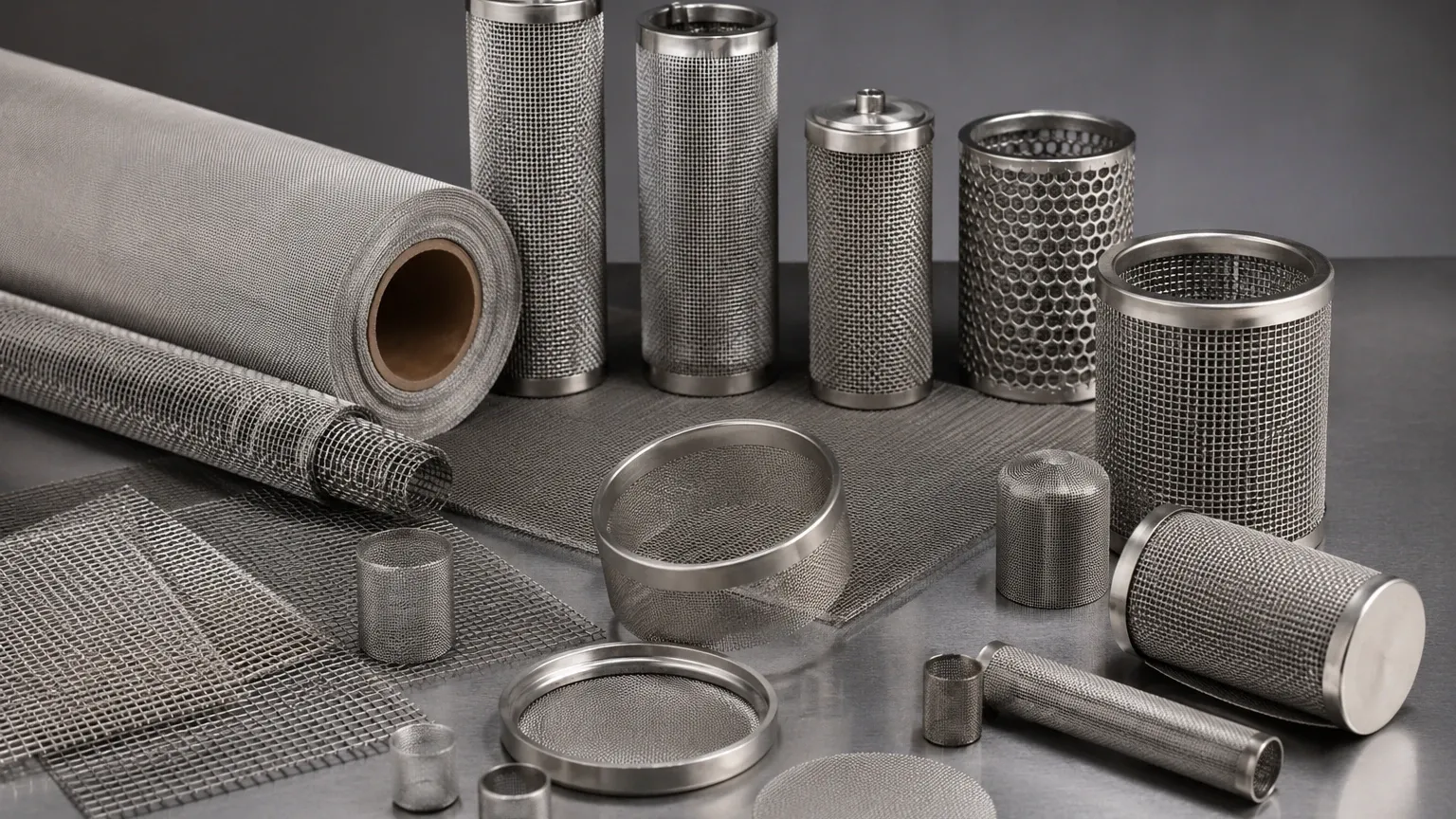
When evaluating Plain, twill and dutch woven wire mesh in SS304/316L — rolls, cut mesh and framed panels. Send mesh count or micron target for a technical quote., technical professionals must look beyond the basic mesh count. Several critical factors determine the performance of the mesh in a pressurized system:
1. Weave Type and Filtration Mechanics
Retail sources typically focus on Plain Weave, where each warp wire crosses over and under each shute wire. However, industrial applications often require more complex weaves:
* Twill Weave: This allows for the use of heavier wires in a fine mesh count, increasing the mechanical strength of the filter. It is often used in applications where the mesh must withstand significant back-pressure.
* Dutch Weave (Plain and Twill): These are the workhorses of fine filtration. By using different diameters for warp and shute wires and weaving them tightly together, manufacturers create a "zero-aperture" mesh that filters on a micron level rather than a simple hole-size level. This provides superior flow rates and cake-release properties compared to standard square mesh.
2. Open Area and Flow Rate
The percentage of open area determines the throughput of the filter. A mesh with a high mesh count but thick wires will have a low open area, leading to high pressure drops and increased energy consumption for pumps. Industrial suppliers provide calculated open area percentages, allowing engineers to model the fluid dynamics of their systems accurately.
3. Micron Rating vs. Nominal Rating
In critical applications, the difference between a nominal micron rating (an average) and an absolute micron rating (the maximum possible opening) is the difference between success and failure. Retail-sourced mesh rarely provides absolute ratings, which are essential for hydraulic systems and pharmaceutical sterile filtration.
Material Integrity and Chemical Compatibility
One of the most significant risks of sourcing woven wire mesh through non-specialized retail channels is the lack of material traceability. In the world of stainless steel, "Grade 316" is not a monolithic category.
The Importance of SS316L and MTRs
For chemical processing and marine environments, SS316L (low carbon) is often required to prevent intergranular corrosion after welding. Industrial manufacturers like Kaifil provide Material Test Reports (MTRs) that confirm the chemical heat analysis of the steel. This documentation is vital for compliance with ISO, FDA, and ASME standards. Without an MTR, a buyer has no way of verifying if the mesh they received is truly the alloy advertised or a lower-grade substitute that will corrode within weeks of exposure to process chemicals.
Temperature and Pressure Extremes
Industrial filters often operate in environments exceeding 300°C or under pressures of several hundred PSI. Engineered mesh is designed to maintain its geometric stability under these loads. Retail-grade mesh, often intended for insect screens or decorative use, may undergo "annealing" or structural softening at high temperatures, leading to a collapse of the filter structure and catastrophic system failure.
Customization and Value-Added Engineering
A roll of mesh is rarely the final product in a B2B environment. Industrial applications require the mesh to be transformed into a functional component. This is where the limitations of searching for "woven wire mesh amazon" become most evident. Retailers sell raw materials; manufacturers provide solutions.
Precision Fabrication
Industrial filters often require specific shapes—discs, cylinders, or pleated cartridges. Professional manufacturers use laser cutting or EDM (Electrical Discharge Machining) to ensure clean edges that do not fray. Frayed wires in a hydraulic system can break off and migrate into the fluid stream, causing severe damage to valves and actuators.
Ultrasonic Cleaning and Degreasing
For oxygen service or pharmaceutical applications, mesh must be free of all residual weaving oils and lubricants. Industrial suppliers perform multi-stage ultrasonic cleaning to ensure the mesh meets high-purity standards. Retail mesh is often shipped with manufacturing oils still present on the surface, which can contaminate a sensitive process.
Layer Bonding and Sintering
In many high-pressure applications, a single layer of mesh is insufficient. Manufacturers can sinter multiple layers of mesh together—combining a fine filtration layer with a heavy-duty support layer—to create a composite material that is both fine-filtering and structurally robust. This level of engineering is unavailable through standard retail outlets.
Risk Mitigation and Total Cost of Ownership (TCO)
While the initial price of a retail purchase might seem lower, the Total Cost of Ownership (TCO) is often significantly higher when factoring in the risks of failure. For a purchasing team, the value of an industrial partner lies in risk mitigation.
1. Downtime Costs: If a non-certified filter fails in a continuous production line, the cost of the resulting downtime can reach thousands of dollars per hour. The reliability of an engineered component far outweighs the marginal savings of a retail purchase.
2. Regulatory Liability: In the food, beverage, and pharmaceutical industries, using non-documented materials can lead to regulatory fines, product recalls, and loss of certification.
3. Technical Support: When an engineer encounters a filtration challenge—such as rapid clogging or unexpected corrosion—a manufacturer like Kaifil provides technical consultation to adjust the weave, alloy, or filter design. A retail platform provides no such support.
Conclusion: Selecting the Right Path for Your Project
In summary, while searching for "woven wire mesh amazon" may provide a quick fix for non-critical or small-scale needs, it is rarely the optimal solution for industrial filtration requirements. The complexities of weave types, material certifications, and custom fabrication necessitate a partnership with a manufacturer that understands the engineering behind the mesh.
By prioritizing technical specifications, material traceability, and long-term reliability, engineers and procurement professionals can ensure that their filtration systems perform as intended. Whether you are designing a new chemical reactor, maintaining a hydraulic fleet, or developing a new medical device, choosing an industrial-grade Woven Wire Mesh is a critical step in protecting your equipment and your process integrity. Moving beyond the convenience of retail to the precision of engineered manufacturing is the hallmark of a robust industrial procurement strategy.
