


Understanding the Woven Wire Mesh Size Chart: A Technical Guide for Industrial Filtration
In industrial filtration and separation processes, the precision of the media determines the efficiency of the entire system. Woven wire mesh is a versatile material used across industries ranging from petrochemical processing to food production. However, selecting the correct mesh requires more than a casual understanding of "fine" or "coarse." Engineers and procurement specialists rely on a woven wire mesh size chart to translate operational requirements—such as particle retention and flow rate—into physical specifications like mesh count, wire diameter, and aperture size.
This guide provides a technical deep dive into how to interpret these charts, the engineering math behind the specifications, and the critical factors that influence the performance of stainless steel filtration components.
The Fundamentals of Woven Wire Mesh Specifications
To use a woven wire mesh size chart effectively, one must first master the terminology. Unlike many industrial materials defined by a single dimension, woven wire mesh is defined by the intersection of several geometric variables.
1. Mesh Count
The mesh count is the number of openings per linear inch (25.4 mm), measured from the center of one wire to the center of the wire one inch away. A "10 mesh" means there are 10 openings and 10 wires per inch. As the mesh count increases, the size of the openings typically decreases, provided the wire diameter remains constant.
2. Wire Diameter
This refers to the thickness of the wire before it is woven. Wire diameter is a critical factor because it determines the mechanical strength of the mesh and the resulting aperture size. In many size charts, you will find multiple wire diameter options for a single mesh count. For example, a 40-mesh screen might be available with a 0.25 mm wire for high-flow applications or a 0.35 mm wire for heavy-duty industrial sieving.
3. Aperture (Opening Size)
The aperture is the clear distance between two adjacent parallel wires. This is the most critical value for filtration because it defines the maximum size of a particle that can pass through the mesh. It is usually expressed in millimeters, microns (μm), or inches.
4. Percentage of Open Area
The open area is the ratio of the area of the openings to the total area of the mesh, expressed as a percentage. This value directly impacts the flow capacity and pressure drop across the filter. The formula for calculating open area is:
\[ \text{Open Area \%} = \left( \frac{\text{Aperture}}{\text{Aperture} + \text{Wire Diameter}} \right)^2 \times 100 \]
Decoding the Woven Wire Mesh Size Chart: Key Parameters
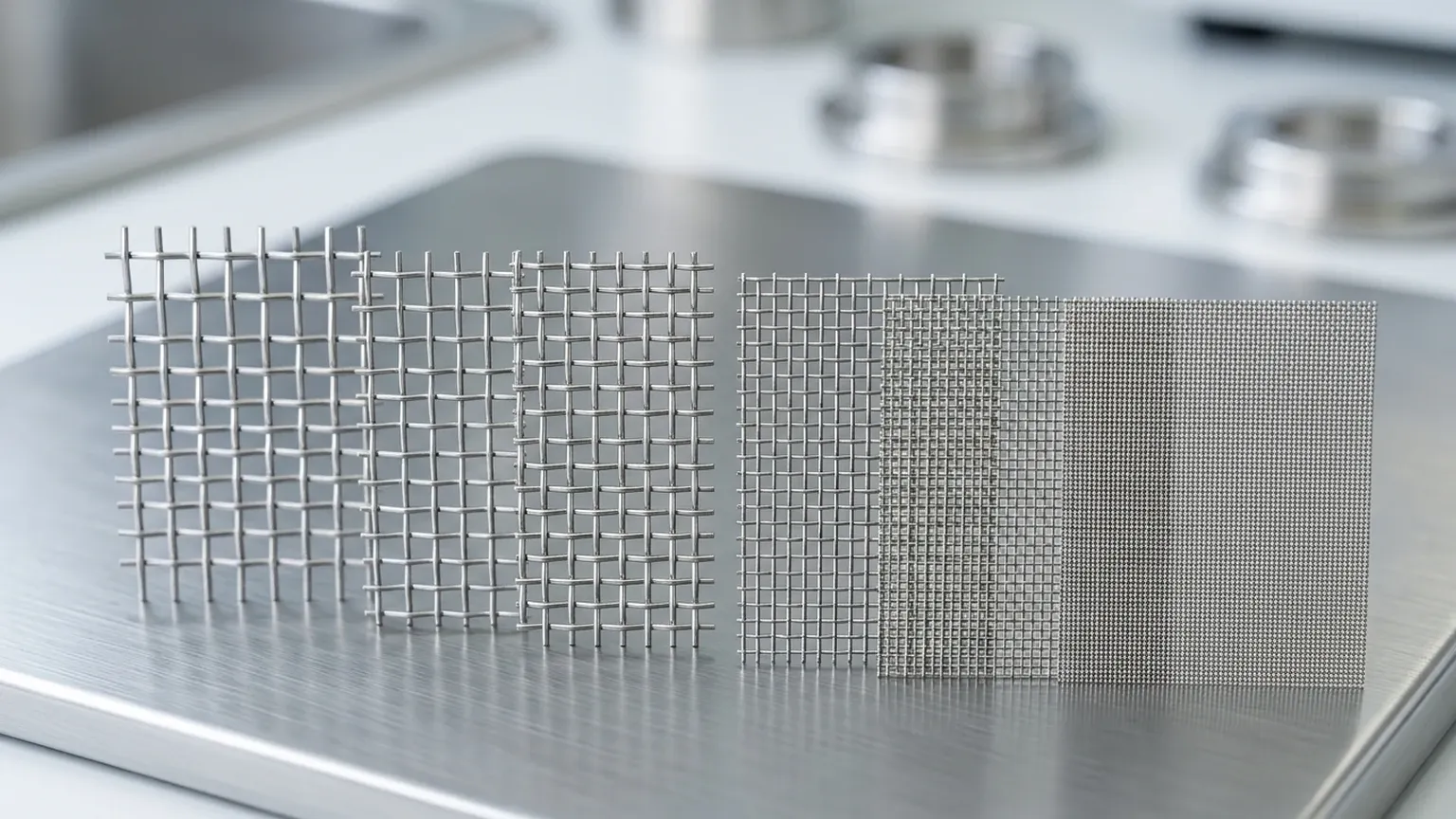
A standard woven wire mesh size chart serves as a technical bridge between theoretical filtration needs and manufacturing reality. When reviewing a chart, engineers should look for the following standard correlations for stainless steel 304 or 316L mesh:
| Mesh Count | Wire Diameter (mm) | Aperture (mm) | Aperture (Microns) | Open Area % |
| :— | :— | :— | :— | :— |
| 10 | 0.80 | 1.74 | 1740 | 46.9% |
| 20 | 0.40 | 0.87 | 870 | 46.9% |
| 40 | 0.25 | 0.385 | 385 | 36.8% |
| 60 | 0.19 | 0.233 | 233 | 30.3% |
| 80 | 0.13 | 0.188 | 188 | 34.9% |
| 100 | 0.10 | 0.154 | 154 | 36.8% |
| 200 | 0.05 | 0.077 | 77 | 36.8% |
| 400 | 0.03 | 0.033 | 33 | 27.5% |
*Note: These values are representative of standard commercial grades. Custom weaves can vary these ratios significantly to balance strength and throughput.*
For specialized applications, you may require Plain, twill and dutch woven wire mesh in SS304/316L — rolls, cut mesh and framed panels. Send mesh count or micron target for a technical quote. to ensure the specifications align with your specific pressure and flow requirements.
The Relationship Between Mesh Count, Aperture, and Micron Rating
One of the most common points of confusion in industrial procurement is the relationship between mesh count and microns. Because "mesh" is a count of openings and not a direct measurement of the opening itself, the micron rating can change depending on the wire diameter used.
Why Microns Matter More Than Mesh
In high-precision filtration, such as pharmaceutical or chemical processing, the micron rating is the authoritative metric. A "micron" (micrometer) is one-millionth of a meter. If an application requires the removal of 100-micron particles, a 150-mesh screen with a standard wire diameter might suffice. However, if the wire diameter is increased to improve the filter's lifespan, the aperture will shrink, effectively lowering the micron rating while keeping the mesh count the same.
Nominal vs. Absolute Micron Ratings
* Nominal Rating: Refers to the ability of the mesh to retain a majority of particles of a specified size. Woven wire mesh typically offers a very consistent nominal rating due to its geometric regularity.
* Absolute Rating: Refers to the diameter of the largest hard spherical particle that will pass through the mesh under specified test conditions. For square-weave mesh, the absolute rating is essentially the aperture size.
Impact of Weave Types on Size Chart Interpretation
The way wires are interlaced—the weave type—significantly alters how a size chart is read and how the mesh performs under pressure.
Plain Weave
This is the most common weave where each warp wire (running lengthwise) passes alternately over and under each weft wire (running crosswise). Plain weave provides the most straightforward relationship between mesh count and aperture. It is ideal for general-purpose screening and low-pressure filtration.
Twill Weave
In a twill weave, each warp wire passes over two and under two weft wires. This allows for the use of heavier wire diameters than a plain weave of the same mesh count would permit. Twill weave is often used for fine filtration where the mesh needs to withstand higher mechanical loads without deforming.
Dutch Weave (Plain and Twill)
Dutch weaves utilize different wire diameters for the warp and weft. Typically, the warp wires are heavier and spaced further apart, while the weft wires are thinner and driven closely together. This creates a "zero-aperture" appearance where the openings are not visible when looking straight through the mesh.
On a woven wire mesh size chart, Dutch weaves are listed with two numbers (e.g., 24 x 110). The first number is the warp count, and the second is the weft count. These meshes are valued for their high strength and precise micron ratings (down to 5 microns or less), making them the standard for hydraulic filters and high-pressure fuel filtration.
Engineering Considerations: Open Area and Flow Dynamics
When selecting a mesh from a size chart, engineers must balance filtration efficiency with flow dynamics. The percentage of open area is the primary indicator of how the mesh will affect system pressure.
Pressure Drop (ΔP)
A mesh with a low percentage of open area (due to thick wires) will cause a higher pressure drop across the filter. If the pressure drop is too high, it can lead to pump cavitation, reduced flow rates, or even the structural failure of the mesh element. In applications involving high-viscosity fluids, such as polymers or heavy oils, maximizing the open area while maintaining structural integrity is the primary design challenge.
Blinding and Clogging
Blinding occurs when particles that are near the size of the aperture become lodged in the openings, reducing the effective open area. A size chart can help engineers select a mesh that is slightly smaller or larger than the critical particle size to minimize this risk. Furthermore, the smooth surface of stainless steel woven wire mesh allows for easier backwashing and mechanical cleaning compared to felt or paper media.
Material Selection and Environmental Compatibility
The mechanical data in a woven wire mesh size chart must be paired with the correct material selection to ensure longevity in demanding industrial environments.
* Stainless Steel 304: The standard industrial grade. It offers excellent strength and good corrosion resistance for most water treatment and food-grade applications.
* Stainless Steel 316L: Contains molybdenum, which provides superior resistance to chlorides and pitting. This is the preferred choice for marine environments, chemical processing, and pharmaceutical manufacturing where aggressive cleaning agents are used.
* High-Temperature Alloys: For applications exceeding 400°C, such as catalyst recovery or hot gas filtration, specialized alloys like Inconel or Monel may be required, though these often follow different manufacturing tolerances than standard stainless steel.
Common Pitfalls in Mesh Selection and Specification
Despite the availability of technical charts, several common errors occur during the specification process:
1. Ignoring Wire Diameter: Ordering "100 mesh" without specifying wire diameter can result in receiving a product that is either too fragile for the application or has an aperture size that does not meet filtration requirements.
2. Over-specifying Filtration Fineness: Selecting a 5-micron mesh when a 40-micron mesh would suffice leads to unnecessary pressure drops and more frequent cleaning cycles, increasing the total cost of ownership.
3. Neglecting the Weave Type: Using a plain weave in a high-pressure hydraulic system where a Dutch weave is required can lead to mesh migration or "blowouts," where the wires shift and create larger-than-specified openings.
4. Assuming All Charts Are Equal: Different standards (ASTM E11 vs. ISO 9044) have slightly different tolerances for aperture and wire diameter. Always confirm which standard the manufacturer follows.
Procurement Checklist: What to Confirm Before Ordering
Before moving from the size chart to a purchase order, technical teams should confirm the following details with their supplier:
* Mesh Count and Wire Diameter: Ensure both are specified to lock in the aperture size and open area.
* Material Grade: Verify if 304, 316L, or a specialty alloy is required based on the chemical compatibility of the fluid.
* Dimensions and Form: Will the mesh be supplied in rolls, cut-to-size circles, or as part of a framed panel or pleated cartridge?
* Certification Requirements: Does the application require a certificate of conformance, material test reports (MTRs), or FDA compliance for food contact?
* Quantity and Lead Time: For custom weaves or non-standard wire diameters, lead times can vary significantly.
By understanding the technical nuances of the woven wire mesh size chart, engineers can optimize their filtration systems for performance, durability, and cost-effectiveness. Whether you are designing a new chemical reactor or replacing filters in a food processing line, the data within these charts is the foundation of a reliable filtration solution.
