


Woven Wire Mesh Specifications: A Technical Guide for Industrial Filtration
In industrial filtration and separation processes, the performance of a system is often dictated by the precision of its components. Woven wire mesh serves as a critical medium in applications ranging from chemical processing and pharmaceutical manufacturing to hydraulic systems and food production. However, selecting the correct mesh is not merely a matter of choosing a material; it requires a comprehensive understanding of woven wire mesh specifications and how they interact with fluid dynamics, mechanical stresses, and environmental conditions.
For engineers and procurement professionals, navigating these specifications is essential to ensure filtration efficiency, structural integrity, and cost-effectiveness. This guide examines the technical parameters that define woven wire mesh, the engineering considerations for material selection, and the performance variables that impact industrial operations.
Fundamental Parameters of Woven Wire Mesh Specifications
To specify a mesh accurately, one must define several interdependent variables. These parameters determine the mesh’s ability to retain particles while allowing fluid or gas to pass through with minimal resistance.
1. Mesh Count
The mesh count refers to the number of openings per linear inch (25.4 mm), measured from the center of one wire to the center of the next. A higher mesh count indicates a finer screen with smaller openings. For example, a 100-mesh screen has 100 openings per inch in both the warp (lengthwise) and weft (crosswise) directions. In high-precision industrial applications, the uniformity of this count is paramount to ensure consistent filtration across the entire surface area.
2. Wire Diameter
Wire diameter is the thickness of the individual wires before weaving. This specification directly influences the mechanical strength and the "open area" of the mesh. While thinner wires increase the open area and flow rate, they may reduce the mesh's resistance to high pressure or abrasive particles. Conversely, heavier wires provide greater durability and a longer service life in demanding environments but may increase the pressure drop across the filter.
3. Aperture (Opening Size)
The aperture is the clear distance between two adjacent parallel wires. This is perhaps the most critical specification for filtration, as it defines the size of the particles that will be retained. It is calculated by the formula:
Aperture = (1 / Mesh Count) – Wire Diameter
In many technical contexts, the aperture is expressed in microns (μm). When evaluating woven wire mesh specifications, engineers must distinguish between the nominal aperture (the average size) and the maximum aperture (the largest possible opening allowed by manufacturing tolerances).
4. Percentage of Open Area
The open area is the ratio of the total area of the openings to the total area of the mesh, expressed as a percentage. It determines the flow capacity and the rate of blinding (clogging). A higher open area results in a lower initial pressure drop and higher throughput. The formula for open area in a square mesh is:
Open Area % = (Aperture / (Aperture + Wire Diameter))² × 100
Material Selection and Chemical Compatibility
Industrial filtration often occurs in aggressive environments involving corrosive chemicals, extreme temperatures, or high-pressure cycles. Therefore, the material of the Woven Wire Mesh must be selected based on the specific chemical and thermal requirements of the application.
Stainless Steel 304 (SS304)
SS304 is the most common material used in industrial mesh due to its excellent balance of cost and performance. It offers good corrosion resistance to many chemicals and atmospheric conditions. It is widely used in food processing and general industrial filtration where extreme acidity or salinity is not present.
Stainless Steel 316L (SS316L)
For more demanding environments, SS316L is the industry standard. The addition of molybdenum provides enhanced resistance to pitting and crevice corrosion, particularly in chloride-rich environments (such as seawater or brine). The "L" denotes low carbon content, which improves weldability and prevents sensitization—a common cause of corrosion in the heat-affected zones of welded filter components.
Specialty Alloys
In specialized chemical processing or high-temperature aerospace applications, other alloys may be specified:
* 904L: High-nickel, high-molybdenum steel for severe sulfuric acid environments.
* Duplex Stainless Steels: Offering higher mechanical strength and resistance to stress corrosion cracking.
* Hastelloy and Inconel: Reserved for extreme temperatures and highly oxidizing or reducing environments where standard stainless steels would fail.
Analyzing Weave Patterns: From Plain to Dutch Weaves
The method by which the wires are interlaced—the weave pattern—significantly affects the flow characteristics, strength, and filtration accuracy of the mesh. Understanding these patterns is a core component of mastering woven wire mesh specifications.
Plain Weave
This is the most straightforward pattern, where each weft wire passes alternately over and under each warp wire. It is highly stable and produces precise, square openings. Plain weave is ideal for general-purpose filtration and sieving where high flow rates are required.
Twill Weave
In a twill weave, each weft wire passes alternately over and under two warp wires. This allows for the use of heavier wires in a given mesh count, providing greater strength and flexibility. Twill weaves are often used when the wire diameter is too large relative to the mesh count to allow for a plain weave.
Dutch Weave (Plain and Twill)
Dutch weaves utilize different wire diameters for the warp and weft directions. The warp wires are typically heavier and spaced further apart, while the weft wires are finer and woven tightly together. This creates a "tortuous path" for the fluid, allowing for very fine filtration (down to 5–10 microns) without sacrificing the structural integrity of the mesh.
* Plain Dutch Weave (PDW): Offers high mechanical strength and is easy to clean through backwashing.
* Twill Dutch Weave (TDW): Allows for the smallest apertures and highest filtration precision by layering multiple weft wires within the weave.
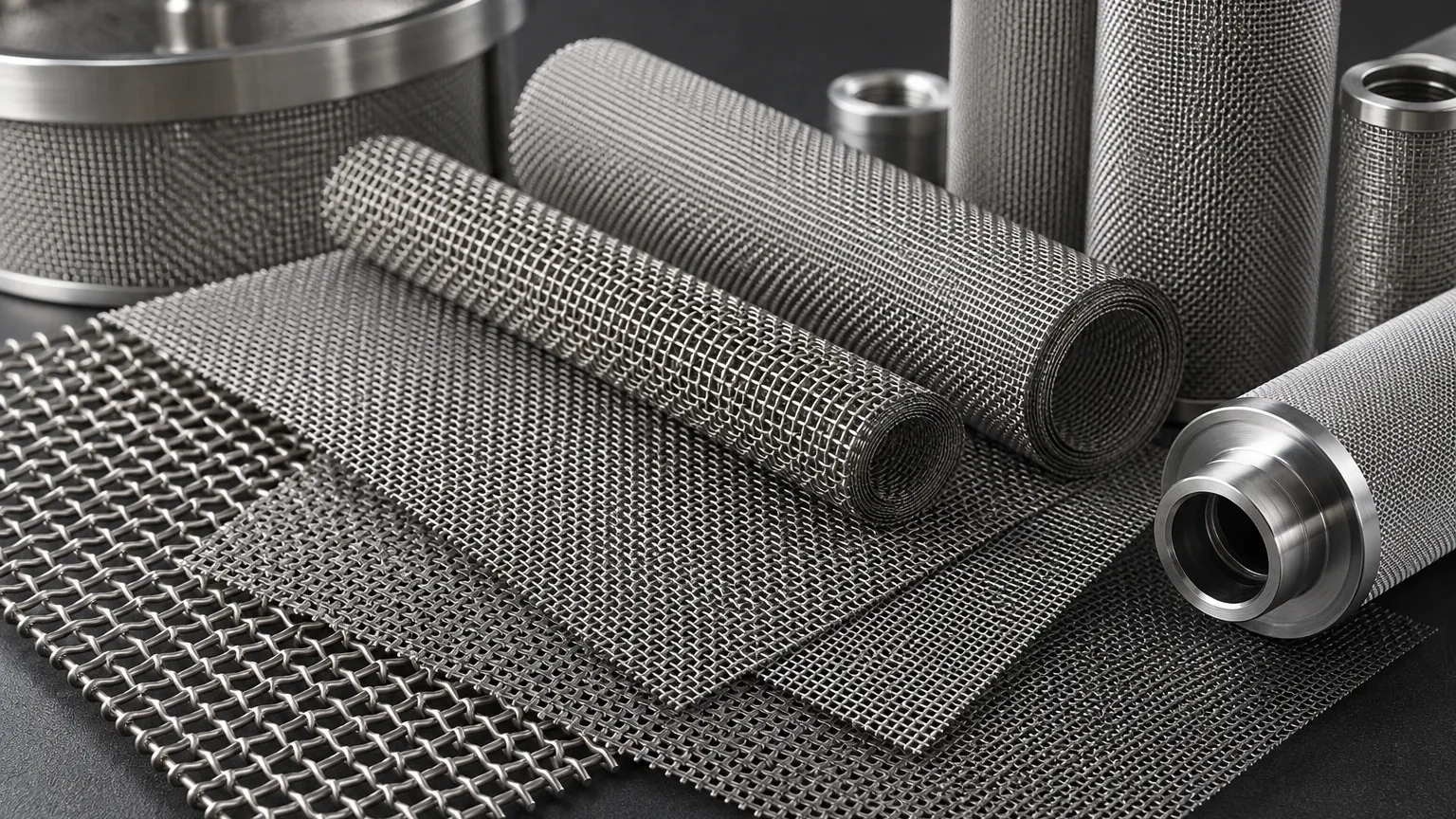
For those seeking specific configurations, Kaifil offers Plain, twill and dutch woven wire mesh in SS304/316L — rolls, cut mesh and framed panels. Send mesh count or micron target for a technical quote.
Calculating Performance: Open Area and Flow Dynamics
When designing a filtration system, the physical woven wire mesh specifications must be translated into performance metrics. Engineers must account for the relationship between the mesh structure and the fluid it processes.
Pressure Drop (ΔP)
The pressure drop is the difference in pressure between the upstream and downstream sides of the filter. It is influenced by the fluid's viscosity, velocity, and the mesh's open area. A mesh with a low open area will cause a higher pressure drop, which may require more powerful pumps and increase energy consumption. Over time, as the mesh captures particles, the effective open area decreases, and the pressure drop increases. Specifying a mesh with an optimized open area is crucial for extending the interval between cleaning or replacement cycles.
Dirt Holding Capacity
This refers to the amount of contaminant a filter can retain before the pressure drop reaches a critical limit. Dutch weaves typically offer higher dirt-holding capacity than plain weaves because their three-dimensional structure allows particles to be trapped within the depth of the mesh, rather than just on the surface.
Mechanical Strength and Stability
Under high-pressure flow, mesh can experience "migration" or shifting of the wires, which alters the aperture size and compromises filtration accuracy. To prevent this, engineers may specify sintered wire mesh (where multiple layers are fused together) or framed panels that provide additional support to the woven structure.
Quality Standards and Manufacturing Tolerances
In technical B2B procurement, the reliability of a supplier’s manufacturing process is as important as the material itself. Woven wire mesh is produced according to international standards such as ISO 9044 or ASTM E2011, which define the allowable tolerances for mesh count, wire diameter, and aperture size.
Wire Diameter Tolerance
Small variations in wire diameter can significantly impact the open area and aperture size, especially in fine meshes. High-quality manufacturers use precision-drawn wire with tight tolerances to ensure that the final product meets the engineering design requirements.
Weave Uniformity
Inconsistent tension during the weaving process can lead to "thick and thin" spots in the mesh. For pharmaceutical or high-purity chemical applications, this lack of uniformity can lead to bypass—where large particles pass through oversized openings. Rigorous quality control, including automated optical inspection, is necessary to verify that the mesh conforms to the specified micron rating across the entire roll.
Surface Finish and Cleaning
For food and beverage or pharmaceutical industries, the surface finish of the mesh is critical. Post-weaving processes such as ultrasonic cleaning, degreasing, or electropolishing may be required to remove residual lubricants and ensure the mesh is free from contaminants. Additionally, some applications require the mesh to be annealed to remove internal stresses, making it easier to form into filter cartridges or pleated elements.
Engineering Checklist for Custom Filter Procurement
Before finalizing woven wire mesh specifications for a project, engineers and purchasing teams should confirm several key factors to ensure the selected product is fit for purpose:
1. Operating Environment: What is the maximum temperature and pressure? Are there corrosive agents present (acids, alkalis, chlorides)?
2. Filtration Target: What is the specific micron rating required? Is the goal to remove all particles above a certain size (absolute filtration) or a percentage of them (nominal filtration)?
3. Flow Requirements: What is the required flow rate, and what is the maximum allowable initial pressure drop?
4. Mechanical Constraints: Will the mesh be pleated, welded, or formed into a cylinder? Does it require a support layer or a protective outer shroud?
5. Regulatory Compliance: Does the material need to meet FDA, USP Class VI, or other industry-specific certifications for food or medical contact?
By addressing these questions, technical teams can avoid common pitfalls such as premature filter failure, insufficient flow, or contamination issues. Working with an experienced manufacturer like Kaifil allows for the development of customized filtration solutions that balance these complex variables.
Conclusion
Precision in woven wire mesh specifications is the foundation of effective industrial filtration. From the initial selection of the alloy to the calculation of open area and the choice of weave pattern, every technical detail influences the efficiency and longevity of the filtration system. By focusing on technical accuracy and engineering principles, procurement professionals can ensure they receive components that meet the rigorous demands of modern industrial processes, ultimately reducing total cost of ownership and optimizing production performance.
