


Wire Cloth Filter Manufacturing: An Engineering Guide to Industrial Filtration Solutions
In industrial processing, the efficiency of a filtration system is often the determining factor in product purity, equipment longevity, and operational safety. Among the various technologies available, stainless steel wire cloth remains a cornerstone for demanding applications. The process of wire cloth filter manufacturing involves a sophisticated blend of metallurgical science, precision weaving, and advanced fabrication techniques to produce components capable of withstanding extreme pressures and corrosive environments.
For engineers and procurement professionals, understanding the nuances of how these filters are designed and manufactured is essential for selecting the right component. This guide explores the technical foundations of wire cloth filtration, the manufacturing processes involved, and the critical selection criteria for industrial applications.
1. The Principles of Wire Cloth Filtration
Wire cloth filters operate primarily through surface filtration. Unlike depth filters (such as sand or felt) that trap particles within a thick medium, wire mesh captures contaminants on the upstream surface of the screen. This mechanism allows for precise control over the size of particles removed, as the pore size is determined by the geometric spacing of the woven wires.
Nominal vs. Absolute Filtration
In the context of wire cloth filter manufacturing, two ratings are commonly discussed:
- Nominal Rating: An approximate value indicating the ability of the filter to retain the majority of particles of a specific size. It is often based on weight percentage.
- Absolute Rating: The diameter of the largest hard spherical particle that will pass through the filter under specified test conditions. For critical pharmaceutical or chemical processes, absolute ratings are typically required to ensure consistent results.
Because stainless steel wire mesh is rigid and non-deformable under standard operating pressures, it provides a more stable pore structure than synthetic or fiber-based media, ensuring that the filtration threshold remains constant throughout the service life of the filter.
2. Materials and Weave Patterns in Wire Cloth Filter Manufacturing
The performance of a filter is dictated by the alloy used and the configuration of the weave. In industrial settings, stainless steel is the standard due to its mechanical strength and resistance to oxidation.
Common Material Grades
- AISI 304: The most common grade, offering good corrosion resistance and affordability for water treatment and general industrial use.
- AISI 316L: Contains molybdenum, providing superior resistance to chlorides and acids. The "L" denotes low carbon, which improves weldability and prevents intergranular corrosion in the heat-affected zones of the filter.
- Specialty Alloys: For extreme environments, manufacturers may utilize Monel, Inconel, or Hastelloy to combat high temperatures or highly aggressive chemical reagents.
Weave Types and Their Applications
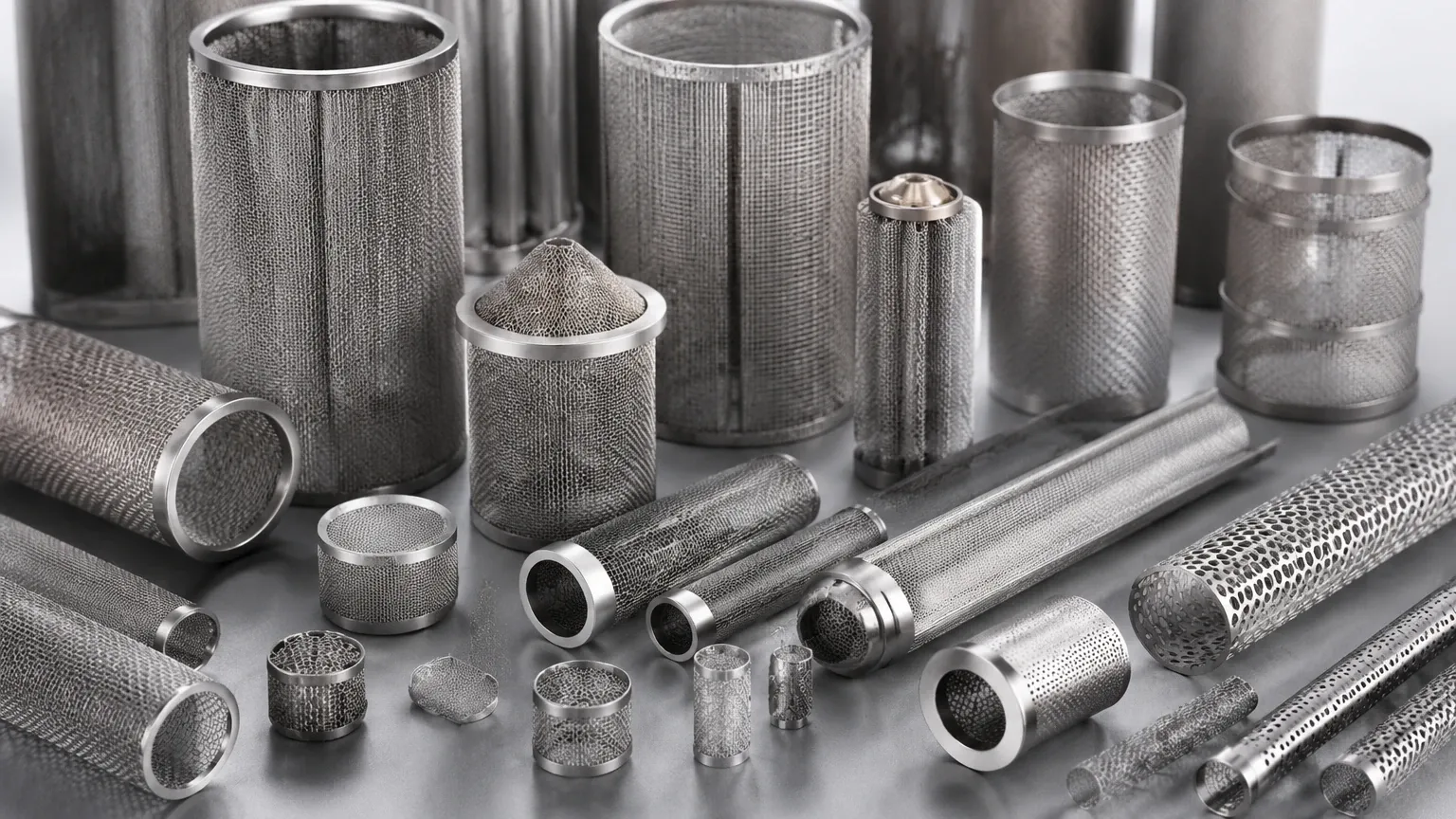
The geometry of the weave determines the flow capacity and the micron rating of the Wire Mesh Filter Cylinders & Tubes.
- Plain Weave: A simple over-and-under pattern. It offers the highest flow rates but is generally limited to coarser filtration (above 50 microns).
- Twill Weave: Each shute wire passes over and under two warp wires. This allows for heavier wire diameters in a given mesh count, increasing the strength of the filter.
- Dutch Weave (Plain and Twill): These weaves use different wire diameters for the warp and shute, resulting in a dense, "zero-aperture" mesh. Dutch weaves are essential for fine filtration, reaching down to 5-10 microns, and offer high mechanical stability.
3. The Manufacturing Process: From Mesh to Component
Converting raw wire cloth into a finished industrial filter requires several precise fabrication steps. Quality control at each stage is vital to prevent bypass—where unfiltered fluid escapes through gaps or weak welds.
Slitting and Cutting
The process begins with slitting the woven mesh rolls into specific widths. Precision is required here to ensure that the edges are clean and that the mesh count remains consistent across the entire surface area.
Forming and Seaming
To create Wire Mesh Filter Cylinders & Tubes, the flat mesh is rolled around a mandrel. The longitudinal seam is the most critical point of the structure. In high-quality wire cloth filter manufacturing, this seam is typically joined using:
- Plasma Welding: Provides a clean, narrow weld bead with minimal thermal distortion.
- TIG (Tungsten Inert Gas) Welding: Offers high-strength bonds suitable for high-pressure applications.
- Resistance Welding: Often used for spot-welding mesh to support frames or end caps.
Multi-Layer Sintering (Optional)
For applications involving high differential pressures, multiple layers of wire cloth may be sintered together. Sintering bonds the contact points of the wires through heat and pressure without melting them, creating a porous, rigid plate that combines fine filtration layers with coarse, protective support layers.
4. Engineering Considerations for Filter Design
When specifying filters for industrial systems, engineers must look beyond the micron rating. The structural integrity of the filter must match the hydraulic conditions of the system.
Support Structures
Fine wire mesh lacks the structural rigidity to withstand high pressure drops on its own. Therefore, wire cloth filters are often integrated with:
- Internal Support Cores: Usually made of perforated stainless steel or heavy-duty expanded metal to prevent the mesh from collapsing inward under flow.
- Outer Cages: Protect the delicate mesh from mechanical damage during installation or backwashing.
Pleating for Surface Area
In systems where space is limited but high flow rates are required, the wire cloth can be pleated. Pleating significantly increases the effective filtration area within the same cylindrical footprint, which lowers the flux (flow per unit area) and extends the time between cleaning cycles.
End Fittings and Sealing
The method by which the filter connects to the housing is a common failure point. Options include threaded fittings, NPT/BSP connections, or flange mounts. Proper sealing—using O-rings or gaskets made of Viton, EPDM, or PTFE—is necessary to prevent bypass at the interface between the filter and the housing.
5. Performance Evaluation and Selection Criteria
Selecting the optimal filter requires a balance between filtration efficiency and operational costs. Before finalizing a design in wire cloth filter manufacturing, the following parameters must be evaluated:
1. Viscosity of the Medium: High-viscosity fluids (like resins or heavy oils) require larger surface areas and coarser mesh to maintain acceptable flow rates.
2. Operating Temperature: Stainless steel can handle high temperatures, but the expansion coefficients of the filter and the housing must be considered to maintain a seal.
3. Pressure Drop (Delta P): The difference in pressure between the inlet and outlet. A high initial Delta P indicates that the filter is either too fine for the application or the surface area is insufficient.
4. Contaminant Loading: The nature of the particles (slimy, abrasive, or crystalline) affects how quickly the filter will blind (clog).
6. Maintenance, Cleaning, and Reusability
One of the primary advantages of stainless steel wire cloth filters over disposable cartridges is their cleanability. In many B2B industrial environments, the total cost of ownership (TCO) is significantly lower for permanent metal filters despite the higher initial investment.
Cleaning Methods
- Backwashing/Backpulsing: Reversing the flow of the fluid to dislodge particles from the surface of the mesh. This is often automated in continuous process plants.
- Ultrasonic Cleaning: Utilizing high-frequency sound waves in a solvent bath to remove fine particles trapped within the weave of Dutch weave meshes.
- Chemical Cleaning: Using acids or alkalis to dissolve organic or mineral scale, provided the chemical is compatible with the stainless steel grade.
Replacement Cycles
While wire cloth filters are durable, they are not infinite. Fatigue from pressure cycling or erosion from abrasive particles will eventually degrade the mesh. Regular inspection for "pinholes" or seam separation is necessary to ensure the integrity of the process.
7. Procurement Checklist for International Buyers
To ensure a successful partnership with a manufacturer, technical buyers should provide a comprehensive data sheet when requesting a quote for Wire Mesh Filter Cylinders & Tubes. Essential information includes:
- Dimensions: Outer diameter (OD), inner diameter (ID), and overall length.
- Micron Rating: Specify whether this is nominal or absolute.
- Material Grade: e.g., SS304, SS316L.
- End Cap Configuration: e.g., Double Open End (DOE), Single Open End (SOE) with specific code (Code 7, 222, 226).
- Operating Conditions: Normal and maximum operating pressure, temperature, and flow rate.
- Fluid Characteristics: Chemical composition and viscosity.
Conclusion
Wire cloth filter manufacturing is a specialized field that bridges the gap between raw material science and precision mechanical engineering. By selecting the appropriate weave, material, and structural reinforcements, industrial facilities can achieve highly efficient and repeatable filtration results. Whether used in hydraulic systems, chemical reactors, or food processing lines, stainless steel wire mesh filters provide a robust, cleanable, and cost-effective solution for modern industrial challenges.
