


Engineering Guide to Metal Wire Mesh Filter Solutions for Industrial Applications
In industrial process engineering, the selection of filtration media is a critical decision that impacts system efficiency, product purity, and long-term operational costs. Among the various options available, the metal wire mesh filter stands out as a robust, versatile, and reusable solution designed to withstand conditions that would cause polymer-based filters to fail. Specifically, Wire Mesh Filter Cylinders & Tubes are widely utilized across the chemical, pharmaceutical, and food and beverage industries due to their structural integrity and precise filtration capabilities.
This guide provides a technical overview of the engineering principles, material considerations, and selection criteria essential for engineers and purchasing teams when integrating stainless steel filtration components into their systems.
1. Fundamentals of Metal Wire Mesh Filtration
A metal wire mesh filter operates primarily through mechanical sieving. Unlike depth filters that trap particles within a thick matrix of fibers, wire mesh provides surface filtration. This means particles larger than the pore size of the mesh are retained on the upstream surface, while the fluid passes through.
Surface Filtration vs. Depth Filtration
The primary advantage of surface filtration in an industrial context is the ease of cleaning. Because the contaminants are not embedded deep within the media, they can be removed through backwashing, ultrasonic cleaning, or chemical soaking. This reusability significantly reduces the total cost of ownership compared to disposable cartridges.
Weave Types and Their Impact
The performance of a metal wire mesh filter is largely determined by its weave pattern. Common weaves include:
- Plain Weave: The simplest pattern where wires cross over and under each other. It offers high flow rates and is ideal for coarse filtration.
- Twill Weave: Each shute wire passes over and under two warp wires. This allows for heavier wire diameters in a given mesh count, increasing strength.
- Dutch Weave: This weave utilizes a higher density of finer wires in one direction, creating a "tortuous path" that allows for much finer filtration ratings (down to 5-10 microns) while maintaining high mechanical strength.
2. Structural Design: Wire Mesh Filter Cylinders & Tubes
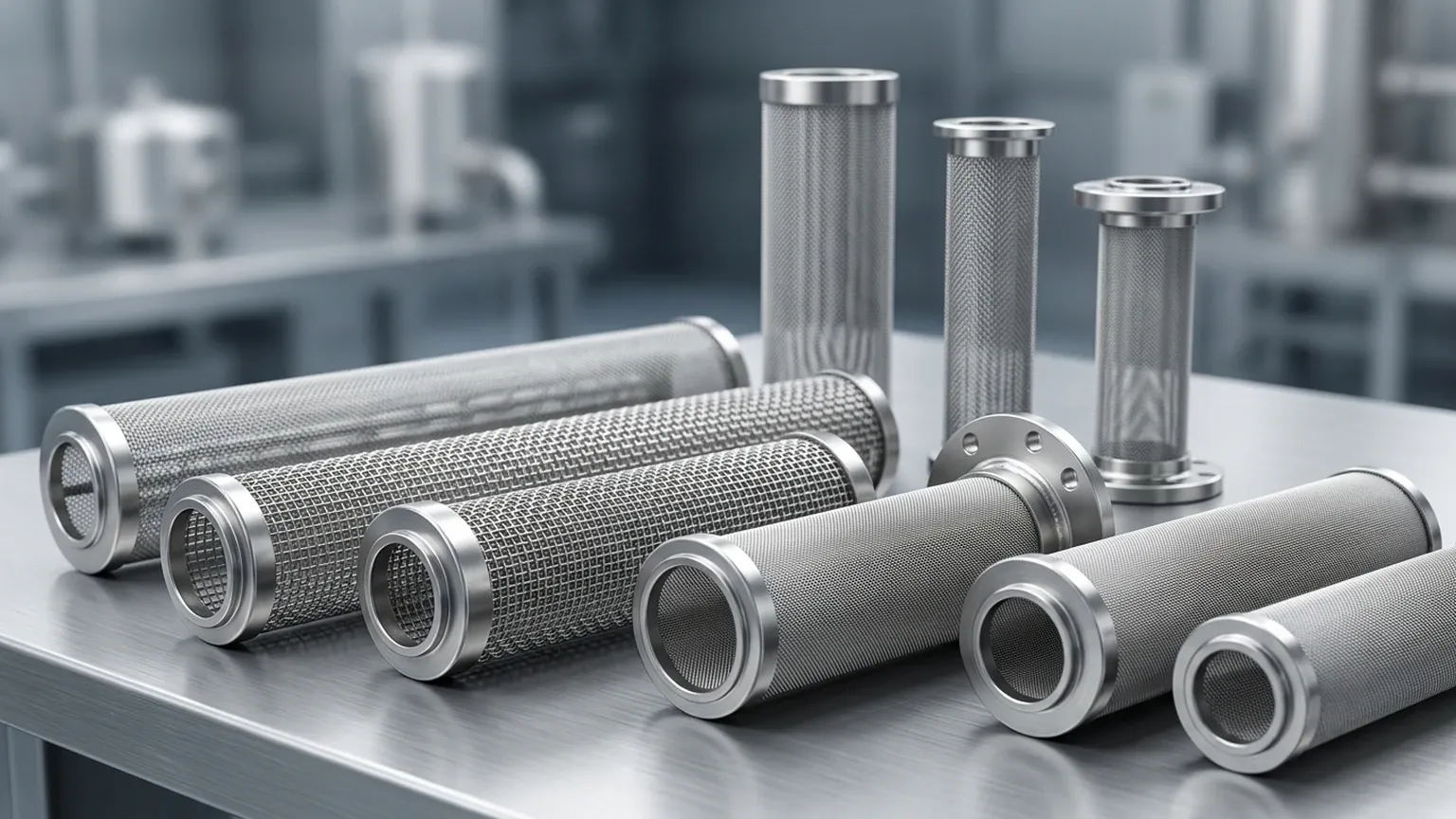
The cylindrical geometry is the most common form for industrial metal filters. This shape provides an optimal balance between surface area and structural rigidity. When designing or specifying Wire Mesh Filter Cylinders & Tubes, several structural elements must be considered:
Single-Layer vs. Multi-Layer Construction
Single-layer cylinders are suitable for low-pressure applications where the primary goal is coarse straining. However, for high-pressure hydraulic systems or fine chemical processing, multi-layer constructions are preferred. These often include:
1. Filtration Layer: The fine mesh that determines the micron rating.
2. Support Layers: Coarser mesh layers on either side of the filtration layer to prevent deformation under pressure.
3. Protective Layer: An outermost layer that protects the delicate filtration mesh from mechanical damage during handling and installation.
Sintered Mesh Options
For the most demanding environments, engineers often specify sintered wire mesh. Sintering is a process where multiple layers of mesh are bonded together using heat and pressure without the use of binders. This creates a monolithic structure that is incredibly strong, maintains a fixed pore size even under high pressure, and eliminates the risk of wire migration.
3. Material Selection and Chemical Compatibility
Kaifil specializes in custom stainless steel solutions because the material choice is the first line of defense against corrosion and thermal degradation. The most common materials used in a metal wire mesh filter include:
- AISI 304: The standard grade for general industrial use. It offers good corrosion resistance and is cost-effective for water treatment and food processing.
- AISI 316L: Contains molybdenum, which provides superior resistance to chlorides and acids. This is the industry standard for pharmaceutical and marine applications.
- 904L and Hastelloy: Used in extreme chemical environments where standard stainless steel would succumb to pitting or stress corrosion cracking.
Temperature Constraints
One of the primary reasons engineers move away from polymer filters is temperature. A stainless steel metal wire mesh filter can typically operate in environments ranging from cryogenic temperatures up to 500°C (932°F), depending on the alloy and seal materials used. This makes them indispensable for steam filtration and high-temperature polymer melt processes.
4. Key Performance Metrics for Engineers
When evaluating Wire Mesh Filter Cylinders & Tubes, technical professionals must focus on three primary metrics: filtration accuracy, pressure drop, and dirt-holding capacity.
Filtration Accuracy (Micron Rating)
It is vital to distinguish between nominal and absolute micron ratings. A nominal rating refers to the filter's ability to retain a percentage of particles of a certain size. An absolute rating, common in high-precision stainless steel mesh, indicates the largest opening in the mesh, ensuring that no particle larger than that size can pass through.
Pressure Drop (ΔP)
The differential pressure across the filter is a function of the fluid viscosity, flow rate, and the open area of the mesh. A well-designed metal wire mesh filter minimizes initial pressure drop to reduce energy consumption in pumping systems. Engineers should request flow-versus-pressure-drop curves during the specification phase.
Dirt-Holding Capacity
While surface filters generally have lower dirt-holding capacity than depth filters, this can be mitigated through pleating. Pleated Wire Mesh Filter Cylinders & Tubes significantly increase the available surface area within the same footprint, extending the time between cleaning cycles.
5. Customization and OEM Considerations
Industrial systems rarely follow a one-size-fits-all approach. Customization is often required to integrate a filter into existing piping or specialized machinery. When working with a manufacturer like Kaifil, engineers should be prepared to define the following parameters:
- End Cap Configurations: Options include DOE (Double Open End), SOE (Single Open End) with various O-ring fittings (e.g., 222, 226), or threaded NPT/BSP connections.
- Internal Support Cores: For high-collapse pressure requirements, a perforated metal core is often inserted inside the mesh tube to provide additional radial strength.
- Overall Dimensions: Precise length and diameter tolerances are critical for ensuring a bypass-free seal within the filter housing.
6. Maintenance, Cleaning, and Replacement Cycles
The longevity of a metal wire mesh filter is one of its strongest selling points. However, improper maintenance can lead to permanent fouling or mechanical failure.
Cleaning Protocols
1. Backwashing: Reversing the flow of the fluid to dislodge particles. This is often automated in continuous process systems.
2. Ultrasonic Cleaning: Using high-frequency sound waves in a cleaning solvent to remove fine particles from deep within the mesh pores. This is the most effective method for Dutch weave and sintered filters.
3. Chemical Cleaning: Using acids or alkalis to dissolve organic or inorganic deposits. Material compatibility must be verified before selecting a cleaning agent.
Determining Replacement
While stainless steel filters are durable, they are not infinite. Replacement should be considered if:
- The baseline pressure drop after cleaning remains significantly higher than the original "clean" pressure drop (indicating permanent fouling).
- There is visible mechanical damage, such as pleat deformation or mesh tearing.
- The filter fails a bubble point test, indicating that the absolute micron rating has been compromised.
7. Purchasing Checklist for Technical Buyers
Before finalizing an order for Wire Mesh Filter Cylinders & Tubes, international buyers and engineers should confirm the following data points with the manufacturer:
1. Operating Conditions: Maximum operating pressure, temperature, and expected differential pressure.
2. Fluid Characteristics: Chemical composition, viscosity, and the nature of the contaminants (e.g., deformable vs. hard particles).
3. Certification Requirements: Does the application require FDA compliance for food contact, or 3.1 material certificates for traceability in pharmaceutical or oil and gas sectors?
4. Seal Compatibility: Ensure that O-rings (Viton, EPDM, PTFE) are compatible with the process fluid.
Conclusion
The metal wire mesh filter is an essential component in modern industrial engineering, providing a level of durability and precision that synthetic media cannot match. By understanding the nuances of weave types, material grades, and structural designs of Wire Mesh Filter Cylinders & Tubes, technical teams can optimize their filtration processes for maximum uptime and efficiency.
Kaifil continues to support global industries by providing high-performance, customized filtration solutions that meet the rigorous demands of chemical processing, hydraulics, and beyond. Whether you are designing a new system or looking to optimize an existing one, focusing on these technical boundaries ensures a reliable and cost-effective filtration outcome.
