


What Size Cartridge Filter for 12000 Gallon Pool
Selecting the correct filtration system for a 12,000-gallon pool requires more than a simple volume-to-surface-area calculation. From an engineering perspective, sizing a cartridge filter involves understanding fluid dynamics, turnover rates, and the specific flux rates of the filter media. While residential standards provide a baseline, industrial water treatment principles—often involving high-performance components like Filter Discs & Packs—offer a more robust framework for ensuring water clarity and system longevity.
In this guide, we analyze the technical requirements for a 12,000-gallon system, focusing on flow velocity, pressure drop, and the material science behind effective filtration.
The Fundamentals of Turnover and Flow Rate
The primary metric for sizing any filtration system is the turnover rate. For a 12,000-gallon pool, the goal is typically to circulate the entire volume of water through the filter at least once every 8 to 10 hours. In commercial or high-load environments, this turnover rate may need to be increased to once every 6 hours.
Calculating Gallons Per Minute (GPM)
To determine the required flow rate for a 12,000-gallon pool with an 8-hour turnover, use the following calculation:
1. Total Volume: 12,000 Gallons
2. Turnover Time in Minutes: 8 hours × 60 minutes = 480 minutes
3. Required Flow Rate: 12,000 / 480 = 25 GPM
While a flow rate of 25 GPM is technically sufficient to meet the turnover requirement, engineers must account for "head loss" or resistance within the plumbing system. Pumps and filters are rarely 100% efficient due to friction in the pipes, elbows, and the filter media itself. Therefore, a system designed for a 12,000-gallon pool should ideally be capable of handling 35 to 50 GPM to maintain performance as the filter accumulates debris.
Determining Filter Surface Area (Square Footage)
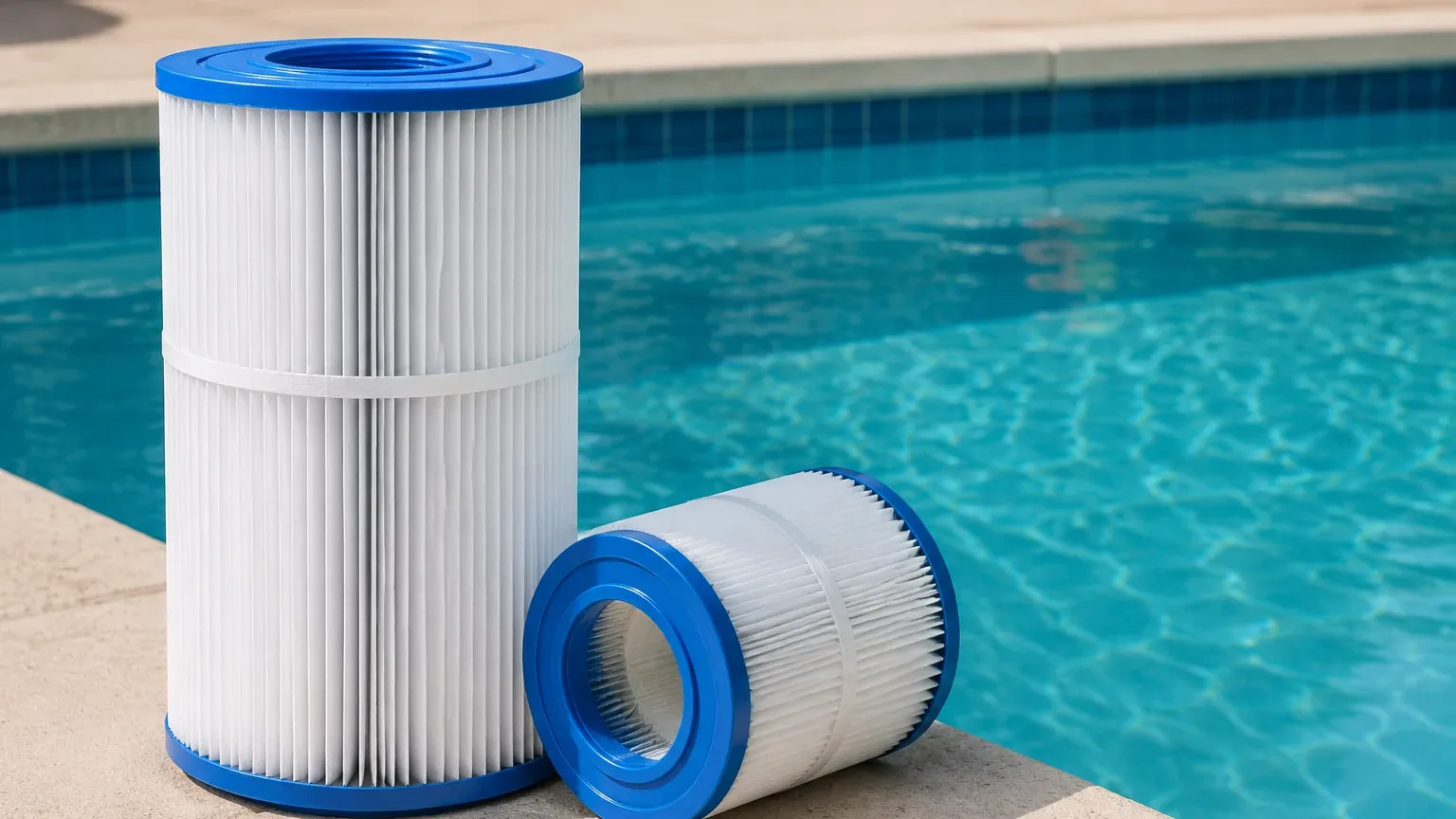
Cartridge filters are rated by their effective filtration area, measured in square feet. The relationship between the surface area and the flow rate is known as the "flux rate." For cartridge filters, a lower flux rate (GPM per square foot) generally leads to better filtration and longer intervals between cleanings.
Recommended Sizing for 12,000 Gallons
For a standard residential 12,000-gallon pool, the following sizes are common:
* Minimum Size: 100 Square Feet. This is the absolute baseline. While it can handle the flow, it will require frequent cleaning and may experience higher pressure drops.
* Optimal Size: 150 to 200 Square Feet. This range provides a balanced flux rate, ensuring that the velocity of water passing through the media does not force fine particulates through the pores.
* Commercial/Heavy Load: 250+ Square Feet. In environments with high bather loads or heavy organic debris, over-sizing the filter reduces the maintenance burden and extends the life of the cartridge.
By increasing the surface area, you reduce the velocity of the water at the point of filtration. This is a critical engineering consideration: high-velocity filtration can lead to "bridging" or the bypass of contaminants, whereas low-velocity filtration allows the media to capture finer particles more effectively.
Engineering Considerations: Pressure Drop and ΔP
In industrial filtration, the pressure differential (ΔP) is the most important indicator of filter health. As a cartridge filter captures debris, the resistance to flow increases, causing the pressure on the inlet side to rise relative to the outlet side.
When asking what size cartridge filter for 12000 gallon pool, one must consider the "clean" starting pressure. A properly sized filter should show a clean start pressure of 8 to 12 PSI. Once the pressure increases by 8 to 10 PSI over the clean starting point, the filter is considered fouled and requires cleaning or replacement.
Using precision components, such as multi-layer Filter Discs & Packs, in specialized water treatment applications allows for more predictable pressure drop curves. In industrial-grade systems, stainless steel wire mesh is often preferred over traditional polyester cartridges because it can withstand higher differential pressures without collapsing or deforming.
Material Science in Filtration Media
Most standard pool cartridge filters utilize spun-bond polyester. While effective for basic debris, this material has limitations regarding chemical resistance and temperature stability. In more demanding water treatment scenarios—such as heated pools, salt-water systems, or industrial process water—the material of the filter becomes paramount.
Synthetic vs. Metal Mesh
* Polyester Cartridges: Cost-effective and capable of filtering down to 10–20 microns. However, they degrade over time when exposed to high chlorine levels or acidic conditions.
* Stainless Steel Wire Mesh: Often utilized in the form of filter discs or custom cartridges, stainless steel offers superior durability. It is cleanable, reusable, and maintains precise pore sizes even under high pressure. For specialized 12,000-gallon systems where longevity and precision are required, metal filtration components provide a significantly lower total cost of ownership over several years.
The Importance of Micron Ratings
Micron rating refers to the size of the particles the filter can successfully trap. A standard cartridge filter for a 12,000-gallon pool typically offers a nominal rating of 15 to 25 microns. To put this in perspective, a human hair is approximately 70 microns in diameter.
If the application requires the removal of finer silt or bacteria, engineers may specify a "depth" filter or a multi-stage system using Filter Discs & Packs. By layering different mesh counts, these packs can achieve graduated filtration, where larger particles are trapped on the outer layers and finer particles are captured deeper within the media. This prevents the surface from blinding (clogging) too quickly, which is a common failure point in undersized pool filters.
Common Risks of Undersizing Filters
Choosing a filter that is too small for a 12,000-gallon volume leads to several operational failures:
1. Shortened Pump Life: An undersized or clogged filter increases backpressure, forcing the pump motor to work harder and run hotter, leading to premature mechanical failure.
2. Poor Water Quality: High flow velocity through a small surface area can cause "channeling," where water finds a path of least resistance and bypasses the filtration media entirely.
3. Frequent Maintenance: A 100 sq. ft. filter on a 12,000-gallon pool may require cleaning every 2–4 weeks, whereas a 200 sq. ft. filter might only need attention every 3–6 months.
4. Chemical Imbalance: Inefficient filtration leaves organic matter in the water, which consumes chlorine and other sanitizers more rapidly, increasing chemical costs.
Custom Filtration Solutions for Demanding Applications
While standard off-the-shelf cartridges suffice for many, certain 12,000-gallon systems—such as those used in laboratory water loops, specialized aquatic exhibits, or industrial cooling—require customized filtration components.
At Kaifil, we specialize in manufacturing high-precision stainless steel filtration products designed to meet specific engineering tolerances. Our Filter Discs & Packs are engineered for applications where standard plastic housing and polyester media are insufficient. By utilizing advanced welding and assembly techniques, we provide filtration components that offer:
* High Temperature Resistance: Ideal for industrial heat exchange systems.
* Corrosion Resistance: Essential for saline environments or aggressive chemical processing.
* Structural Integrity: Capable of withstanding high-pressure surges that would burst a standard pool cartridge.
Final Recommendations for Sizing
When determining what size cartridge filter for 12000 gallon pool, the most technically sound approach is to oversize the surface area whenever possible.
For a 12,000-gallon capacity:
* Residential Standard: 150 sq. ft. cartridge.
* High-Efficiency/Low Maintenance: 200 sq. ft. cartridge.
* Industrial/Precision Requirement: Consult with a filtration engineer to determine if a custom stainless steel mesh solution or a multi-stage filter pack is necessary to meet specific water quality standards.
By prioritizing a lower flux rate and selecting high-quality media, you ensure a filtration system that is not only effective at removing contaminants but also durable enough to withstand the rigors of continuous operation. For technical teams and purchasing managers looking to optimize their filtration processes, understanding these engineering boundaries is the first step toward achieving long-term operational efficiency.
Download What Size Cartridge Filter for 12000 Gallon Pool as a PDF
