


Engineering Guide to Wedge Wire Screen Filter Nozzle Selection and Application
In industrial liquid-solid separation, the efficiency of a treatment system often depends on the smallest components within the vessel. The wedge wire screen filter nozzle is a critical engineered component used primarily in underdrain systems for water treatment, ion exchange, and various chemical processes. These nozzles serve two primary functions: retaining the filter media (such as sand, gravel, or ion-exchange resin) and ensuring the uniform distribution of flow during both the service and backwash cycles.
For engineers and procurement professionals, selecting the correct nozzle design is not merely a matter of sizing a thread. It requires a deep understanding of hydraulic flow rates, material compatibility, and mechanical stress limits. This guide examines the technical specifications, engineering considerations, and selection criteria necessary for optimizing industrial filtration performance.
The Engineering Principle of Wedge Wire Technology
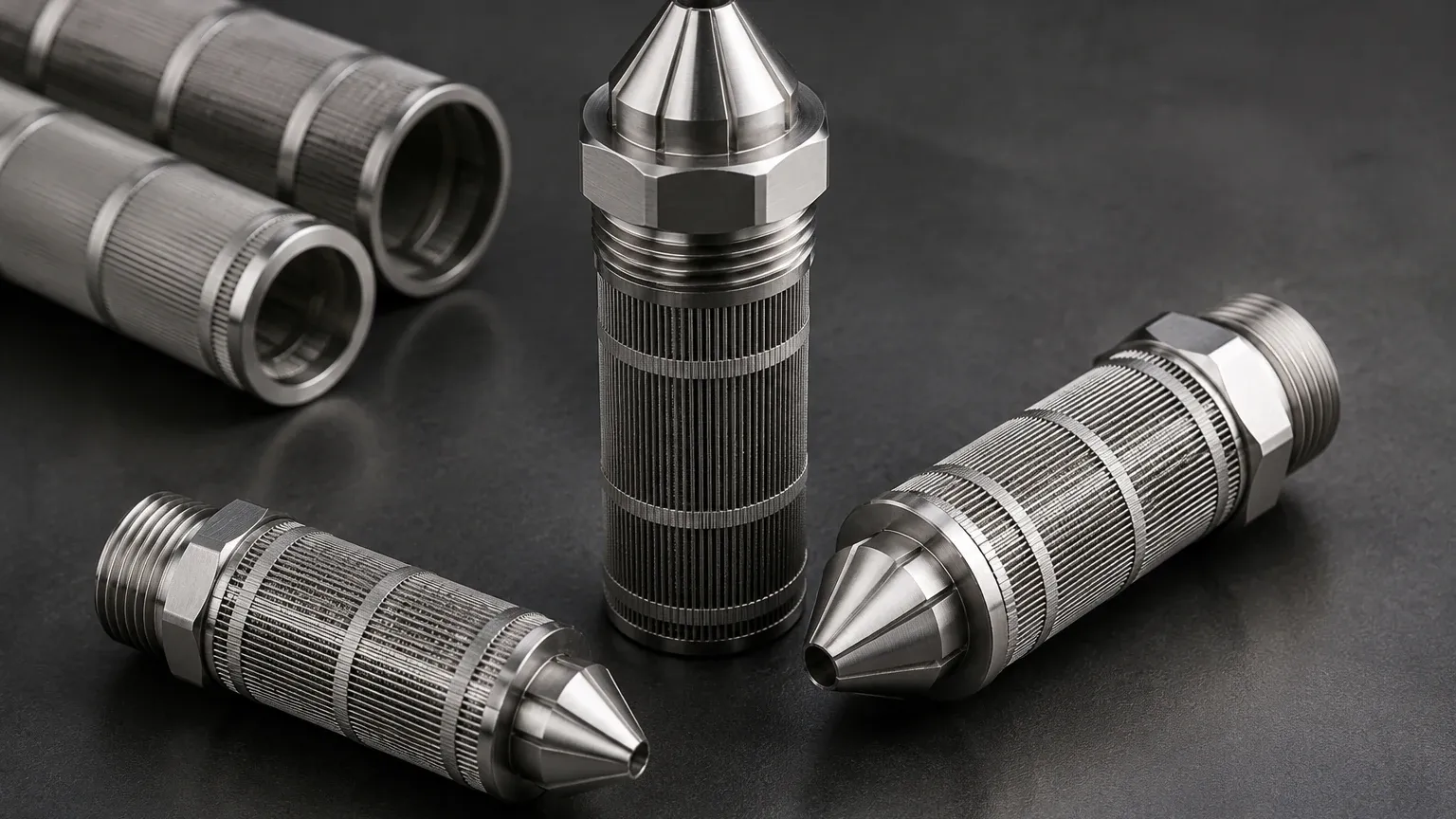
The core of a wedge wire screen filter nozzle is the V-shaped profile wire. Unlike standard perforated pipe or woven mesh, wedge wire is manufactured by wrapping a continuous cold-rolled wire around a circular array of longitudinal support rods. Every intersection is resistance-welded to create a robust, single-piece structure.
Non-Clogging Geometry
The "V" profile creates a slot that widens inwardly. This geometry is essential for industrial applications because it provides a two-point contact for any particles. If a particle manages to pass through the narrowest part of the slot (the exterior), it will fall freely into the wider internal area without becoming wedged. This "self-cleaning" characteristic significantly reduces the risk of blinding compared to traditional mesh filters.
High Open Area and Low Pressure Drop
By adjusting the width of the profile wire and the spacing of the slots, manufacturers can achieve a high percentage of open area. In industrial filtration, a higher open area translates to lower velocity through the slots, which minimizes pressure drop (ΔP) and reduces the energy required for pumping. For high-flow applications where energy efficiency is a priority, the precision of the wedge wire slot is superior to many alternative media retention methods.
Anatomy of an Industrial Filter Nozzle
A standard industrial nozzle consists of several key components, each of which must be specified based on the vessel's internal environment and the mechanical loads expected during operation.
1. The Filter Head: This is the active screening portion of the nozzle. It contains the wedge wire slots. Heads can be single-sided, double-sided, or even multi-stage depending on the required flow rate and the depth of the media bed.
2. The Stem (Tailpipe): The stem connects the filter head to the nozzle plate (underdrain). Stems come in various lengths. Long-stem nozzles are often used in air-scour systems, where a cushion of air is maintained beneath the plate to ensure even distribution during the air-washing phase of a cleaning cycle.
3. The Fitting/Thread: Standard connections include NPT, BSP, or Metric threads. In some specialized applications, quick-connect or flange-style fittings are used to speed up installation and replacement.
4. Sealing Components: Gaskets and nuts are used to secure the nozzle to the plate. These must be made of materials that are chemically compatible with the process fluid, such as EPDM, PTFE, or Viton.
Material Selection for Demanding Environments
Material choice is perhaps the most critical factor in determining the lifespan of a wedge wire screen filter nozzle. While stainless steel is the standard, the specific grade must be matched to the chemical profile of the fluid.
* Grade 304/304L: Suitable for general water treatment and applications with low chloride levels. It offers good mechanical strength and cost-effectiveness.
* Grade 316L: The industry standard for pharmaceutical, food and beverage, and chemical processing. The addition of molybdenum provides superior resistance to pitting and crevice corrosion in chloride-rich environments.
* Duplex and Super Duplex: In highly aggressive environments, such as seawater desalination or concentrated brine handling, Duplex steels (e.g., 2205) provide much higher yield strength and exceptional corrosion resistance.
* Specialty Alloys: For extreme temperatures or highly acidic/alkaline fluids, alloys like Hastelloy or Monel may be required to prevent premature structural failure.
Hydraulic Performance and Slot Sizing
When specifying a nozzle, engineers must balance the slot width against the particle size of the media being retained. A common engineering rule of thumb is that the slot width should be approximately 50% of the smallest grain size of the media. For example, if a system uses an ion-exchange resin with a minimum bead size of 0.4 mm, the nozzle slot should be no larger than 0.2 mm.
Calculating Flow Capacity
The flow capacity of a nozzle is a function of the total open area and the permissible velocity. If the velocity through the slot is too high, it can lead to:
* Media Abrasion: High-velocity fluid can cause resin beads or sand grains to rub against each other, leading to degradation and the creation of "fines."
* Increased Pressure Drop: This forces the system to work harder and can lead to the collapse of the nozzle if the differential pressure exceeds the design limits.
In most underdrain designs, the total number of nozzles is calculated to ensure that the total flow is distributed evenly across the entire surface area of the plate, preventing "channeling" where fluid bypasses parts of the media bed.
Installation and Layout Design
The physical arrangement of nozzles on the underdrain plate is as important as the nozzle design itself. There are two primary layout patterns used in industrial vessels:
1. Square Pitch: Nozzles are arranged in a grid. This is easier to layout but can leave slightly larger "dead zones" between the nozzles where media is not effectively reached by the backwash flow.
2. Triangular (Staggered) Pitch: This allows for a higher density of nozzles (typically 30 to 60 nozzles per square meter). It provides more uniform flow distribution and is generally preferred for high-performance ion exchange units.
Sealing and Mechanical Integrity
During installation, it is vital to ensure that the nozzle plate is perfectly level and that each nozzle is torqued correctly. A single loose nozzle can allow media to bypass the filter, potentially contaminating downstream equipment or fouling expensive membranes. For systems involving high-temperature fluctuations, the thermal expansion coefficients of the nozzle and the plate must be considered to prevent the loosening of the fittings.
Application Risks and Maintenance
While wedge wire nozzles are durable, they are not immune to failure. Understanding common risk factors can help in developing a robust maintenance schedule.
* Fines Accumulation: Over time, broken media particles (fines) can accumulate in the underdrain. While the V-wire resists clogging, a massive influx of fines can eventually restrict flow. Periodic backwashing with air and water is necessary to clear these accumulations.
* Water Hammer: Sudden changes in valve position can create pressure surges. Because nozzles are often the narrowest point in the flow path, they bear the brunt of these surges. If not designed for the peak surge pressure, the wedge wire head can deform or detach from the stem.
* Chemical Degradation: In demineralization plants, the use of strong acids or bases for resin regeneration can degrade gaskets or cause stress-corrosion cracking in lower-grade stainless steels.
Comparing Nozzles with Other Filtration Components
In some industrial contexts, engineers may need to choose between a nozzle-based underdrain and other filtration structures. While nozzles are ideal for plate-based distribution, Wire Mesh Filter Cylinders & Tubes are often utilized for inline strainers or applications requiring much higher surface areas in a compact footprint.
Wire mesh components typically offer finer filtration ratings (down to 5-10 microns), whereas wedge wire nozzles are generally limited to 50 microns and above due to the physical constraints of the wire profile. However, the mechanical rigidity of a wedge wire nozzle far exceeds that of a standard wire mesh cylinder, making it the preferred choice for heavy media beds and high-pressure backwash environments.
Procurement Checklist for International Buyers
When sourcing a wedge wire screen filter nozzle for a new project or as a replacement part, providing the manufacturer with precise technical data is essential to ensure performance. International buyers should confirm the following parameters:
* Exact Slot Width: Specified in millimeters or microns.
* Material Grade: Confirmed via Mill Test Reports (MTRs).
* Thread Specification: Including length and pitch (e.g., M20 x 1.5, 1" BSP).
* Flow Rate Requirements: Nominal and peak flow per nozzle.
* Maximum Differential Pressure: Both in the forward (service) and reverse (backwash) directions.
* Media Type: To ensure the slot geometry and material are compatible with the specific resin or sand used.
* Stem Length: Especially critical if the vessel uses an air-scour distribution system.
Conclusion
The wedge wire screen filter nozzle is a sophisticated piece of industrial hardware that requires careful engineering to function correctly. By focusing on the V-wire geometry, material science, and hydraulic distribution, facilities can ensure long-term operational stability and high-purity output. Whether you are designing a new desalination plant or retrofitting a chemical reactor, selecting high-quality filtration components is the most effective way to protect downstream assets and minimize total cost of ownership. For applications requiring different geometries or finer filtration, exploring options like Wire Mesh Filter Cylinders & Tubes can provide the necessary versatility for complex industrial filtration challenges.
