


Engineering Guide to Stainless Steel Mesh Filter Selection and Procurement
For procurement managers and industrial engineers, the search for a "stainless steel mesh filter near me" often begins with an immediate need for a replacement part or a localized solution for a filtration bottleneck. However, in high-stakes industrial environments—such as chemical processing, pharmaceutical manufacturing, and hydraulic systems—the proximity of a supplier is frequently secondary to the technical precision and material integrity of the filtration component.
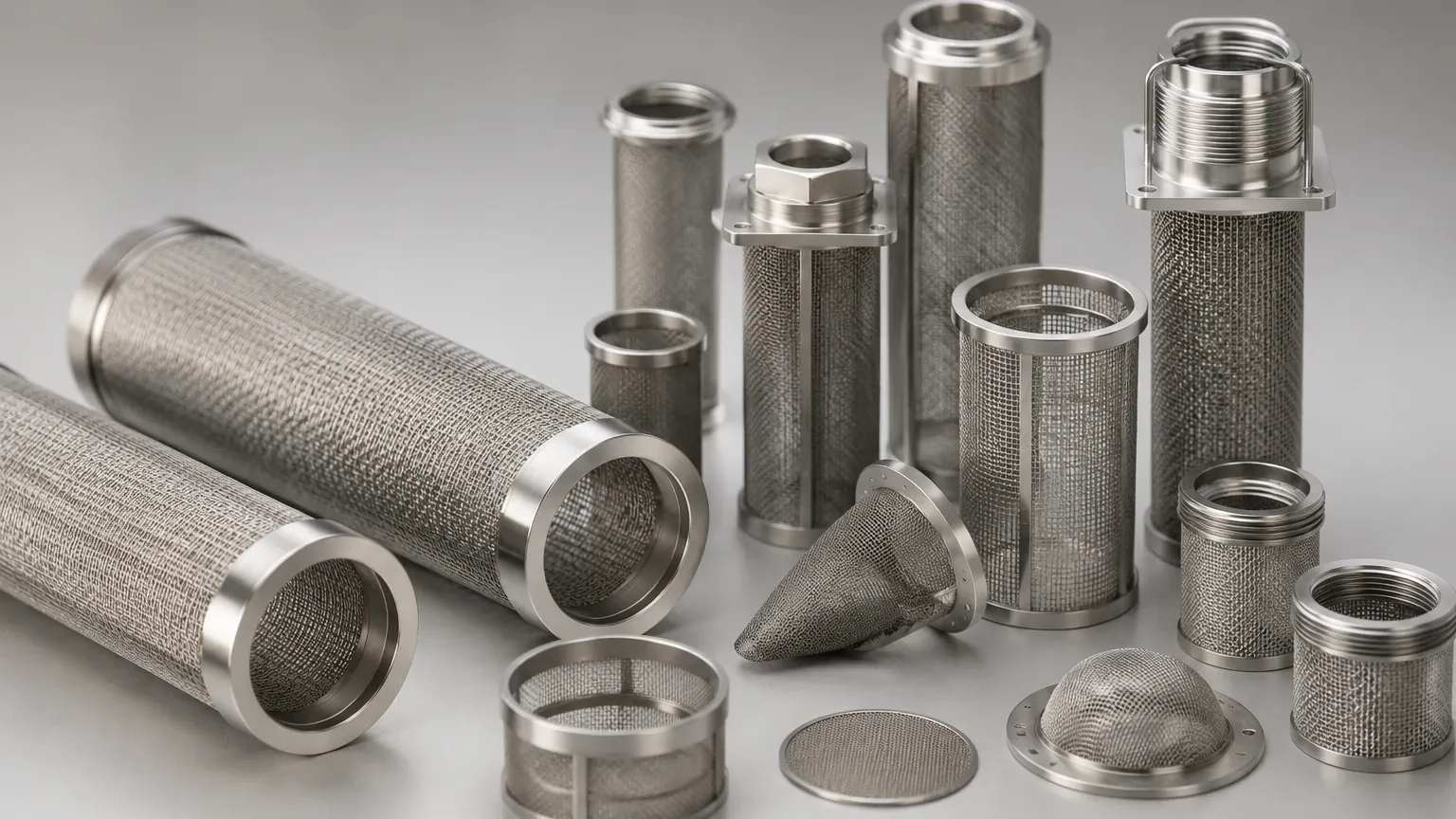
Selecting the right Wire Mesh Filter Cylinders & Tubes requires a deep understanding of fluid dynamics, material science, and mechanical engineering. While local distributors may offer off-the-shelf solutions, specialized B2B manufacturers provide the customization necessary to ensure long-term operational efficiency and equipment protection. This guide examines the technical criteria for selecting stainless steel mesh filters and why engineering specifications must drive the procurement process.
1. Technical Fundamentals of Wire Mesh Filtration
Stainless steel wire mesh is the primary medium for industrial filtration due to its exceptional durability and resistance to thermal and chemical degradation. Unlike polymer or paper filters, wire mesh maintains its pore structure under high pressure and can be cleaned and reused, significantly lowering the total cost of ownership.
Weave Types and Filtration Accuracy
The performance of a filter cylinder or tube is largely determined by the weave pattern of the mesh. Different weaves offer varying levels of mechanical strength and filtration fineness:
* Plain Weave: The most common type, where each warp wire crosses over and under each weft wire. It offers high flow rates and is suitable for general-purpose filtration.
* Twill Weave: Each warp wire passes over and under two weft wires. This allows for thicker wires and finer mesh counts, providing higher strength for heavy-duty applications.
* Dutch Weave (Plain and Twill): These weaves use a higher density of finer wires in one direction, creating a "tortuous path" for particles. Dutch weaves are essential for high-pressure applications requiring precise micron ratings (down to 5-10 microns).
When evaluating a stainless steel mesh filter near me, engineers must verify if the local stock meets the specific micron rating (nominal vs. absolute) required for their process. A mismatch in pore size can lead to either downstream contamination or premature filter blinding.
2. Material Selection: 304 vs. 316L Stainless Steel
In industrial filtration, material compatibility is non-negotiable. The search for a local supplier must be filtered through the lens of metallurgical requirements. Most industrial wire mesh filters are constructed from either Grade 304 or Grade 316L stainless steel.
* Grade 304: Suitable for standard industrial applications, including water treatment and food and beverage processing where corrosion risks are moderate.
* Grade 316L: Contains molybdenum, which provides superior resistance to chlorides and pitting. This is the industry standard for marine environments, chemical processing plants, and pharmaceutical applications where aggressive cleaning agents or acidic fluids are present.
Using a lower-grade stainless steel in a corrosive environment leads to stress corrosion cracking and eventual filter failure. For engineers, confirming the material certificate (MTR) of the filter is a critical step in the procurement process, regardless of the supplier's location.
3. Structural Design of Wire Mesh Filter Cylinders & Tubes
Industrial filters are often subjected to high differential pressures (ΔP). A simple mesh screen is rarely sufficient; it must be engineered into a robust cylindrical or tubular form. The structural integrity of these components depends on several design factors:
Support Layers and Reinforcement
For high-pressure hydraulic or gas filtration, a single layer of mesh may collapse. Engineers often specify multi-layer sintered mesh or mesh supported by an internal or external perforated metal core. This reinforcement allows the filter to withstand high flow velocities without deforming the filtration surface.
End Cap Configurations
The method by which the filter is integrated into the housing is vital for preventing bypass. Common configurations include:
* DOE (Double Open End): Requires gaskets at both ends to ensure a seal.
* SOE (Single Open End): Often features a threaded connection (NPT/BSP) or a specialized flange for secure installation.
* Custom Flanges: For OEM equipment, custom-machined end caps are often required to match proprietary housing dimensions.
4. Why "Near Me" May Not Meet Industrial Standards
The convenience of a local hardware or general industrial supply store is often offset by the limitations of their inventory. For specialized B2B applications, "local" sourcing often presents three primary risks:
1. Lack of Customization: Local distributors typically stock standard sizes. If your system requires a specific length, diameter, or non-standard micron rating, a stock item will likely result in a poor fit or suboptimal filtration.
2. Material Traceability: High-end industrial processes require documented proof of material grade and filtration efficiency. Specialized manufacturers like Kaifil provide full traceability, which is often unavailable through general retailers.
3. Engineering Support: A local salesperson may understand the basic dimensions of a filter but may lack the expertise to calculate the required surface area for a specific flow rate or advise on the chemical compatibility of different alloys.
By working directly with a manufacturer specializing in Wire Mesh Filter Cylinders & Tubes, engineers can ensure that the component is designed for the specific viscosity, temperature, and pressure of their application.
5. Application-Specific Engineering Considerations
Different industries impose unique demands on stainless steel mesh filters. Understanding these demands is essential before finalizing a purchase order.
Food and Beverage Processing
Filters in this sector must be "sanitary grade." This means the welds must be smooth (no pits or crevices where bacteria can grow) and the materials must be FDA-compliant. Stainless steel is preferred here because it can withstand CIP (Clean-in-Place) procedures involving high temperatures and caustic chemicals.
Chemical and Petrochemical
In these environments, the primary concern is chemical resistance and the ability to handle high temperatures. Sintered wire mesh cylinders are often used here because the sintering process fuses the wire contact points, creating a rigid structure that does not shed fibers or shift under extreme thermal cycling.
Hydraulic and Lubrication Systems
These systems require high-strength tubes capable of handling viscous fluids. The pressure drop across the filter is a critical metric; if the mesh is too fine or the surface area is too small, the resulting ΔP can trigger bypass valves or damage pumps.
6. Evaluating Total Cost of Ownership (TCO)
When searching for a stainless steel mesh filter near me, the initial purchase price is only one component of the total cost. Engineers should evaluate the following to determine the true value of a filtration solution:
* Cleaning Cycles: How easily can the filter be backwashed or ultrasonically cleaned? A high-quality stainless steel filter can be cleaned dozens of times, whereas a cheaper, lower-quality mesh may fray or clog permanently after a few uses.
* Service Life: Precision-welded cylinders last significantly longer than those with crimped seams, which are prone to leaking under vibration.
* Downstream Protection: The cost of a filter is negligible compared to the cost of a damaged high-pressure pump or a contaminated batch of pharmaceutical product. Investing in a precision-engineered filter is essentially an insurance policy for the entire production line.
7. Procurement Checklist for Industrial Filters
Before contacting a manufacturer or local supplier, engineers should have the following data points ready to ensure an accurate quote and a functional product:
1. Fluid Medium: What is being filtered? (Water, oil, gas, acid, etc.)
2. Flow Rate: What is the maximum volume of fluid passing through the filter per minute?
3. Operating Temperature and Pressure: What are the normal and peak conditions?
4. Micron Rating: What is the size of the smallest particle that must be removed?
5. Dimensions: What are the exact OD (Outer Diameter), ID (Inner Diameter), and Length requirements?
6. Connection Type: Does it require threads, flanges, or a simple friction fit?
Conclusion
While the impulse to find a stainless steel mesh filter near me is driven by the need for speed, the complexities of industrial filtration demand a more rigorous approach. For critical applications, the priority must be on engineering specifications, material certification, and structural durability.
By partnering with a dedicated manufacturer of Wire Mesh Filter Cylinders & Tubes, technical teams gain access to OEM-quality components tailored to their specific operational needs. Whether you are designing a new system or optimizing an existing one, focusing on the technical fundamentals of wire mesh filtration ensures a reliable, cost-effective, and high-performance solution that localized retail options simply cannot match.
