


Charcoal Filter Discs
In the landscape of industrial separation technology, the requirement for high-purity outputs often necessitates a dual-action approach: mechanical straining and chemical adsorption. Charcoal filter discs represent a specialized category within the broader family of Filter Discs & Packs, designed to address complex filtration challenges where particulate removal alone is insufficient. By integrating the structural reliability of stainless steel wire mesh with the high surface area of activated carbon, these components serve as a critical line of defense in chemical processing, pharmaceutical manufacturing, and high-purity water treatment.
For engineers and procurement specialists, selecting the appropriate charcoal filter discs involves a deep understanding of material compatibility, adsorption kinetics, and mechanical housing requirements. As a manufacturer specializing in custom stainless steel filtration solutions, Kaifil provides the technical framework necessary to integrate these media into demanding industrial environments, ensuring that the final assembly meets both the flow requirements and the purification standards of the application.
The Technical Structure of Industrial Charcoal Filter Discs
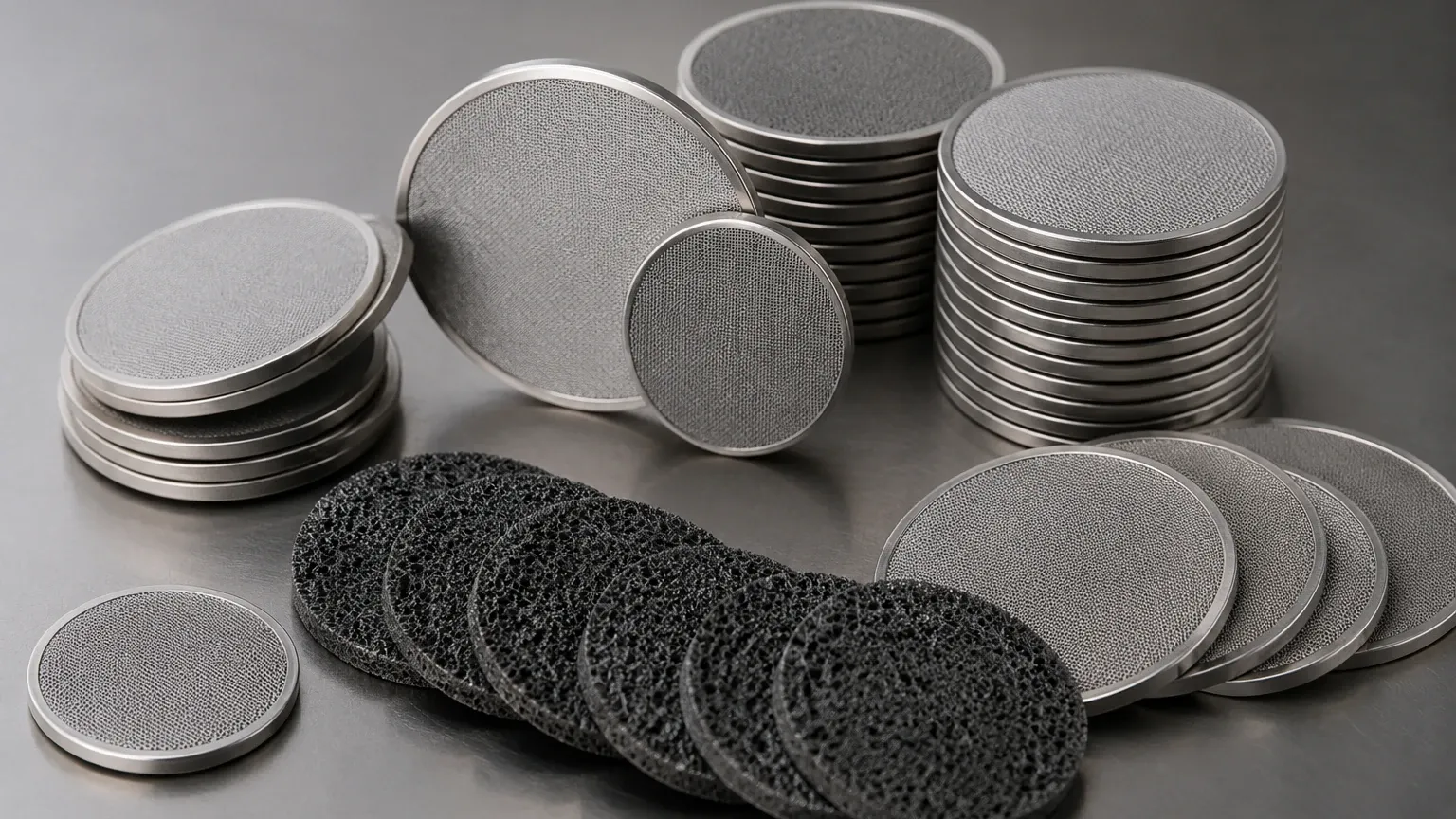
Unlike standard wire mesh filters that rely solely on geometric pore sizes to intercept solids, charcoal filter discs are composite structures. The effectiveness of the disc is determined by the synergy between the carbon media and the metallic support layers. In an industrial B2B context, these discs are rarely composed of charcoal alone; they are engineered "packs" that ensure the carbon remains contained while allowing the process fluid to pass through with minimal resistance.
Media Composition and Containment
The core of the disc typically consists of activated carbon, often derived from coconut shells, wood, or coal, processed to create a vast network of micropores. In many high-end industrial applications, this carbon is impregnated into a cellulose or synthetic fiber matrix, or it is held as a granular bed between two layers of fine stainless steel wire mesh. The choice of containment mesh is critical; it must be fine enough to prevent "carbon fines"—tiny particles of charcoal—from migrating downstream and contaminating the filtrate, yet open enough to avoid contributing excessive pressure drop.
Multi-Layer Engineering
Industrial Filter Discs & Packs often utilize a multi-layer construction. A typical charcoal filter disc assembly might include:
1. An Outer Protective Layer: A coarse stainless steel mesh that provides mechanical strength and protects the inner media from high-velocity fluid impact.
2. The Active Layer: The charcoal-infused media responsible for the adsorption of organic compounds, chlorine, or color-causing molecules.
3. The Fine Filtration Layer: A high-precision micron-rated wire mesh that acts as a final barrier to ensure zero media migration.
4. Support Drainage Layer: A rigid mesh that prevents the disc from deforming under differential pressure.
Engineering Considerations for Selection and Specification
When specifying charcoal filter discs for an industrial system, engineers must look beyond the basic dimensions. The performance of the filter is a variable of the fluid dynamics and the chemical nature of the contaminants.
Adsorption Capacity vs. Residence Time
Adsorption is a time-dependent process. For charcoal filter discs to effectively remove impurities, the fluid must have sufficient "contact time" with the activated carbon. This is often referred to as the Empty Bed Contact Time (EBCT). In a disc format, where the depth of the media is relatively shallow compared to a large carbon tower, the flow rate must be carefully calibrated. If the velocity is too high, the contaminants will pass through the disc before they can be adsorbed by the carbon pores. Engineers must balance the disc diameter and the number of stacked layers to achieve the required purity at the desired flow rate.
Material Compatibility and Corrosion Resistance
In the chemical and pharmaceutical sectors, the housing and the support mesh of the charcoal filter discs must withstand the process environment. Kaifil utilizes high-grade stainless steel, such as SS304 or SS316L, to ensure longevity. SS316L is particularly favored in applications involving chlorides or acidic solutions where pitting corrosion is a risk. Furthermore, the charcoal itself must be high-purity and acid-washed to ensure it does not leach minerals or ash into the process stream, which is a common concern in pharmaceutical API (Active Pharmaceutical Ingredient) production.
Pressure Drop (Delta P) Management
Every filter media introduces a resistance to flow. As charcoal filter discs capture particulates on their surface and fill their internal pores with adsorbed molecules, the differential pressure across the disc will increase. It is essential to calculate the initial clean pressure drop to ensure the system’s pump capacity is adequate. In many industrial designs, multiple Filter Discs & Packs are used in parallel to increase the total surface area, thereby reducing the flux (flow per unit area) and extending the service life between replacements.
Primary Applications in Industrial Sectors
Charcoal filter discs are indispensable in processes where molecular-level cleaning is required. Their ability to remove dissolved organic carbon (DOC) and volatile organic compounds (VOCs) makes them a versatile tool across several industries.
Chemical and Petrochemical Processing
In the chemical industry, charcoal filter discs are frequently used for the decolorization of solvents and the removal of trace impurities from intermediate products. For instance, in plasticizer production or specialty chemical synthesis, unwanted color bodies can degrade the final product's value. The activated carbon within the disc adsorbs these large organic molecules, resulting in a clear, high-purity fluid.
Food and Beverage Purification
The food industry relies on charcoal filtration for both safety and sensory quality. These discs are used to remove chlorine and off-flavors from process water used in brewing and soft drink production. Because these applications involve human consumption, the charcoal filter discs must often meet FDA or equivalent regulatory standards for food contact materials, ensuring that the stainless steel mesh and the carbon media are free from toxic binders or contaminants.
Pharmaceutical and Biotechnology
In the pharmaceutical sector, the removal of pyrogens, catalysts, and unwanted side-products is critical. Charcoal filter discs provide a compact and disposable solution for batch processing. They are often used in the final stages of purification to ensure that the medication is free from any residual organic impurities that could affect the stability or efficacy of the drug.
Performance Evaluation and Quality Control
To ensure the reliability of filtration systems, purchasing teams must evaluate the quality metrics of the charcoal filter discs they procure. A failure in the filter disc can lead to downstream equipment damage or, worse, a contaminated batch of product.
Iodine Value and Pore Distribution
The "activity" of the charcoal is often measured by its Iodine Value (mg/g), which indicates the micropore content and the adsorption capacity for small molecules. For larger organic molecules, the Molasses Number is a more relevant metric. When ordering Filter Discs & Packs, it is vital to confirm that the carbon media used is appropriate for the specific molecular weight of the target contaminant.
Mechanical Integrity and Edge Sealing
One of the most common failure points in industrial filter discs is bypass. If the edges of the disc are not properly sealed, the fluid will take the path of least resistance around the media rather than through it. Kaifil employs advanced manufacturing techniques, such as ultrasonic welding, spot welding, or the application of metal rims (binding), to ensure a leak-proof seal. A robust edge seal also prevents the individual layers of a multi-layer pack from separating under the stress of back-pulsing or high-pressure surges.
Maintenance, Saturation, and Replacement Cycles
Unlike purely mechanical filters that can sometimes be cleaned and reused (such as plain stainless steel mesh), charcoal filter discs have a finite life determined by the saturation of the carbon's adsorption sites. Once the pores are filled, the disc will no longer remove dissolved contaminants, even if the pressure drop remains low.
Monitoring Breakthrough
In critical applications, the replacement cycle is determined by "breakthrough"—the point at which the concentration of the contaminant in the effluent exceeds the allowable limit. This is typically monitored via online sensors (such as TOC analyzers or UV-Vis spectrometers) or regular laboratory sampling. Establishing a predictable replacement schedule is essential for maintaining process consistency.
Handling and Disposal
Because charcoal filter discs adsorb hazardous or concentrated impurities, the spent discs must be handled according to environmental regulations. In some cases, the metal components of the Filter Discs & Packs can be recycled after the carbon media has been removed and properly disposed of, contributing to a more sustainable industrial operation.
Customization and OEM Solutions
Every industrial filtration system has unique constraints regarding space, flow, and chemical exposure. Off-the-shelf solutions rarely provide the optimized performance required for high-efficiency operations. Customization is where engineering expertise becomes a tangible asset.
Kaifil works closely with OEM partners to develop charcoal filter discs tailored to specific housing designs. This includes:
* Bespoke Geometry: From standard circular discs to complex oval or rectangular shapes required for specialized machinery.
* Variable Layering: Adjusting the thickness of the carbon layer and the mesh count of the support layers to meet specific micron ratings and adsorption targets.
* Material Selection: Offering a range of alloys beyond standard stainless steel for highly aggressive chemical environments.
By focusing on precision manufacturing and technical consultation, Kaifil ensures that each filtration component contributes to the overall efficiency and reliability of the industrial process. Whether the goal is to protect sensitive downstream membranes from organic fouling or to ensure the purity of a final chemical product, the correct application of charcoal filter discs is a fundamental requirement for modern industrial success.
