


Disc Filter for Wastewater Treatment
In the landscape of industrial wastewater management, the efficiency of solid-liquid separation determines the success of downstream processes, the longevity of equipment, and compliance with environmental regulations. Among the various technologies available, the use of a disc filter for wastewater treatment has become a standard for achieving high-flux filtration within a compact footprint. For engineers and technical procurement teams, selecting the right filtration media is not merely a matter of finding a component that fits; it involves understanding the interplay between material science, mesh geometry, and the specific chemical profile of the effluent.
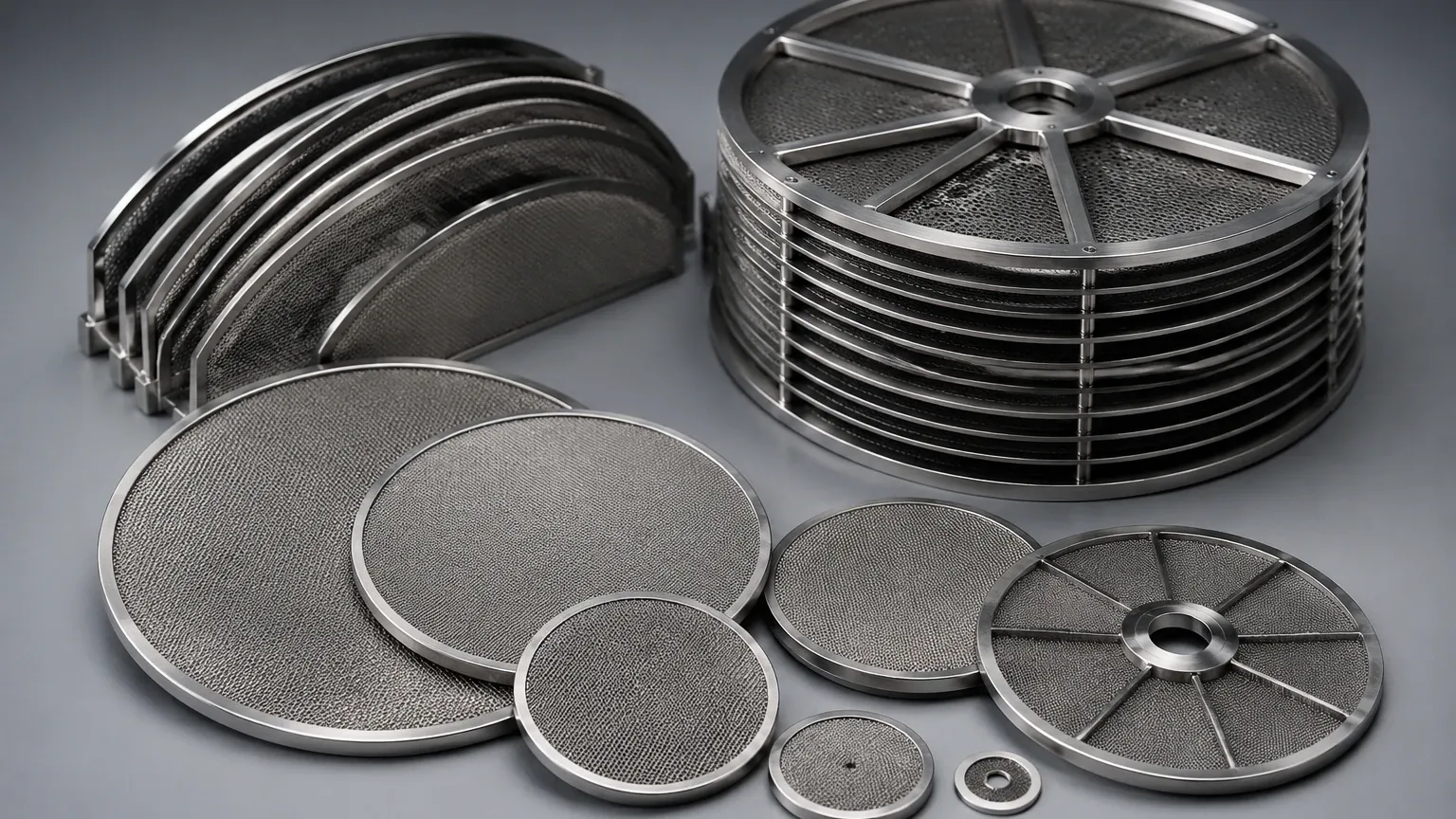
Industrial filtration requires components that can withstand corrosive environments, high pressure, and frequent cleaning cycles. Stainless steel Filter Discs & Packs serve as the critical functional element in these systems, providing the precision necessary to remove suspended solids, protect sensitive membranes, and facilitate water reuse in sectors ranging from chemical processing to food and beverage production.
Technical Principles of Disc Filtration in Industrial Effluent
A disc filter for wastewater treatment operates on the principle of surface filtration, where particles larger than the mesh openings are captured on the upstream side of the filter media. In industrial applications, these discs are often arranged in stacks or integrated into housing assemblies to maximize the available surface area without increasing the system's physical dimensions.
The performance of these filters is dictated by the characteristics of the wire mesh. Unlike disposable polymer filters, stainless steel wire mesh provides a rigid structure that maintains its pore size even under significant differential pressure. This stability is essential in wastewater scenarios where surge flows or high solids loading can cause flexible media to deform, leading to "particle bypass" or premature clogging.
When evaluating Filter Discs & Packs, engineers must consider the type of weave. Plain weave offers a straight-through flow path and is easy to clean, making it suitable for larger particle removal. Conversely, Dutch weave patterns—such as Plain Dutch or Twill Dutch—provide a more complex, tortuous path that allows for finer filtration ratings (down to 5 microns or less) while maintaining high mechanical strength. This complexity is particularly beneficial in tertiary wastewater treatment, where the goal is to remove fine silt and organic debris before the water enters a reverse osmosis (RO) or ultrafiltration (UF) stage.
Engineering Considerations for Filter Discs & Packs
Selecting the appropriate filter disc involves more than just identifying a micron rating. In a B2B industrial context, the design of the disc pack itself influences the total cost of ownership and the frequency of maintenance.
Single-Layer vs. Multi-Layer Construction
Single-layer filter discs are typically used for coarse filtration or as support structures. However, for most wastewater applications, multi-layer packs are preferred. These packs combine different mesh counts to achieve a gradient filtration effect. For example, a fine inner mesh performs the actual filtration, while coarser outer layers provide mechanical support and protect the fine mesh from damage during backwashing or high-pressure events.
Sintered vs. Spot-Welded Packs
There are two primary methods for joining multiple layers of mesh into a single disc pack:
1. Spot-Welding: The layers are joined at specific points along the circumference. This is a cost-effective solution for applications with moderate pressure and temperature requirements.
2. Sintering: The mesh layers are bonded together through a high-temperature diffusion process. Sintered Filter Discs & Packs act as a single, monolithic piece of metal. They offer superior structural integrity, no risk of wire migration, and the ability to withstand extreme back-pressure, making them ideal for heavy-duty disc filter for wastewater treatment systems.
Rimming and Edge Treatment
To prevent bypass and ensure a secure seal within the filter housing, discs are often finished with a rim. Common materials for rims include stainless steel, aluminum, or copper. A properly engineered rim ensures that the fluid is forced through the mesh rather than around the edges, which is a common failure point in poorly manufactured filtration components.
Material Selection for Corrosive Wastewater Environments
Wastewater is rarely pure water; it often contains a cocktail of chemicals, salts, and biological agents. The choice of material for a disc filter for wastewater treatment is therefore a critical engineering decision.
* Stainless Steel 304: Suitable for general industrial water and mildly corrosive environments. It offers good durability but may be susceptible to pitting in high-chloride environments.
* Stainless Steel 316L: The industry standard for wastewater treatment. The addition of molybdenum provides enhanced resistance to chlorides and acids. The "L" denotes low carbon content, which improves weldability and prevents intergranular corrosion in the heat-affected zones of welded packs.
* Specialty Alloys: For highly aggressive chemical effluents, materials such as Hastelloy or Monel may be required. These alloys provide exceptional resistance to extreme pH levels and high temperatures that would degrade standard stainless steels.
By utilizing high-grade stainless steel Filter Discs & Packs, facilities can ensure that their filtration systems remain operational for years, rather than months, significantly reducing the frequency of replacement and the associated downtime.
Application Guidance: Integration into Treatment Trains
A disc filter for wastewater treatment is rarely a standalone solution. Instead, it serves as a vital link in a larger treatment train. Understanding where to place the disc filter is key to optimizing performance.
Pre-Filtration for Membrane Systems
Membrane bioreactors (MBR) and RO systems are highly sensitive to particulate fouling. A stainless steel disc filter acts as a robust "police filter," removing larger suspended solids that could tear or clog expensive membranes. Because metal discs can be cleaned and reused, they provide a much lower long-term cost compared to disposable cartridge filters in high-fouling applications.
Industrial Cooling Water Loops
In power plants and manufacturing facilities, cooling water is often drawn from secondary treated wastewater. Disc filters are used to remove scale, biological growth, and debris that could foul heat exchangers. The high flow rates and low pressure drop of Filter Discs & Packs make them ideal for these high-volume loops.
Recovery of Valuable Solids
In some industrial processes, the "waste" in the water is actually a valuable byproduct, such as catalyst fines in chemical processing or pulp fibers in paper milling. Precision-engineered disc filters allow for the efficient recovery of these solids, turning a waste stream into a revenue stream.
Selection Advice: Confirming Technical Requirements
When sourcing a disc filter for wastewater treatment, engineers and purchasing teams should be prepared to provide specific technical data to the manufacturer. This ensures the resulting product meets the operational demands of the site.
1. Micron Rating (Nominal vs. Absolute): Specify whether you require a nominal rating (where a percentage of particles are captured) or an absolute rating (where all particles above a certain size are blocked). For critical protection of downstream equipment, absolute ratings are necessary.
2. Flow Rate and Pressure Drop: What is the maximum allowable pressure drop ($ΔP$) across the filter? A smaller pore size increases the pressure drop, which may require a larger surface area (more discs) to maintain the desired flow rate.
3. Operating Temperature and Pressure: Ensure the material and construction (e.g., sintered vs. welded) can handle the thermal and mechanical stresses of the process.
4. Cleaning Protocol: Will the filters be cleaned via back-pulsing, ultrasonic baths, or chemical cleaning? The mechanical strength of the Filter Discs & Packs must be compatible with the intended cleaning method.
Maintenance and Total Cost Considerations
While the initial cost of a stainless steel disc filter for wastewater treatment is higher than that of plastic or fabric alternatives, the total cost of ownership (TCO) is often significantly lower.
Durability and Reusability
Stainless steel filters are designed for longevity. Unlike polymer discs that can become brittle or cloth filters that can tear, metal mesh maintains its integrity over thousands of cleaning cycles. In many industrial settings, a single set of stainless steel discs can last for several years, whereas disposable filters might require replacement weekly or even daily.
Reduced Waste and Environmental Impact
For companies focused on sustainability, reducing the volume of spent filter media sent to landfills is a priority. Reusable metal filters align with circular economy goals by minimizing consumable waste.
Precision and Consistency
In regulated industries like pharmaceuticals or food production, the consistency of filtration performance is paramount. High-quality Filter Discs & Packs provide a verifiable, repeatable level of filtration that ensures final product quality and protects the brand's reputation.
Conclusion
The selection of a disc filter for wastewater treatment is a technical decision that impacts the entire efficiency of an industrial facility. By focusing on high-quality materials, precise mesh engineering, and customized designs, engineers can implement filtration solutions that are both durable and cost-effective. Whether protecting sensitive RO membranes or recovering valuable catalysts, the right Filter Discs & Packs provide the reliability needed to manage complex industrial effluents. When evaluating suppliers, it is essential to partner with a manufacturer that understands these engineering nuances and can provide the OEM capabilities required to meet specific application challenges.
