


Disc Filter in Wastewater Treatment
In the landscape of modern wastewater management, the demand for high-quality effluent has led to the widespread adoption of advanced tertiary treatment technologies. Among these, the disc filter has emerged as a critical component for the removal of total suspended solids (TSS), phosphorus, and other particulate matter. For engineers and facility managers, understanding the technical nuances of a disc filter in wastewater treatment is essential for optimizing plant performance, reducing footprint, and ensuring compliance with stringent environmental regulations.
As a specialized manufacturer of stainless steel filtration components, Kaifil provides the high-precision Filter Discs & Packs that serve as the functional heart of these systems. This article examines the engineering principles, material considerations, and selection criteria for disc filtration in industrial and municipal wastewater applications.
The Role of Disc Filtration in Tertiary Treatment
Tertiary treatment represents the final stage of wastewater processing before discharge or reuse. Traditional methods, such as sand filtration, often require significant physical space and involve complex backwashing procedures. The introduction of the disc filter in wastewater treatment addressed these limitations by providing a compact, modular, and highly efficient alternative.
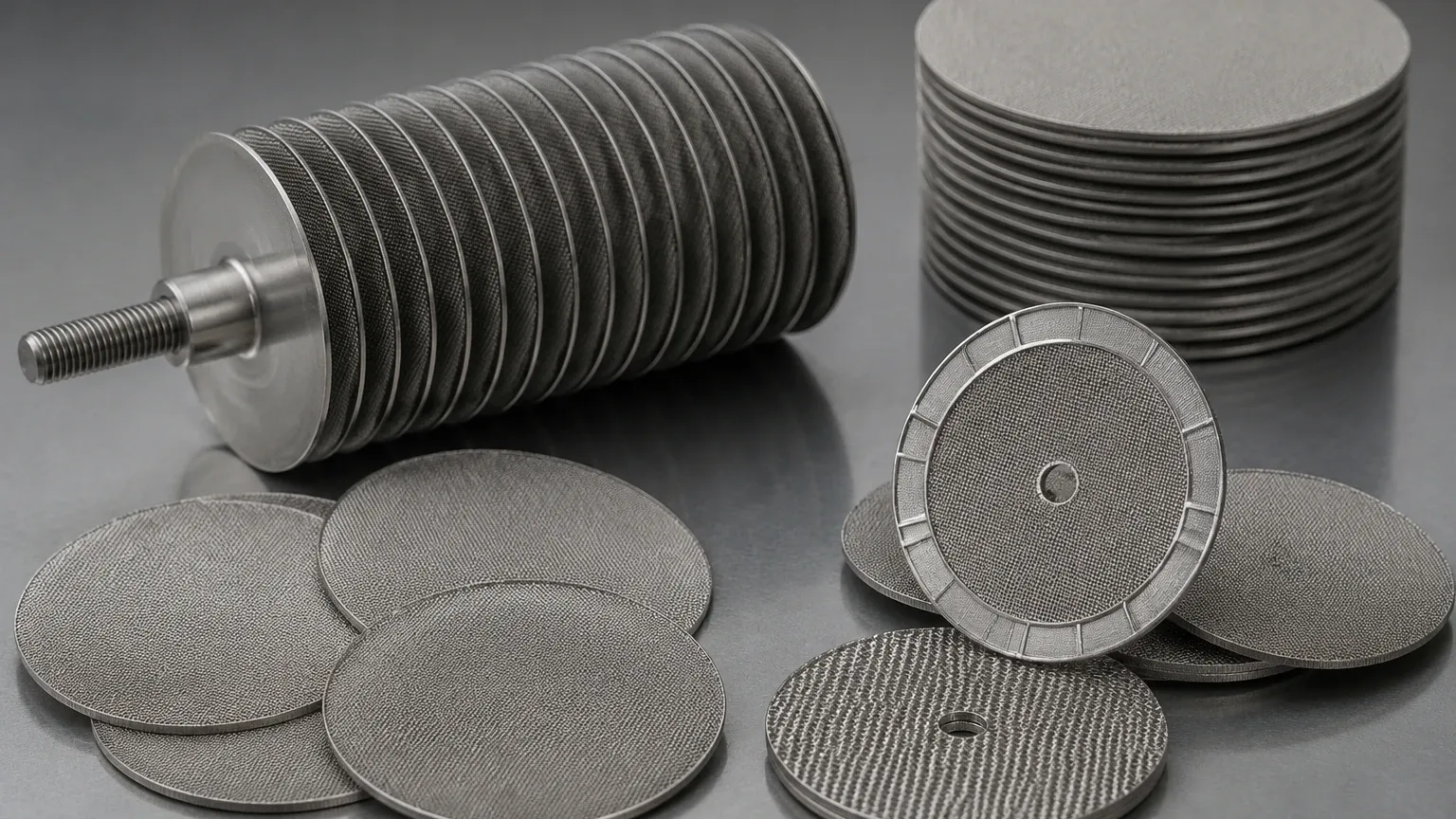
A disc filter typically consists of a series of parallel discs mounted on a central drum. Each disc is covered with a fine filtration medium—most commonly stainless steel wire mesh or synthetic fabric. As influent flows through the filter media, solids are captured on the surface, while the filtered water (permeate) passes through to the center of the drum for discharge. This surface filtration mechanism allows for precise control over particle size removal, making it ideal for polishing effluent to meet high-clarity standards.
Engineering Principles of Disc Filter Operation
The efficiency of a disc filter in wastewater treatment is governed by several hydraulic and mechanical factors. Unlike depth filtration, where particles are trapped within a thick bed of media, disc filters rely on surface or thin-layer filtration. This allows for a much higher filtration area relative to the system's footprint.
Filtration and Backwashing Cycles
The operation is generally continuous. As solids accumulate on the mesh surface, the head loss (pressure drop) across the media increases. Once a predetermined pressure threshold or time interval is reached, the backwash cycle is initiated. During backwashing, the drum rotates while high-pressure spray nozzles direct filtered water or air from the outside of the discs inward (or vice versa, depending on the design) to dislodge the accumulated solids. These solids are collected in a reject trough and returned to the head of the plant or a solids handling facility.
Hydraulic Loading Rates
Engineers must calculate the hydraulic loading rate (HLR) based on the effective filtration area (EFA). Because Filter Discs & Packs can be configured in multiple layers or segments, the EFA can be significantly increased without expanding the tank size. This modularity is a primary reason why disc filters are favored for plant retrofits where space is limited.
Material Selection: Why Stainless Steel Wire Mesh?
While some disc filters utilize polyester or other synthetic cloths, stainless steel wire mesh remains the gold standard for demanding industrial wastewater and heavy-duty municipal applications. Kaifil specializes in the production of stainless steel filter components because of the material's inherent advantages in harsh environments.
1. Chemical Compatibility: Wastewater often contains varying pH levels, residual chlorine, and industrial chemicals. Stainless steel (typically 304, 316L, or 904L) offers superior corrosion resistance compared to polymers.
2. Mechanical Strength: The high-pressure sprays used in backwashing can cause fatigue in synthetic fibers over time. Stainless steel mesh maintains its structural integrity under repeated mechanical stress, extending the replacement cycle.
3. Precision and Uniformity: Metal weaving technologies allow for extremely precise pore sizes. For applications requiring 10-micron to 100-micron filtration, stainless steel provides a stable aperture that does not stretch or deform under load.
4. Thermal Resistance: In industrial processes where wastewater may be discharged at elevated temperatures, stainless steel components ensure consistent performance where plastics might soften or fail.
Technical Specifications for Filter Discs & Packs
When specifying Filter Discs & Packs for a disc filter in wastewater treatment, several technical parameters must be defined to ensure the longevity and efficiency of the system.
Mesh Weave Types
The type of weave impacts both the filtration rating and the ease of backwashing. Plain weave is common for general applications, while Dutch weave (Plain or Twilled) provides a more robust structure and finer filtration capabilities. For wastewater applications involving sticky or biological solids, the weave must be selected to minimize "blinding"—the permanent clogging of the mesh pores.
Layer Configuration
Filter discs are rarely a single layer of mesh. They are often engineered as multi-layer packs. A typical configuration includes:
* The Filtration Layer: The fine mesh that determines the micron rating.
* Support Layers: Coarser mesh layers that provide rigidity and protect the fine mesh from hydraulic surges.
* Drainage Layers: Optimized to facilitate the flow of permeate and ensure even distribution during the backwash cycle.
Micron Rating and TSS Removal
In municipal wastewater, a disc filter is often tasked with reducing TSS from 20–30 mg/L down to less than 5 mg/L. This typically requires a mesh rating between 10 and 30 microns. In industrial settings, such as food processing or pulp and paper, the required micron rating may vary significantly based on the nature of the suspended solids.
Common Challenges and Performance Optimization
Implementing a disc filter in wastewater treatment is not without challenges. Engineers must account for potential operational hurdles during the design phase.
Handling High Grease and Oil Content
If the influent contains high levels of Fats, Oils, and Grease (FOG), the filter media can become coated, leading to rapid blinding. In these cases, pre-treatment via Dissolved Air Flotation (DAF) or the use of specialized oleophobic coatings on the stainless steel mesh may be necessary.
Biological Growth and Biofouling
In tertiary treatment, the presence of nutrients can encourage the growth of biofilm on the filter discs. Regular chemical cleaning (CIP) or the integration of UV disinfection prior to filtration can help manage biofouling. The durability of stainless steel Filter Discs & Packs is an advantage here, as they can withstand the aggressive chemicals used in cleaning cycles better than synthetic alternatives.
Managing Peak Flows
Wastewater plants must handle diurnal flow variations and storm events. Disc filters are inherently flexible; by increasing the rotation speed of the drum or increasing the backwash frequency, the system can handle temporary spikes in solids loading without a total system bypass.
Selection Criteria for Engineers and Purchasing Teams
When sourcing components for a disc filter in wastewater treatment, technical professionals should evaluate suppliers based on more than just initial cost. The total cost of ownership (TCO) is heavily influenced by the quality of the filter media.
* Customization Capabilities: Does the manufacturer provide custom diameters, segment shapes, and mounting configurations? Standardized parts often require compromises in system design, whereas custom-engineered discs can optimize the EFA.
* Quality Control: For precision filtration, the consistency of the wire diameter and the accuracy of the weave are paramount. Inconsistent pore sizes lead to "breakthrough," where particles larger than the target micron rating pass through the filter.
* Structural Integrity: High-quality Filter Discs & Packs should feature robust edge sealing—often via welding or specialized framing—to prevent bypass at the periphery of the disc.
* Technical Support: Suppliers should be able to provide data on pressure drop vs. flow rate and offer guidance on the best mesh structures for specific types of wastewater solids.
The Future of Disc Filtration in Water Reuse
As water scarcity becomes a global concern, the transition from "wastewater treatment" to "water reclamation" is accelerating. Disc filters play a pivotal role in this transition. By providing a reliable barrier against particulates, they protect downstream processes such as Ultrafiltration (UF) and Reverse Osmosis (RO) membranes from premature fouling.
In these high-stakes applications, the reliability of the disc filter in wastewater treatment is non-negotiable. Utilizing high-performance stainless steel components ensures that the system can operate for years with minimal downtime. Kaifil’s expertise in manufacturing durable, precision-engineered filtration solutions supports these critical infrastructure goals, providing the industry with the components needed for efficient and sustainable water management.
For those involved in the design or maintenance of filtration systems, choosing the right Filter Discs & Packs is a decision that impacts the entire plant's operational efficiency. By focusing on material quality, precise engineering, and application-specific design, facilities can achieve superior effluent quality and long-term cost savings.
