


Disc Filter Mining
In the demanding sector of mineral processing, the efficiency of solid-liquid separation directly impacts the profitability and environmental footprint of mining operations. Disc filter mining applications represent a critical stage in dewatering concentrates and tailings, where the selection of filtration media determines the throughput, moisture content of the final cake, and the longevity of the equipment. For engineers and procurement specialists, understanding the technical nuances of Filter Discs & Packs is essential for optimizing these high-volume processes.
Industrial mining environments subject filtration components to extreme mechanical stress, abrasive particles, and often corrosive chemical reagents. This guide explores the engineering considerations, material requirements, and performance metrics necessary to maintain efficient disc filter operations in the mining industry.
The Role of Filter Discs & Packs in Mining Operations
Disc filters are widely used in the mining industry for the dewatering of mineral concentrates such as iron ore, coal, copper, gold, and various industrial minerals. The process typically involves a series of rotating discs partially submerged in a slurry tank. As the discs rotate, vacuum or pressure is applied to draw the liquid through the filter media, leaving a solid cake on the surface.
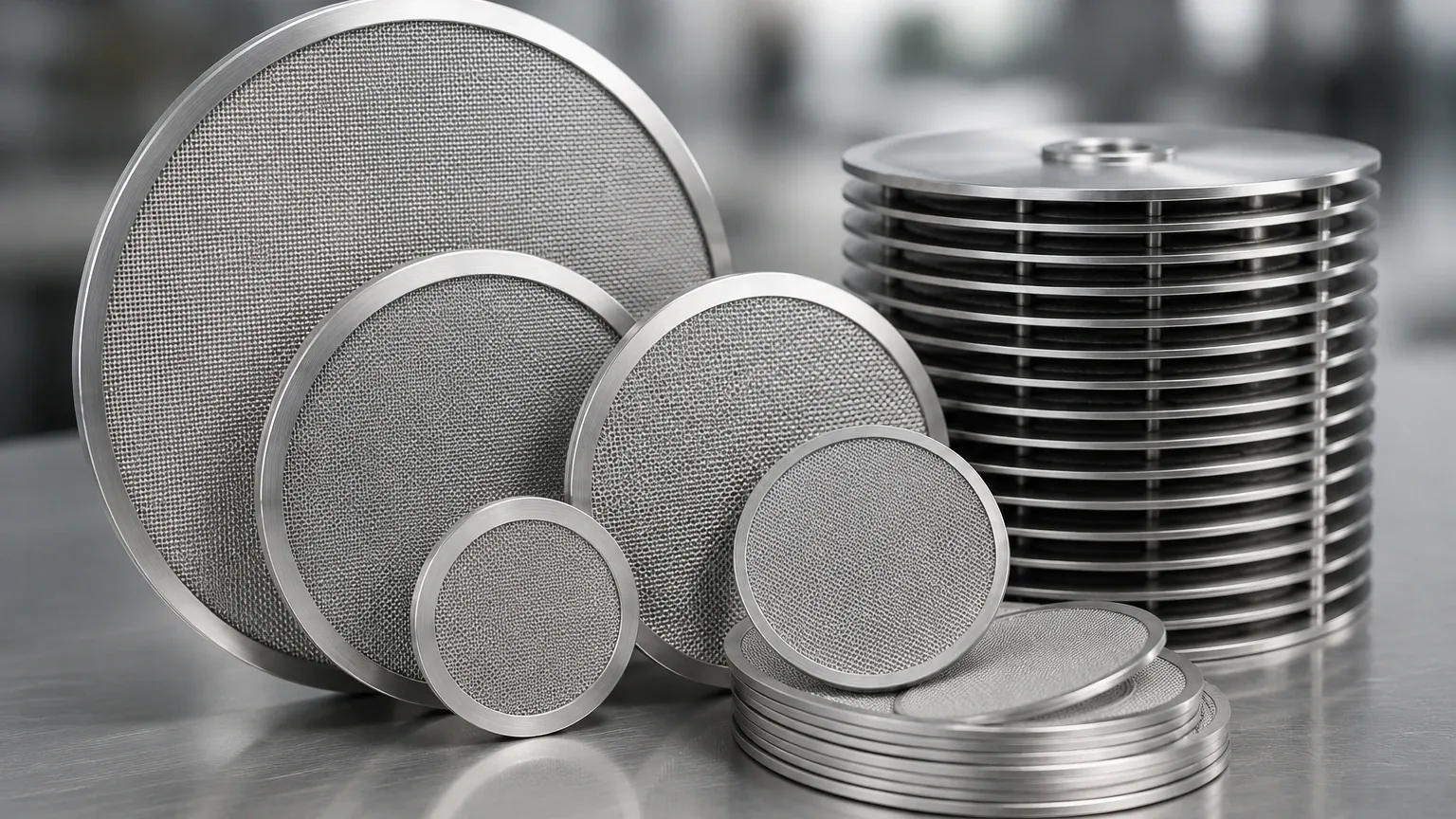
In this context, the filter discs and packs serve as the primary barrier. Their performance is measured by their ability to provide a high flow rate while retaining fine mineral particles. Because mining operations often run 24/7, these components must withstand continuous duty cycles without frequent failure. The choice of filter media—ranging from multi-layer sintered wire mesh to specialized metal fiber felts—dictates the clarity of the filtrate and the dryness of the discharged solids.
Vacuum vs. Pressure Disc Filtration
Most mining applications utilize vacuum disc filters due to their continuous operation and relatively lower energy consumption for large volumes. However, pressure disc filters are increasingly employed for finer particles or materials that are difficult to dewater. In both systems, the structural integrity of the filter pack is paramount. If the mesh deforms under pressure or vacuum pulses, the filtration efficiency drops, and the risk of bypass (where solids enter the filtrate stream) increases significantly.
Engineering Considerations for Mining Environments
When specifying filtration components for mining, engineers must move beyond simple micron ratings. Several environmental and mechanical factors must be balanced to ensure the system operates within its design parameters.
1. Abrasion Resistance
Mineral slurries are inherently abrasive. Particles of silica, magnetite, or pyrite act as grinding agents against the filter surface. Standard synthetic cloths often fail prematurely in these conditions. Stainless steel wire mesh, particularly when constructed with specialized weave patterns, offers superior resistance to surface wear. The use of larger wire diameters on the outer layers of a filter pack can provide a sacrificial wear surface that protects the finer internal filtration layers.
2. Chemical Compatibility
Mining processes frequently involve extreme pH levels. For example, heap leaching or bio-leaching processes may involve highly acidic environments, while other mineral flotations occur in alkaline conditions. Furthermore, the presence of chlorides in process water can lead to pitting corrosion in standard stainless steels. Engineers must select materials like 316L, 904L, or even duplex stainless steels to ensure the Filter Discs & Packs do not degrade chemically before their mechanical life is exhausted.
3. Mechanical Strength and Rigidity
During the discharge phase of a disc filter cycle, a snap-blow (air pulse) or a scraper blade is often used to remove the cake. This puts significant mechanical strain on the filter media. If the disc pack is not sufficiently rigid, it can flex and fatigue, leading to cracks and holes. Sintered multi-layer mesh is often the preferred solution here, as the diffusion bonding process fuses the wires together, creating a monolithic structure that maintains its shape under high differential pressures.
Material Selection and Weave Patterns
The performance of a disc filter is largely determined by the geometry of the wire mesh. Different weave patterns offer different advantages in terms of flow resistance and particle retention.
* Plain Weave: Simple and cost-effective, suitable for coarser separation where high flow rates are the priority.
* Twill Weave: Allows for a heavier wire diameter in a given mesh count, increasing the strength and life of the disc.
* Dutch Weave (Plain and Twill): These weaves provide a tortuous path for the fluid, offering high filtration accuracy and excellent cake release properties. Dutch weaves are particularly effective in mining for capturing fine concentrates while preventing "blinding" (the clogging of the mesh pores).
* Sintered Metal Fiber: For ultra-fine filtration in specialized mining applications, sintered metal fiber felts provide high porosity and low pressure drop, though they are typically reserved for high-value mineral processing due to their higher cost.
At Kaifil, the focus is on providing customized configurations that match the specific particle size distribution of the mine's slurry. By layering different mesh types, a gradient density can be achieved, allowing for deep-bed filtration characteristics within a thin disc profile.
Optimizing Throughput and Cake Moisture Content
The primary goal of dewatering in mining is to reach a specific moisture target for transport or further processing. High moisture content increases shipping costs and can complicate downstream smelting or refining. Conversely, a cake that is too dry may be difficult to discharge from the filter.
Filtration accuracy plays a vital role here. If the mesh is too coarse, fine particles pass through, leading to high solids in the filtrate and potential damage to pumps. If the mesh is too fine, the filter may blind quickly, reducing the throughput and increasing the moisture in the cake because the air cannot pull through the solids effectively during the drying phase of the cycle.
Engineers should evaluate the "bubble point" and air permeability of their Filter Discs & Packs to ensure they are optimized for the specific vacuum levels used on-site. A well-designed filter pack allows for rapid cake formation and efficient air-pull during the drying zone, resulting in a drier, more manageable product.
Maintenance Challenges and Replacement Cycles
In a B2B mining context, the total cost of ownership (TCO) is a more critical metric than the initial purchase price. Frequent downtime for filter replacement can cost a mine thousands of dollars per hour in lost production.
Common Failure Modes in Mining Disc Filters:
1. Blinding: Fine particles become lodged within the mesh pores. While backwashing can alleviate this, persistent blinding requires chemical cleaning or replacement.
2. Fatigue Cracking: Caused by the constant pressure/vacuum cycling and the mechanical action of cake discharge.
3. Edge Leakage: Failure of the seals or the peripheral support of the disc pack, allowing unfiltered slurry to bypass the media.
To extend replacement cycles, Kaifil recommends a rigorous maintenance schedule that includes regular inspection of the mesh surface for wear patterns. Utilizing reinforced edges and customized support structures within the filter pack can also prevent premature mechanical failure at the stress points where the disc attaches to the center shaft.
Customization and OEM Solutions for Mining Equipment
No two mining operations are identical. Variations in ore mineralogy, grind size, and water chemistry mean that "off-the-shelf" filtration solutions often underperform. Customization is the key to achieving optimal filtration efficiency.
When working with a manufacturer like Kaifil, mining engineers can specify exact dimensions, layer configurations, and material grades. Whether it is a retrofit for existing vacuum disc filters or a new installation for a pressure filtration system, custom-engineered Filter Discs & Packs ensure that the filtration media is perfectly matched to the equipment's mechanical constraints and the process's metallurgical requirements.
Key Data Points for Customization:
* Slurry Concentration: Percentage of solids by weight.
* Particle Size Distribution (PSD): The range of particle sizes in the feed.
* Operating Temperature: High temperatures can affect the tension and chemical resistance of the mesh.
* Vacuum/Pressure Levels: Dictates the required structural strength of the sintered layers.
Conclusion: Selecting the Right Filtration Partner
Disc filter mining operations require a balance of technical expertise and high-quality manufacturing. The selection of filter discs and packs is not merely a procurement task but an engineering decision that affects the entire production chain. By focusing on material durability, precise weave selection, and customized structural designs, mining operations can significantly improve their dewatering efficiency and reduce operational costs.
Kaifil provides the technical support and manufacturing precision needed to develop reliable filtration components for the most demanding industrial environments. From initial material selection to the production of complex, multi-layer filter packs, a commitment to quality ensures that your mining operation maintains peak performance with minimal downtime.
