


Disc Filter Manufacturers
In the landscape of industrial filtration, the precision and reliability of filtration components directly impact the efficiency of downstream processes and the quality of the final product. For engineering and procurement teams in sectors such as chemical processing, pharmaceuticals, and polymer extrusion, selecting the right partner among various disc filter manufacturers is a critical decision. These components, often referred to as Filter Discs & Packs, serve as the primary barrier against contaminants in high-pressure and high-temperature environments.
Understanding the technical nuances of mesh construction, material science, and manufacturing tolerances is essential for optimizing filtration performance. This guide examines the engineering considerations, manufacturing capabilities, and quality benchmarks that define industry-leading filtration solutions.
The Role of Filter Discs and Packs in Industrial Systems
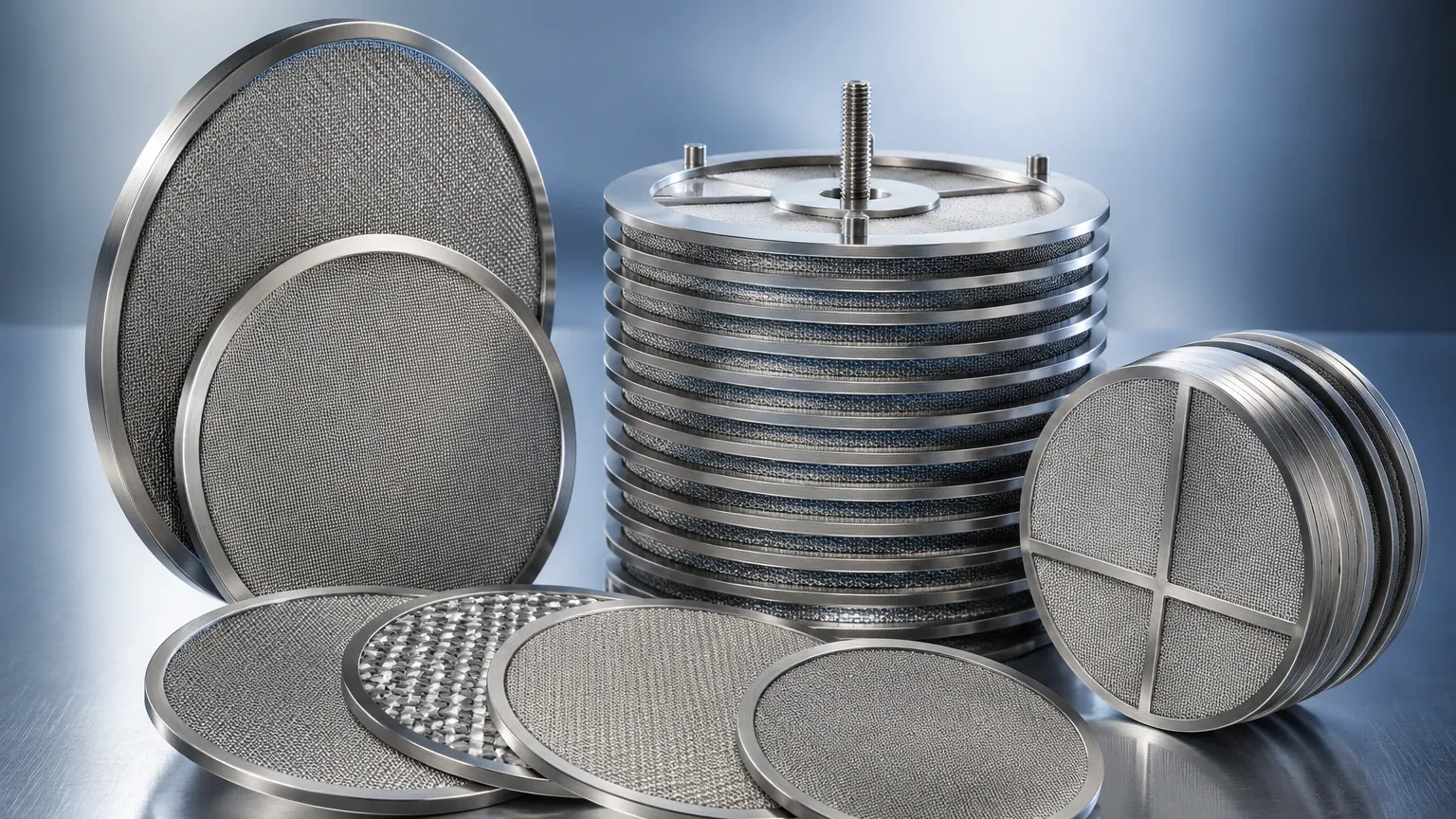
Filter discs and packs are specialized filtration elements constructed from one or more layers of wire mesh. Unlike disposable cartridges, these metal components are designed for durability, chemical resistance, and the ability to withstand significant differential pressures. They are commonly employed in applications where synthetic fibers would fail due to thermal or chemical stress.
Single-Layer vs. Multi-Layer Construction
The complexity of a filter disc depends entirely on the application's requirements.
* Single-Layer Discs: These are typically used in low-pressure environments or as a pre-filtration stage. They provide a high open area and low pressure drop but lack the structural integrity for heavy-duty industrial use.
* Multi-Layer Packs: These consist of several layers of mesh with varying pore sizes. A typical configuration includes a fine filtration layer sandwiched between coarser support and drainage layers. This "pack" design enhances the mechanical strength of the fine mesh, preventing deformation under high flow rates.
Sintered vs. Bound Discs
Experienced disc filter manufacturers offer different methods for securing multi-layer packs. Sintered filter discs undergo a thermal process where the layers are fused at their contact points without the use of binders or adhesives. This creates a monolithic structure that is exceptionally robust and easy to clean. Alternatively, spot-welded or rim-bound packs (using aluminum, stainless steel, or copper frames) offer a cost-effective solution for applications where the extreme rigidity of sintering is not required.
Engineering Material Selection for Durability
Material selection is the foundation of filtration engineering. The chemical environment, operating temperature, and cleaning protocols dictate the choice of alloy.
1. Stainless Steel 304: The standard choice for general industrial applications. It offers good corrosion resistance and mechanical strength at a reasonable cost.
2. Stainless Steel 316L: Preferred in the pharmaceutical and food and beverage industries. The addition of molybdenum provides superior resistance to pitting and crevice corrosion, particularly in chloride-rich environments.
3. High-Nickel Alloys: For extreme environments involving highly corrosive acids or temperatures exceeding 500°C, manufacturers may utilize Monel, Inconel, or Hastelloy mesh. These materials ensure the integrity of the filter disc in conditions where standard stainless steel would degrade.
Technical Specifications: Mesh Weave and Micron Ratings
The performance of Filter Discs & Packs is defined by the weave type and the resulting micron rating. Engineers must balance filtration accuracy with flow capacity.
Plain and Twill Weave
Plain weave is the most common, featuring a simple over-under pattern. It provides a predictable pore size and is easy to clean. Twill weave, where wires pass over two and under two, allows for the use of heavier wires in a given mesh count, increasing the strength of the disc.
Dutch Weave (Plain and Twill)
Dutch weaves use a higher density of smaller diameter wires in the shute direction. This creates a "tortuous path" for particles, offering much finer filtration ratings (down to 2-5 microns) and higher mechanical stability. Twill Dutch weave is often the preferred choice for high-pressure hydraulic and polymer filtration due to its density and strength.
Understanding Micron Ratings
It is vital to distinguish between nominal and absolute micron ratings. A nominal rating refers to the ability of the mesh to retain a certain percentage of particles of a specific size. An absolute rating, often verified through bubble point testing, indicates the size of the largest spherical particle that can pass through the mesh. Leading disc filter manufacturers provide detailed data sheets to help engineers match these ratings to their process requirements.
Key Manufacturing Processes and Quality Control
The reliability of a filter disc is determined by the precision of its manufacture. Even a minor defect in the mesh or a gap in the edging can lead to bypass, where unfiltered fluid escapes through the assembly.
Precision Cutting and Edging
Modern manufacturing utilizes laser cutting or precision die-stamping to ensure that discs meet exact dimensional tolerances. For packs, the edging process is critical. Whether using a compressed metal rim or ultrasonic welding, the edge must be perfectly sealed to prevent wire migration and ensure a leak-proof fit within the filter housing.
Cleaning and Passivation
In industries like pharmaceuticals and semiconductor manufacturing, the cleanliness of the filter itself is paramount. Reputable manufacturers employ ultrasonic cleaning to remove lubricants, metal shavings, and oils left over from the weaving and cutting processes. Passivation treatments are also applied to stainless steel components to enhance the protective oxide layer, further preventing corrosion.
Testing and Validation
To ensure performance, manufacturers conduct several tests:
* Bubble Point Test: Measures the pressure required to force air through a liquid-saturated filter, verifying the pore size and structural integrity.
* Flow Rate vs. Pressure Drop: Provides data on how the filter will impact system energy consumption.
* Material Traceability: High-quality suppliers provide Mill Test Reports (MTRs) to confirm the chemical composition of the wire used in production.
Evaluating Disc Filter Manufacturers: A Checklist for Engineers
When vetting potential suppliers, procurement teams should look beyond unit price and evaluate the manufacturer’s technical depth and quality systems.
Customization Capabilities
Rarely is an industrial filtration problem solved with an off-the-shelf product. Does the manufacturer have the engineering capacity to design a custom multi-layer pack for a specific pressure profile? Can they produce non-standard shapes, such as oval, ring, or pleated discs?
Production Scalability
A reliable partner should be able to handle everything from small-batch prototyping for R&D projects to high-volume production runs. Consistency between batches is a hallmark of a mature quality management system.
Technical Support and Application Knowledge
Leading disc filter manufacturers act as consultants. They should be able to advise on the optimal mesh configuration to reduce the frequency of filter changes or suggest material upgrades to extend the service life of the components in harsh environments.
Common Risks and How to Mitigate Them
Working with sub-standard filtration components introduces several risks to an industrial operation:
* Bypass: Caused by poor edge sealing or incorrect sizing. This allows contaminants to reach sensitive downstream equipment like pumps or spray nozzles.
* Media Migration: In low-quality mesh, individual wires can break loose and contaminate the process fluid. This is particularly dangerous in food and pharmaceutical applications.
* Premature Clogging: If the mesh open area is insufficient or the pore distribution is uneven, the filter will reach its terminal pressure drop too quickly, leading to excessive downtime for cleaning or replacement.
By partnering with a manufacturer that prioritizes ISO-certified quality processes and rigorous material inspection, these risks can be effectively managed.
Total Cost of Ownership in Filtration
While the initial purchase price of Filter Discs & Packs is an important metric, the total cost of ownership (TCO) is a more accurate reflection of value. TCO includes:
1. Service Life: How many cycles can the disc withstand before it suffers from permanent deformation or fatigue?
2. Cleanability: Can the disc be effectively cleaned using backflushing, ultrasonic baths, or chemical solvents? Sintered discs often have a lower TCO because they can be cleaned and reused many more times than bound packs.
3. Process Downtime: The cost of stopping a production line to change a clogged or failed filter often far exceeds the cost of the filter itself. High-performance discs that extend the interval between maintenance cycles provide significant long-term savings.
Conclusion
The selection of disc filter manufacturers is a strategic decision that influences the safety, efficiency, and profitability of industrial operations. By focusing on technical specifications such as material grade, weave type, and construction methods, engineers can ensure they are implementing a filtration solution that meets the rigorous demands of their specific application. Whether for simple liquid straining or complex polymer melt filtration, the right filter disc is an investment in process stability and product excellence.
