


Disc Filter Rainbird
In the realm of industrial and agricultural water management, the efficiency of a filtration system is often measured by its ability to handle high sediment loads while maintaining consistent flow rates. The term "disc filter rainbird" has become a significant reference point for engineers and system designers looking for reliable, high-capacity filtration solutions. While primarily recognized in the irrigation sector, the principles underlying disc filtration—depth filtration, durability, and ease of maintenance—are equally critical in specialized industrial applications.
For technical professionals, understanding the nuances of disc filtration is essential for optimizing system performance. Whether you are managing a large-scale irrigation network or a precise chemical processing line, the choice of filtration media, such as Filter Discs & Packs, dictates the longevity of downstream equipment and the overall cost of ownership. This article explores the technical foundations of disc filtration, compares different material standards, and provides engineering guidance on selecting the right components for demanding environments.
The Mechanics of Disc Filtration Technology
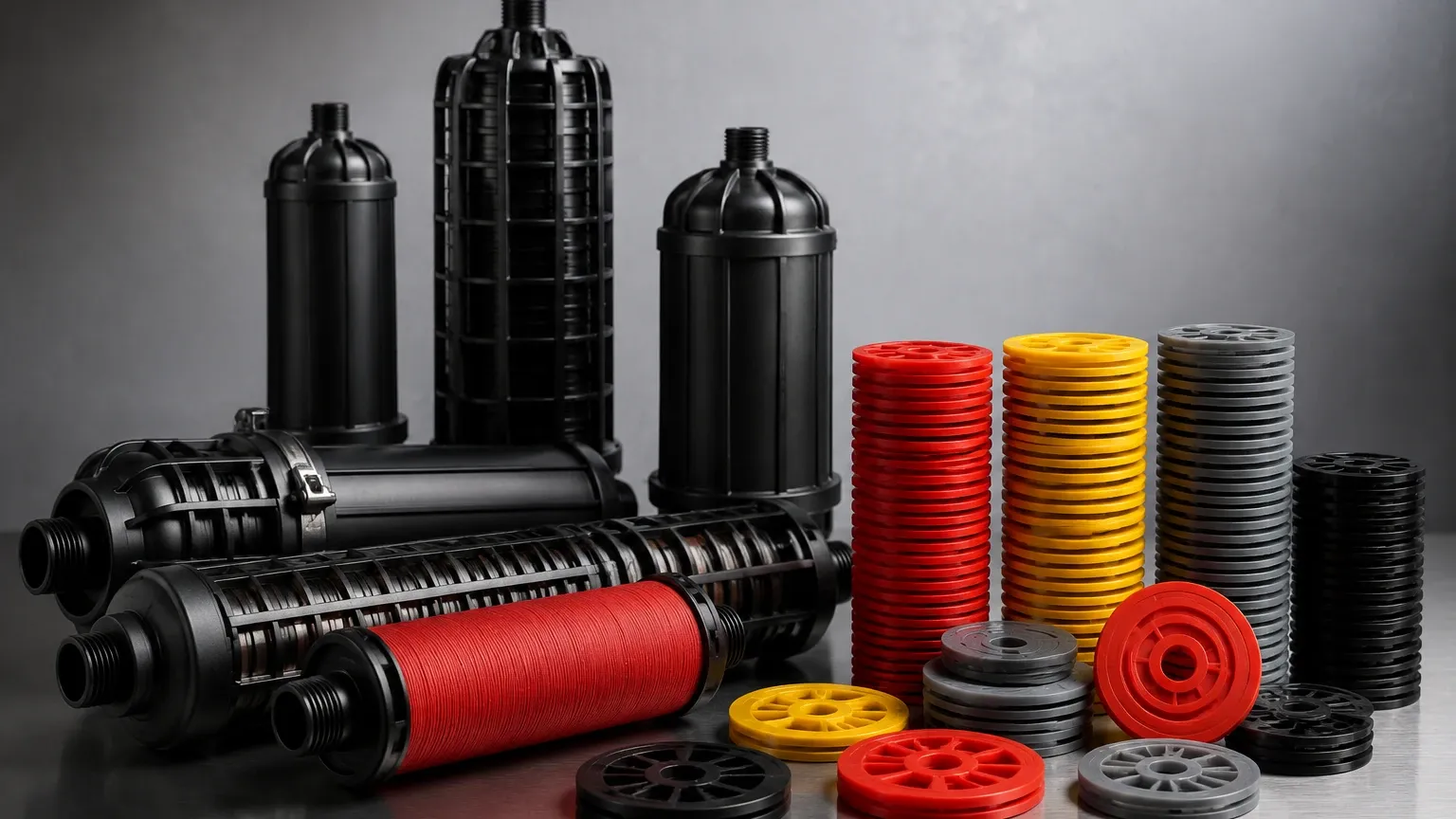
Disc filtration operates on a unique principle that distinguishes it from traditional screen or sand filters. A disc filter consists of a series of grooved plastic or metal discs stacked together on a central telescopic spine. These discs are compressed to create a three-dimensional filtration medium.
Depth Filtration vs. Surface Filtration
Unlike a standard wire mesh screen that captures particles on a single surface, a disc filter provides depth filtration. As water or fluid passes through the stack, the grooves on the discs intersect, creating a complex network of traps. This design allows the filter to capture a higher volume of solids, particularly organic matter and irregular particles that might otherwise "spear" through a flat screen.
In the context of a disc filter rainbird system, this depth filtration is what allows the unit to operate longer between cleaning cycles. For industrial engineers, this translates to reduced downtime and more consistent pressure levels across the filtration stage. When selecting components, the density and geometry of these grooves determine the micron rating, which typically ranges from 20 to 400 microns depending on the application.
The Role of Compression
During the filtration cycle, the discs are tightly compressed. This compression ensures that the only path for the fluid is through the microscopic channels created by the grooves. When the filter requires cleaning—often triggered by a pressure differential—the compression is released, allowing the discs to separate and spin. This mechanical action makes the removal of trapped debris highly efficient, a hallmark of the disc filter rainbird design.
Comparing Plastic and Stainless Steel Filter Discs
While the "disc filter rainbird" standard often utilizes high-impact engineering plastics for irrigation and general water treatment, many industrial processes require the enhanced properties of metal. Choosing between plastic and stainless steel involves evaluating the chemical environment, temperature, and pressure requirements of the system.
Industrial Applications for Stainless Steel
In sectors such as chemical processing, pharmaceuticals, and oil and gas, plastic discs may not withstand the presence of solvents or extreme temperatures. This is where stainless steel Filter Discs & Packs become indispensable. Stainless steel (typically 304 or 316L) offers:
* Chemical Compatibility: Resistance to corrosion from acids, alkalis, and organic solvents.
* Thermal Stability: The ability to maintain structural integrity at temperatures exceeding 200°C, where plastics would deform.
* High Pressure Resistance: Metal discs can handle significantly higher differential pressures without collapsing, making them ideal for hydraulic systems and high-pressure injection lines.
Hybrid Systems and Material Selection
For engineers, the decision often comes down to the "Total Cost of Ownership." While plastic disc filters like those from Rainbird are cost-effective for water-based irrigation, industrial-grade metal filter packs offer a longer service life in harsh environments. In some cases, a hybrid approach is used, where a plastic disc filter serves as a primary pre-filter, followed by a precision stainless steel mesh disc for fine particulate removal.
Engineering Considerations: Micron Ratings and Flow Rates
Selecting a disc filter requires a deep dive into the technical specifications of the media. Two of the most critical factors are the micron rating and the flow capacity.
Determining the Correct Micron Rating
The micron rating indicates the size of the smallest particle the filter is designed to trap. In irrigation (disc filter rainbird applications), common ratings are 100 to 130 microns to protect emitters. However, in industrial hydraulic systems, requirements may drop to 5-10 microns.
Engineers must balance the desire for "cleaner" fluid with the reality of pressure drop. A finer micron rating increases the resistance to flow and leads to more frequent cleaning cycles. It is often recommended to select a micron rating that is 2 to 3 times smaller than the smallest orifice being protected (e.g., a nozzle or valve) to ensure a safety margin without over-filtering.
Flow Rate and Pressure Drop (ΔP)
Every filtration component introduces a pressure drop into the system. For a disc filter, the clean pressure drop is usually minimal, but as the depth of the disc stack fills with contaminants, the ΔP increases.
When designing a system around a disc filter rainbird or an industrial equivalent, the following formula is often considered:
* Total Flow Area: The sum of all the groove intersections in the disc stack.
* Velocity: The speed at which the fluid moves through the filter. High velocity can force soft particles through the grooves, reducing filtration efficiency.
Technical professionals should consult flow charts provided by manufacturers to ensure the selected filter size can handle the peak flow requirements of the system without exceeding the recommended maximum pressure drop.
Customization and OEM Solutions for Industrial Filtration
One of the advantages of working with specialized manufacturers like Kaifil is the ability to customize Filter Discs & Packs to meet specific equipment footprints. While off-the-shelf disc filter rainbird units are excellent for standard pipe sizes, many industrial machines require bespoke filtration components.
Multilayer and Rimmed Designs
In high-precision environments, a single disc may not be sufficient. Multilayer filter packs combine different mesh counts to provide graduated filtration. For example, a coarse outer mesh can provide structural support and pre-filtration, while a fine inner layer performs the final separation.
Furthermore, these packs can be rimmed with aluminum, stainless steel, or copper to provide a leak-proof seal within the housing. This level of customization is vital for ensuring that the filter does not bypass fluid under high-pressure pulses, a common challenge in hydraulic and fuel filtration.
Spot Welding and Sintering
For applications involving high mechanical stress, filter discs are often spot-welded or sintered. Sintering bonds the wire mesh layers together at their contact points, creating a rigid, porous structure that cannot shift or deform. This is a significant step up from standard plastic disc stacks and is required in pharmaceutical and food processing where material migration (the shedding of filter fibers or particles) must be zero.
Maintenance and Operational Efficiency
The long-term success of a filtration system depends heavily on its maintenance profile. A major selling point of the disc filter rainbird is its ease of cleaning, but industrial systems often require more robust strategies.
Automated Backwashing
In large-scale operations, manual cleaning is rarely feasible. Automated disc filters use a pressure differential switch to trigger a backwash cycle. During this cycle, the flow is reversed, the disc stack is decompressed, and high-velocity jets of water spin the discs to centrifugalize the trapped debris.
For engineers, the key metric here is the "Backwash Water Consumption." An efficient system should use less than 1% of the total throughput for cleaning. Stainless steel discs are particularly well-suited for automated systems because they can withstand the repetitive mechanical stress of the decompression and spinning cycle for years without wearing down.
Inspection and Replacement Cycles
Unlike screen filters, which can tear, disc filters are incredibly durable. However, they are not immortal. In industrial settings, discs should be inspected for:
1. Chemical Erosion: Thinning of the disc edges or grooves.
2. Scaling: Mineral buildup (like calcium) that cannot be removed by standard backwashing.
3. Mechanical Wear: Damage to the spine or compression mechanism.
Establishing a clear replacement cycle based on these observations prevents catastrophic failure and ensures that the system maintains its original micron rating.
Selecting the Right Filter Discs: A Checklist for Engineers
Before purchasing or specifying a disc filtration solution, technical teams should confirm the following parameters to ensure compatibility and performance:
* Fluid Characteristics: What is the viscosity? Are there corrosive chemicals present? What is the temperature range?
* Contaminant Profile: Is the debris organic (algae, slime) or inorganic (sand, scale)? What is the particle size distribution?
* Flow Requirements: What is the average and peak flow rate? What is the maximum allowable pressure drop?
* Housing Constraints: Does the filter need to fit into an existing Rainbird housing, or is it a custom industrial manifold?
* Compliance Standards: Does the filter need to meet FDA, 3A, or other industry-specific certifications for food or medical use?
By addressing these questions, purchasing teams can move beyond generic solutions and invest in Filter Discs & Packs that are engineered for their specific operational realities.
Conclusion: The Value of Precision Filtration
Whether you are referencing the disc filter rainbird for a landscape project or integrating complex metal filter packs into a chemical refinery, the goal remains the same: protecting the integrity of the system. Disc filtration offers a robust, high-capacity alternative to traditional methods, providing the depth filtration necessary to handle diverse contaminant loads.
For industrial applications, the transition from standard plastic components to customized stainless steel solutions offers significant benefits in terms of durability, chemical resistance, and filtration accuracy. By understanding the engineering principles of disc compression, micron ratings, and material science, technical professionals can ensure their systems operate at peak efficiency with minimal maintenance overhead. Investing in high-quality filtration is not just a tactical necessity; it is a strategic decision that safeguards equipment and optimizes the total cost of industrial operations.
