


Line Filter Disc Type
In industrial fluid and gas management, the selection of a specific line filter disc type is a critical engineering decision that directly impacts system efficiency, product purity, and equipment longevity. These components, often used in high-pressure environments like plastics extrusion, chemical processing, and hydraulic systems, serve as the primary defense against particulate contamination. Understanding the nuances of material selection, weave patterns, and structural configurations is essential for engineers and procurement teams tasked with optimizing filtration performance.
Industrial filtration requires more than just a physical barrier; it demands a component that can withstand mechanical stress, chemical erosion, and thermal fluctuations. As a specialized manufacturer, Kaifil provides a range of solutions designed to meet these rigorous standards, ensuring that each line filter disc type is engineered for its specific application environment.
Understanding the Line Filter Disc Type in Industrial Applications
The term "line filter disc type" refers to a variety of disc-shaped filtration elements designed for inline placement within a piping system or machinery assembly. Unlike cylindrical cartridges, these discs are typically used where space is constrained or where the filtration process requires a flat, uniform surface area for the fluid to pass through.
These discs are commonly found in polymer melt filtration, where they are used to remove gels and impurities from molten plastics before they reach the die. They are also prevalent in the oil and gas industry for protecting sensitive instrumentation and in the pharmaceutical sector for ensuring the purity of liquid ingredients. The specific "type" of disc chosen depends on the required micron rating, the viscosity of the fluid, and the operating pressure of the system.
Material Specifications and Chemical Compatibility
The foundation of any high-performance line filter disc is the material from which it is manufactured. Stainless steel is the industry standard due to its exceptional durability and resistance to corrosion. However, the specific grade of stainless steel must be matched to the application.
304 Stainless Steel
304 stainless steel is the most common material used for general-purpose filtration. It offers good corrosion resistance and is cost-effective for applications involving water, food products, and mild chemicals. It is suitable for a wide range of industrial environments where extreme acidity or high chloride concentrations are not present.
316L Stainless Steel
For more demanding environments, 316L stainless steel is the preferred choice. The addition of molybdenum provides superior resistance to pitting and crevice corrosion, particularly in chloride-rich environments. The "L" denotes low carbon content, which improves weldability and prevents intergranular corrosion after welding processes. This material is essential for chemical processing, pharmaceutical manufacturing, and marine applications.
Specialty Alloys
In cases involving extreme temperatures or highly aggressive chemical agents, specialty alloys such as Hastelloy, Monel, or Inconel may be utilized. These materials ensure that the line filter disc type maintains its structural integrity and filtration accuracy even under conditions that would cause standard stainless steel to fail.
Mesh Weave Patterns and Micron Precision
The filtration characteristics of a line filter disc are determined by the wire mesh weave pattern. Different weaves offer varying levels of mechanical strength, flow rate, and filtration precision.
Plain Weave
In a plain weave, each warp wire crosses alternately over and under each weft wire. This is the simplest and most common weave, providing a square opening. It is ideal for high-flow applications where the primary goal is to remove relatively large particles. However, it may lack the mechanical strength required for extremely high-pressure applications.
Twill Weave
In a twill weave, each warp wire passes alternately over and under two weft wires. This allows for a heavier wire diameter and a higher mesh count, resulting in a stronger and denser mesh. Twill weaves are often used when a finer micron rating is required without sacrificing the durability of the mesh.
Dutch Weave (Plain and Twill)
Dutch weaves use a larger diameter warp wire and a smaller diameter weft wire. This creates a dense, strong mesh with very small, triangular openings. Plain Dutch weave offers high strength and is easy to clean, while Twill Dutch weave allows for the finest filtration levels, often down to 1-5 microns. This weave is frequently specified for the most demanding line filter disc type requirements in hydraulic and high-precision chemical systems.
Single-Layer vs. Multi-Layer Filter Discs & Packs
Depending on the application, a single layer of wire mesh may not provide sufficient performance. This is where the distinction between a simple disc and a complex pack becomes important. When evaluating Filter Discs & Packs, engineers must consider the trade-off between filtration depth and pressure drop.
Single-Layer Discs
Single-layer discs are used for basic straining and coarse filtration. They are easy to clean and offer the lowest pressure drop. These are typically used as pre-filters or in systems where the contaminant load is low and the particle size is relatively large.
Multi-Layer Filter Packs
Multi-layer packs consist of several layers of wire mesh, often with varying micron ratings, bonded together. The layers are typically arranged with a coarse mesh on the outside for structural support and a fine mesh in the center for precision filtration. This graduated structure allows for "depth filtration," where larger particles are trapped by the outer layers and smaller particles are captured by the inner layers. This significantly increases the dirt-holding capacity of the filter and extends the time between replacements.
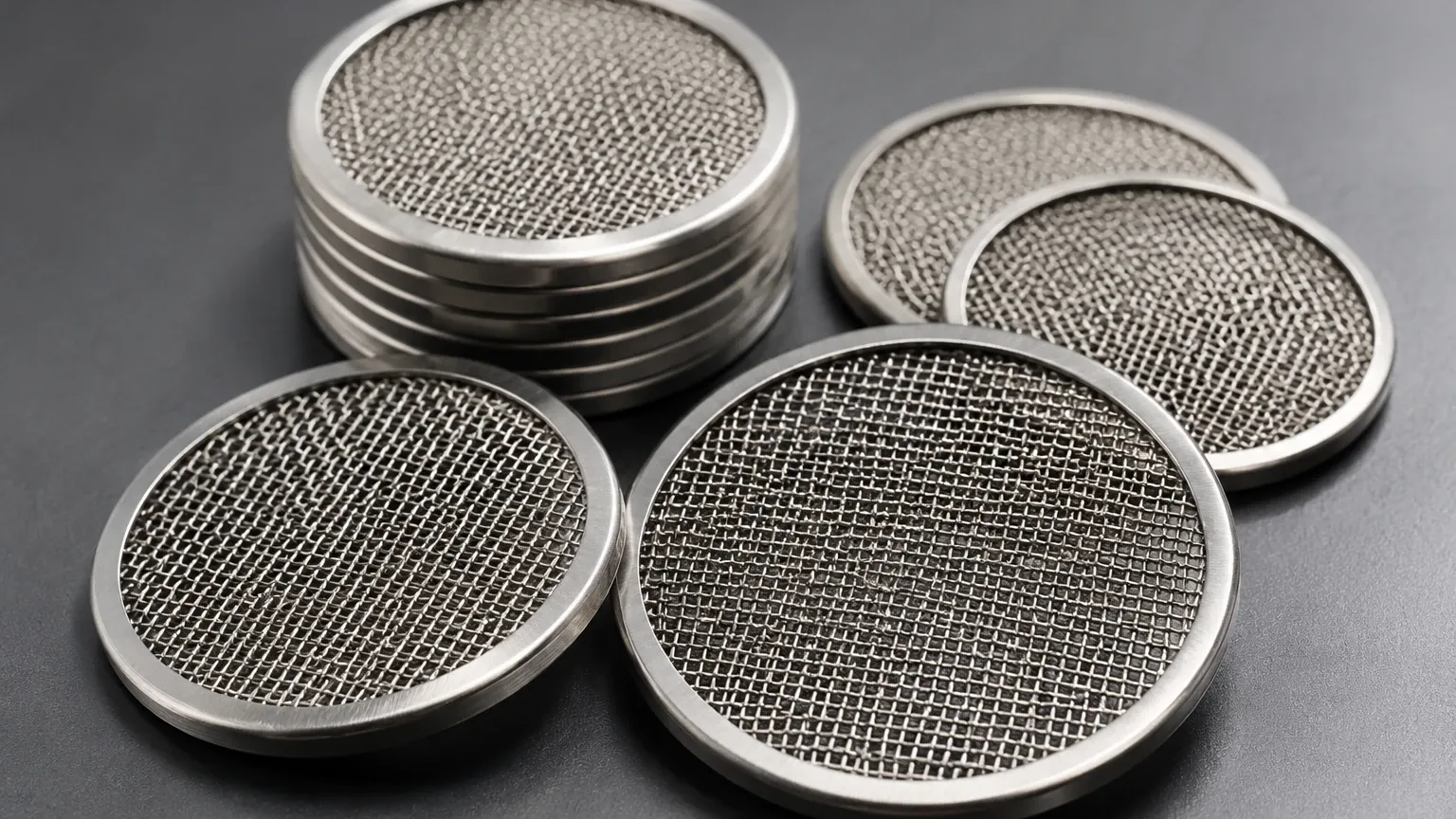
Multi-layer packs can be spot-welded or bound with a metal rim. Spot-welded packs are cost-effective and suitable for applications where the edges of the filter are held securely by the housing. Rimmed packs, however, provide a more robust seal and prevent bypass, which is critical in high-pressure extrusion and hydraulic lines.
Engineering Considerations for High-Pressure Applications
When selecting a line filter disc type for high-pressure systems, engineers must account for the mechanical stresses that will be placed on the mesh. If the pressure differential (the difference in pressure between the upstream and downstream sides of the filter) becomes too great, the mesh can deform or even rupture.
To prevent this, support layers are often added to the filter assembly. These are heavy-duty, coarse meshes that provide the necessary rigidity to prevent the fine filtration mesh from collapsing. Additionally, the method of edge sealing is vital. In high-pressure environments, an unrimmed disc may allow fluid to bypass the filtration media at the edges. A precision-engineered rim, often made of aluminum or stainless steel, ensures that 100% of the fluid passes through the mesh.
Flow rate is another critical KPI. Every filter introduces a certain amount of resistance to the flow. Engineers must calculate the Effective Filtration Area (EFA) to ensure that the line filter disc type can handle the required volume of fluid without causing an excessive pressure drop that could damage pumps or slow down production cycles.
Edge Finishing and Installation Integrity
The finishing of the disc edges is more than an aesthetic choice; it is a functional requirement. There are several common edge treatments for a line filter disc type:
1. Unrimmed (Raw Edge): The mesh is simply cut to size. These are used in applications where the disc is clamped tightly between two flat surfaces.
2. Spot-Welded: Multiple layers are held together by small welds at the periphery. This keeps the pack together during handling and installation.
3. Aluminum or Stainless Steel Rimmed: A metal U-channel is crimped around the edge of the disc or pack. This provides maximum structural integrity, protects the edges of the mesh from fraying, and creates a superior sealing surface for the filter housing.
Proper installation is equally important. Even the highest quality filter disc will fail if it is not seated correctly. Engineers should ensure that the housing is free of debris and that the disc is oriented correctly if it features a graduated multi-layer design.
Maintenance, Cleaning, and Replacement Cycles
One of the primary advantages of stainless steel line filter discs is their reusability. Unlike disposable polymer or paper filters, metal mesh can often be cleaned and returned to service, which lowers the total cost of ownership.
Cleaning Methods
* Ultrasonic Cleaning: High-frequency sound waves create cavitation bubbles that dislodge contaminants from deep within the mesh. This is highly effective for fine Dutch weave meshes.
* Chemical Cleaning: Solvents or acids are used to dissolve specific contaminants, such as polymers or organic deposits. It is crucial to ensure that the cleaning agent is compatible with the filter material (e.g., 316L).
* Burn-off (Pyrolysis): For polymer melt filters, the discs may be placed in a controlled oven to burn off the residual plastic. This must be done carefully to avoid annealing or warping the stainless steel.
Determining Replacement Cycles
Despite their durability, line filter discs eventually reach the end of their service life. Repeated cleaning cycles can eventually fatigue the wire mesh or lead to permanent clogging (blinding). The primary indicator for replacement is a consistently high pressure drop even after a thorough cleaning. Engineers should also inspect the mesh for signs of mechanical damage, such as wire breakage or thinning, which can lead to "breakthrough" where contaminants pass through the filter.
Conclusion
Selecting the correct line filter disc type requires a comprehensive understanding of the operational environment, from chemical exposure and temperature to pressure and flow requirements. By choosing the right material, weave, and structural configuration, industrial operators can ensure high product quality and protect their downstream equipment. Kaifil’s expertise in manufacturing custom Filter Discs & Packs provides the technical foundation necessary for engineers to implement reliable and cost-effective filtration solutions across a wide spectrum of industrial applications.
