


Disc Filter Working Principle PDF
In industrial filtration, the selection of the correct media is a critical engineering decision that directly impacts process efficiency, product purity, and equipment longevity. Among the most versatile components used in high-pressure and high-temperature environments are Filter Discs & Packs. These components are engineered from stainless steel wire mesh to provide precise mechanical separation. Understanding the fundamental mechanics of how these discs operate is essential for engineers and technical procurement teams seeking to optimize their filtration systems.
This technical guide explores the structural design, fluid dynamics, and selection criteria associated with metal filter discs. Whether you are searching for a disc filter working principle pdf to support system design or evaluating vendors for custom OEM components, this analysis provides the factual foundation required for informed decision-making.
The Core Mechanics of Metal Mesh Filtration
The primary function of a filter disc is mechanical sieving. Unlike depth filtration media, such as sand or thick felt, which trap particles within a complex three-dimensional matrix, stainless steel wire mesh discs primarily perform surface filtration.
Mechanical Sieving and Particle Retention
When a fluid—whether liquid or gas—passes through the apertures of a woven wire mesh, particles larger than the pore size are physically blocked. The precision of this process is determined by the weaving pattern and the wire diameter. In industrial applications, the "micron rating" defines the size of the smallest particle the disc can reliably intercept.
Flow Dynamics and Pressure Differential
As fluid approaches the disc, it encounters resistance. This resistance creates a pressure drop (ΔP) across the media. In a clean state, the pressure drop is a function of the fluid's viscosity, the velocity of the flow, and the open area of the mesh. As the filtration cycle progresses, trapped contaminants begin to bridge the apertures, creating a "filter cake." While this cake can actually improve filtration fineness, it also increases the resistance, leading to a rise in differential pressure. Engineers must monitor this ΔP to determine the optimal point for cleaning or replacement.
Structural Anatomy of Filter Discs & Packs
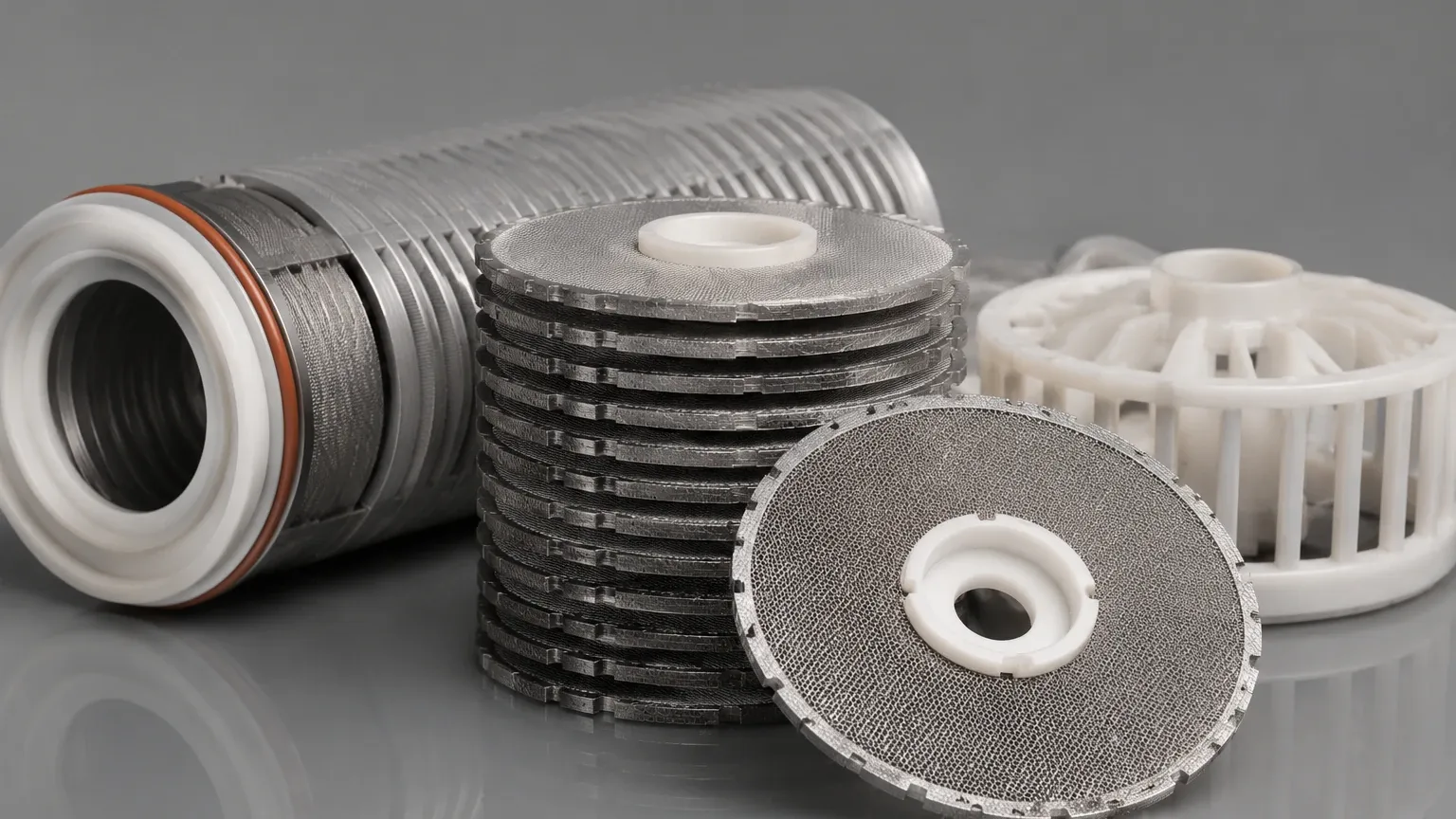
Industrial applications rarely rely on a single, flimsy piece of mesh. Instead, Filter Discs & Packs are often engineered as multi-layered assemblies to balance filtration fineness with structural integrity.
Single-Layer vs. Multi-Layer Designs
* Single-Layer Discs: These are used in low-pressure applications or as primary strainers where high flow rates are prioritized over ultra-fine filtration. They are cost-effective but lack the rigidity required for high-viscosity polymer or hydraulic applications.
* Multi-Layer Packs: These consist of several layers of mesh bonded together. A typical configuration includes a fine filtration layer sandwiched between coarser support and drainage layers. The support layers prevent the fine mesh from deforming under pressure, while the drainage layers ensure the fluid can flow laterally toward the discharge point.
Edge Treatments and Rimming
To ensure a leak-proof seal within the filter housing and to prevent the edges of the wire mesh from fraying, discs are often finished with specific edge treatments:
* Spot Welding: Multiple layers are welded at specific points to maintain alignment.
* Aluminum or Stainless Steel Rims: A metal binding is compressed around the circumference of the disc. This provides a gasket-like surface that ensures all fluid must pass through the mesh rather than bypassing around the edges.
* Ultrasonic Welding: Used for specialized applications where chemical purity is paramount and traditional welding flux or heat-affected zones must be avoided.
Material Science: Why Stainless Steel?
The effectiveness of the disc filter working principle pdf documentation often highlights the importance of material compatibility. In harsh industrial environments, the material of construction is as important as the micron rating.
Grade 304 Stainless Steel
304 is the standard industrial grade, offering excellent strength and basic corrosion resistance. It is suitable for food and beverage applications, general water treatment, and non-corrosive chemical processing.
Grade 316L Stainless Steel
For environments involving chlorides, high acidity, or pharmaceutical requirements, 316L is preferred. The addition of molybdenum and a lower carbon content provides superior resistance to pitting and intergranular corrosion. This is the material of choice for marine environments and aggressive chemical catalysts.
Thermal and Mechanical Stability
Unlike plastic or paper media, stainless steel filter discs maintain their pore geometry under extreme temperatures (up to 400°C or higher depending on the alloy) and high-pressure differentials. This stability ensures consistent filtration performance throughout the entire production cycle.
Engineering Selection Criteria
When specifying Filter Discs & Packs, engineers must look beyond simple dimensions. A comprehensive technical evaluation involves several variables:
1. Micron Rating (Absolute vs. Nominal): Engineers must confirm whether the rating is absolute (100% retention of the specified size) or nominal (a percentage of retention). For critical applications like hydraulic valve protection or pharmaceutical sterilization, absolute ratings are mandatory.
2. Effective Filtration Area (EFA): This is the total surface area of the mesh that is actually open to flow. Increasing the EFA reduces the face velocity and extends the time between cleaning cycles.
3. Mesh Weave Types:
* Plain Weave: Simple over-under pattern, offering high open area.
* Dutch Weave: Uses heavier wires in one direction and finer wires in the other, creating a dense, strong mesh capable of very fine filtration.
* Twill Weave: Allows for thicker wires in a given micron rating, increasing the mechanical strength of the disc.
Applications Across Key Industries
The versatility of metal filter discs allows them to be used in diverse sectors, each with unique performance requirements.
Polymer and Plastic Extrusion
In the production of synthetic fibers and plastics, "screen packs" are used to remove gels and un-melted particles from the polymer melt. These discs must withstand immense pressures (often exceeding 3,000 PSI) and high temperatures while maintaining a precise micron rating to prevent fiber breakage.
Chemical and Petrochemical Processing
Filter discs are used to recover expensive catalysts from process streams and to protect downstream equipment from particulate damage. Their ability to be cleaned and reused makes them more cost-effective than disposable cartridges in high-volume chemical lines.
Food and Beverage
From filtering cooking oils to clarifying syrups, stainless steel discs provide a hygienic solution that complies with stringent safety standards. Because they do not shed fibers (unlike paper or felt), they ensure the purity of the final consumable product.
Maintenance, Cleaning, and Total Cost of Ownership
One of the primary advantages of stainless steel Filter Discs & Packs is their cleanability. While the initial capital expenditure (CAPEX) for metal media is higher than for disposable alternatives, the total cost of ownership (TCO) is often lower due to their extended service life.
Cleaning Methodologies
Depending on the contaminant, discs can be cleaned using several industrial methods:
* Ultrasonic Cleaning: High-frequency sound waves create cavitation bubbles that dislodge particles from deep within the mesh pores.
* Backwashing: Reversing the flow of fluid to push contaminants off the surface of the disc.
* Chemical Cleaning: Using solvents or acids (compatible with 316L) to dissolve organic or mineral buildup.
* Burn-off/Pyrolysis: For polymer applications, discs can be placed in specialized ovens to carbonize and remove plastic residues.
Determining Replacement Cycles
Despite their durability, metal discs eventually reach a point of "permanent fouling" where the pressure drop no longer returns to baseline levels after cleaning. Engineers should establish a SOP (Standard Operating Procedure) for disc replacement based on the number of cleaning cycles or a specific threshold of irrecoverable pressure drop.
Conclusion: Selecting the Right Filtration Partner
Understanding the disc filter working principle pdf is only the first step in optimizing an industrial process. Successful implementation requires a manufacturer that understands the nuances of wire mesh engineering, from material metallurgy to precision die-cutting and welding.
For technical teams, the focus should remain on verifying the quality of the weave, the integrity of the rimming or welding, and the manufacturer's ability to provide customized configurations that fit existing housings. By prioritizing these factual engineering benchmarks, procurement professionals can ensure they receive filtration components that provide reliable, long-term performance in the most demanding industrial environments.
