


Disc Filter 120 Mesh
In industrial filtration, the precision of the mesh count directly correlates with the efficiency of the separation process and the protection of downstream equipment. A disc filter 120 mesh represents a critical specification for medium-to-fine filtration, offering a nominal aperture size of approximately 125 microns (0.125 mm). For engineers and procurement teams, selecting the right disc filter involves more than just identifying the mesh count; it requires a deep understanding of material science, structural integrity, and the fluid dynamics of the specific application.
At Kaifil, we specialize in the manufacturing of high-performance Filter Discs & Packs designed to withstand the rigorous demands of chemical processing, plastic extrusion, and hydraulic systems. This guide provides a technical overview of the 120 mesh disc filter, its engineering considerations, and its role in modern industrial environments.
The Technical Fundamentals of 120 Mesh Filtration
The term "mesh" refers to the number of openings per linear inch of the wire cloth. A 120 mesh specification indicates that there are 120 openings in one inch of the material. To understand the performance of a disc filter 120 mesh, one must consider the relationship between the mesh count, the wire diameter, and the resulting aperture size.
Aperture and Micron Rating
For a standard stainless steel 120 mesh, the wire diameter is typically around 0.08 mm to 0.09 mm. This results in an aperture (the clear opening between wires) of approximately 122 to 125 microns. This size is ideal for capturing medium-sized particulates that could damage precision valves or contaminate high-purity fluids. In many B2B applications, this is considered a "fine" mesh, bridging the gap between coarse straining and ultra-fine micro-filtration.
Open Area Percentage
The open area is the ratio of the total area of the openings to the total area of the mesh. For a 120 mesh disc, the open area typically ranges between 30% and 38%. A higher open area reduces the initial pressure drop across the filter but may compromise the mechanical strength of the mesh. Engineers must balance the need for high flow rates with the structural requirements of the system, especially in high-pressure environments like polymer melt filtration.
Material Properties and Chemical Compatibility
The performance of a disc filter 120 mesh is largely dictated by the alloy used in its construction. Stainless steel is the industry standard due to its corrosion resistance and thermal stability.
* AISI 304 Stainless Steel: This is the most common material for general industrial use. It offers excellent resistance to atmospheric corrosion and many organic and inorganic chemicals. It is widely used in food and beverage processing and general water treatment.
* AISI 316/316L Stainless Steel: For more demanding environments, 316L is preferred. The addition of molybdenum provides superior resistance to chlorides and pitting corrosion. In pharmaceutical and chemical processing where aggressive solvents or acidic solutions are present, 316L ensures a longer service life and prevents metallic contamination of the filtrate.
* Specialty Alloys: In extreme cases involving high temperatures or highly corrosive media, materials such as Monel, Inconel, or Hastelloy may be utilized. These are typically reserved for specialized oil and gas or aerospace applications where standard stainless steels would fail prematurely.
Structural Configurations: Single Layer vs. Multi-Layer Filter Packs
A disc filter 120 mesh can be supplied as a single-layer component or as part of a multi-layer composite pack. The choice depends on the mechanical stress and the required filtration depth.
Single-Layer Discs
Single-layer discs are typically used in low-pressure applications or as a final safety screen. They are cost-effective and easy to clean. However, they lack the structural rigidity to withstand high differential pressures without deformation.
Multi-Layer Filter Packs
In many industrial processes, such as plastic extrusion, the 120 mesh disc is combined with other mesh sizes (e.g., 20 mesh, 40 mesh, and 60 mesh) to create a graduated filtration effect. This configuration serves two purposes:
1. Support: Coarser meshes (like 20 mesh) provide the structural backbone, preventing the finer 120 mesh from collapsing or "dishing" under pressure.
2. Depth Filtration: The coarser outer layers capture larger debris, preventing the 120 mesh layer from blinding prematurely, thereby extending the replacement cycle.
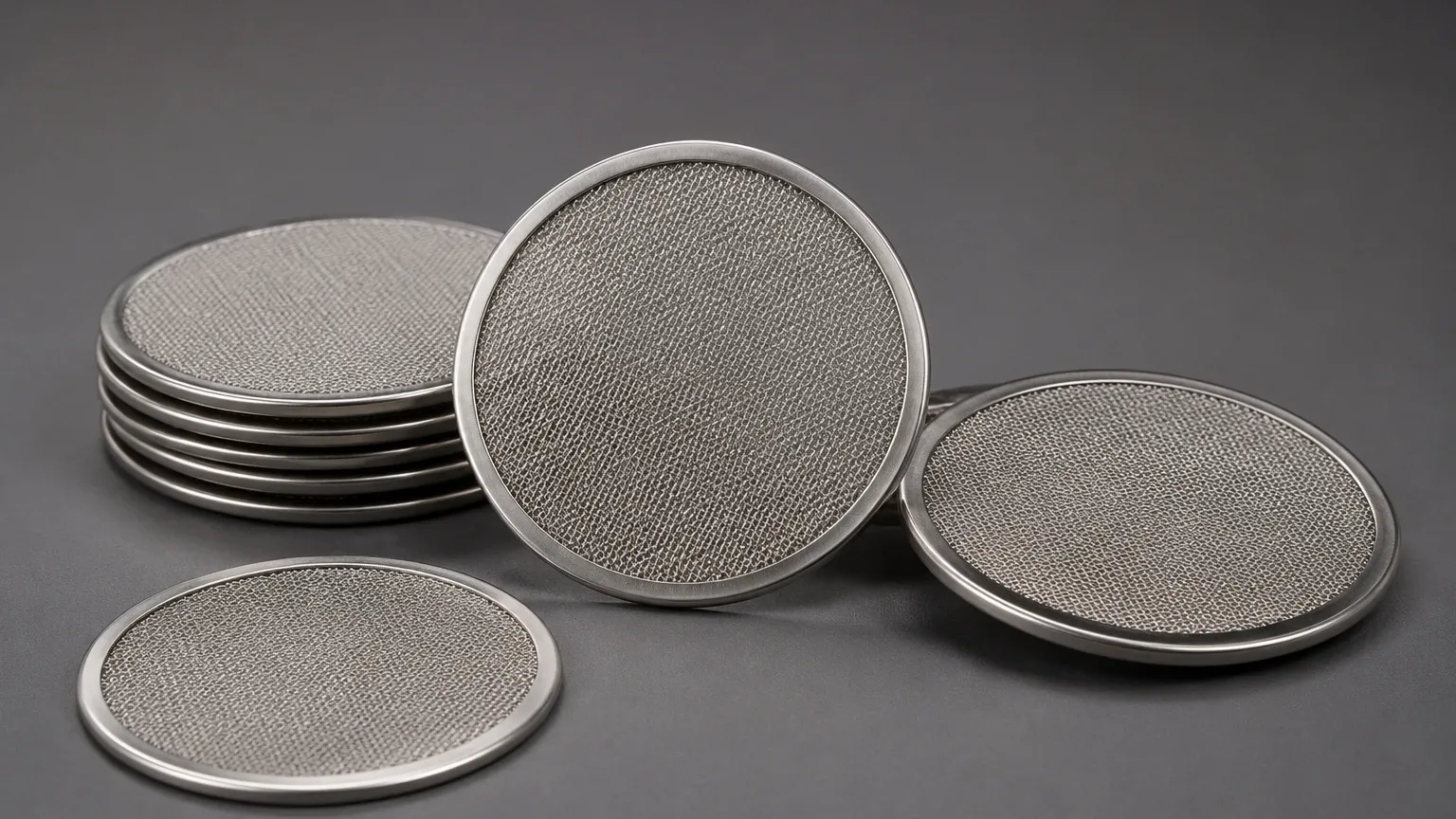
These packs can be spot-welded together or bound with a metal rim (aluminum or stainless steel) to ensure a leak-proof seal within the filter housing.
Critical Performance Metrics in Industrial Applications
When specifying a disc filter 120 mesh, engineers must evaluate several performance metrics to ensure the component meets the system's operational requirements.
Pressure Drop (ΔP)
The pressure drop is the difference in pressure between the upstream and downstream sides of the filter. For a 120 mesh disc, the initial pressure drop is influenced by the fluid viscosity and flow velocity. As the filter captures contaminants, the ΔP will increase. It is vital to determine the "terminal pressure drop"—the point at which the filter must be cleaned or replaced to prevent system failure or bypass.
Dirt Holding Capacity
This refers to the total amount of contaminant the disc can retain before the pressure drop reaches its limit. While 120 mesh provides precise filtration, it has a lower dirt-holding capacity than coarser meshes. In systems with high particulate loading, using a multi-layer pack or a larger surface area (by increasing the disc diameter) is necessary to maintain efficient run times.
Flow Rate and Velocity
High fluid velocity can cause "migration" of particles through the mesh or lead to premature wear of the wire. For liquid applications, maintaining a laminar flow is generally preferred. For gas or steam applications, the 120 mesh disc must be securely fixed to prevent vibration-induced fatigue of the wire mesh.
Manufacturing Precision and Quality Standards
The reliability of a disc filter 120 mesh depends heavily on the manufacturing process. At Kaifil, we focus on precision to ensure that every disc meets exact dimensional tolerances.
* Cutting Techniques: We utilize advanced laser cutting and precision die-stamping to ensure the edges of the discs are clean and burr-free. Burrs can not only damage seals but also break off and become downstream contaminants themselves.
* Flatness: In high-pressure seals, the flatness of the disc is paramount. Any warping can lead to fluid bypass, rendering the filtration process ineffective.
* Ultrasonic Cleaning: Post-manufacturing, discs should undergo ultrasonic cleaning to remove residual oils, metal fines, or dust from the weaving and cutting processes. This is especially critical for pharmaceutical and food-grade applications.
Maintenance, Cleaning, and Lifecycle Management
One of the primary advantages of using stainless steel Filter Discs & Packs is their ability to be cleaned and reused, which significantly lowers the total cost of ownership compared to disposable polymer filters.
Cleaning Methods
1. Backwashing: For liquid systems, reversing the flow can dislodge surface-level contaminants.
2. Ultrasonic Bath: This is the most effective method for 120 mesh discs, as high-frequency sound waves create cavitation bubbles that pull particles out of the mesh openings.
3. Chemical Cleaning: Using compatible solvents or acids can dissolve organic or mineral deposits that are stuck within the wire intersections.
4. Burn-off (Pyrolysis): Common in the plastics industry, this involves heating the filter to high temperatures to carbonize polymer residue, which is then removed via ultrasonic cleaning.
Replacement Indicators
Despite their durability, metal discs eventually experience mechanical fatigue or "blinding" that cannot be reversed. Signs that a disc needs replacement include permanent deformation (dishing), broken wires, or a rapid return to high differential pressure shortly after a cleaning cycle.
Selection Guide: Specifying the Right Disc Filter
To ensure you receive the optimal disc filter 120 mesh for your project, it is essential to confirm the following details with your manufacturer:
1. Exact Dimensions: Specify the outer diameter (OD) and, if applicable, the inner diameter (ID) for donut-shaped discs. Standard tolerances are usually +/- 0.1mm.
2. Layer Composition: If ordering a pack, define the sequence of mesh counts (e.g., 20/60/120/60/20).
3. Edge Treatment: Determine if you require a raw edge, a spot-welded edge, or a rimmed edge (aluminum, copper, or stainless steel).
4. Operating Environment: Provide details on the operating temperature, maximum pressure, and the chemical nature of the fluid.
5. Compliance Requirements: For food or medical applications, ensure the materials meet FDA or REACH standards.
By focusing on these technical details, engineers can optimize their filtration processes, reduce downtime, and protect sensitive industrial equipment. Whether you are looking for a standard disc filter 120 mesh or a custom-engineered multi-layer pack, Kaifil provides the technical expertise and manufacturing precision required to meet the most demanding industrial standards.
