


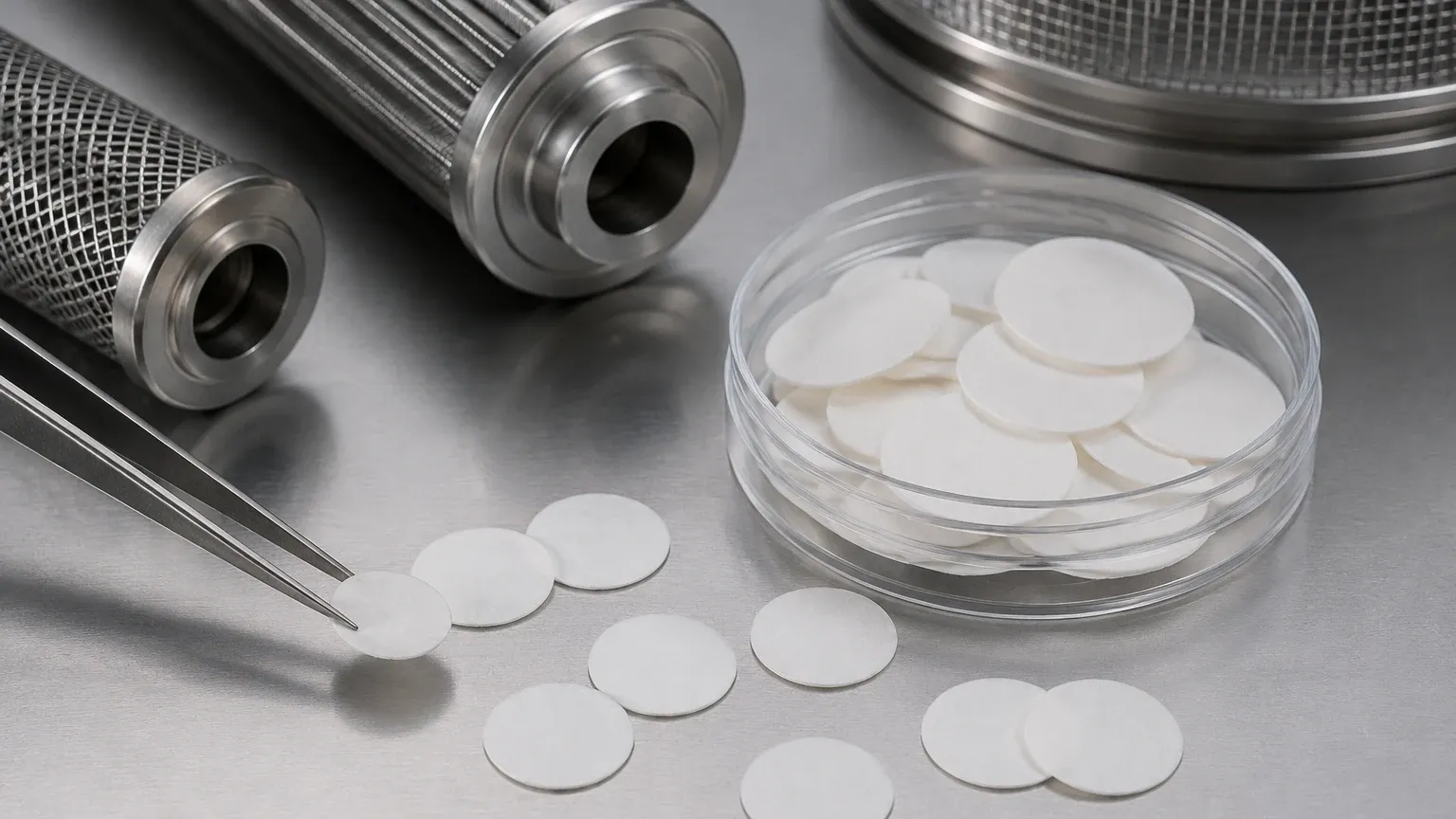
Sterile Filter Paper Discs 6mm
In the specialized fields of microbiology, pharmaceutical manufacturing, and industrial quality control, the precision of filtration components often dictates the reliability of experimental and production outcomes. Among these components, sterile filter paper discs 6mm serve as a fundamental tool for antibiotic susceptibility testing (AST), microbial assays, and small-scale liquid purification. While seemingly simple, the engineering behind these discs involves rigorous material selection, sterilization validation, and dimensional consistency to ensure they meet the demanding standards of laboratory and industrial environments.
For engineers and procurement professionals, understanding the technical nuances of these discs—and how they integrate into broader Filter Discs & Packs systems—is essential for maintaining process integrity and achieving accurate data. This guide explores the technical specifications, application logic, and selection criteria for 6mm sterile filter paper discs within a professional B2B context.
Understanding the Technical Specifications of 6mm Sterile Filter Paper Discs
The 6mm diameter is not an arbitrary figure; it is a standardized dimension widely recognized in clinical and industrial microbiology, particularly for the Kirby-Bauer disc diffusion method. However, the performance of the disc is determined less by its size and more by its material composition and structural uniformity.
Material Composition and Purity
Most high-quality sterile filter paper discs are manufactured from 100% high-purity alpha-cellulose. This material is chosen for its chemical inertness and high absorbency. In industrial applications, it is critical that the paper contains no binders, resins, or wet-strength additives that could leach into the sample or interfere with microbial growth. The purity of the cellulose ensures that the capillary action—the mechanism by which the disc absorbs and subsequently releases liquids—remains consistent across different batches.
Pore Size and Retention Characteristics
Unlike membrane filters, which have a defined pore size, filter paper acts as a depth filter. The "pore size" is typically expressed as a nominal rating. For 6mm discs used in testing, the retention capacity usually falls within the range of 2 to 10 micrometers. This allows the disc to hold a specific volume of reagent or antibiotic solution (typically 20–30 µL) without the fibers breaking down or the liquid migrating unevenly.
Thickness and Basis Weight
The thickness of the paper (often measured in millimeters or microns) and its basis weight (g/m²) determine the total volume of fluid the disc can retain. Engineers must confirm these specs to ensure that the concentration of the substance being tested remains within the required parameters. A disc that is too thin may not hold enough reagent, while one that is too thick may result in slow diffusion rates.
Applications in Microbiology and Industrial Quality Control
Sterile filter paper discs 6mm are ubiquitous in environments where sterility and precision are non-negotiable. Their primary role is to act as a carrier for bioactive substances or as a pre-filter in micro-scale assemblies.
Antibiotic Susceptibility Testing (AST)
In pharmaceutical R&D and clinical diagnostics, these discs are impregnated with specific concentrations of antimicrobial agents. When placed on an agar plate inoculated with bacteria, the agent diffuses into the medium. The resulting "zone of inhibition" is measured to determine the efficacy of the agent. The 6mm standard allows for standardized comparison across global laboratories.
Pharmaceutical Sterility Testing
During the production of injectable drugs or ophthalmic solutions, 6mm discs may be used in specialized filtration manifolds to capture contaminants from small sample volumes. They serve as an initial stage of analysis before moving to larger-scale Filter Discs & Packs used in the actual production line.
Water and Food Safety Analysis
In industrial food processing, these discs are used to detect the presence of inhibitory substances (like residual cleaners or antibiotics) in raw materials such as milk or processed water. The disc's ability to provide a clean, sterile background is vital for avoiding false positives in sensitive assays.
Integrating Paper Discs with Industrial Filter Discs & Packs
While paper discs are excellent for laboratory-scale testing and assays, industrial processes often require a transition from cellulose-based media to more robust, permanent filtration solutions. This is where the concept of Filter Discs & Packs becomes relevant for engineering teams.
Support Structures and Housing
In many industrial filtration housings, a paper disc may be used as a disposable secondary layer, supported by a stainless steel wire mesh disc. The metal mesh provides the mechanical strength required to withstand high differential pressures, while the paper disc provides the specific depth filtration or chemical interaction needed for the process. Kaifil specializes in manufacturing these precision metal components that house or support various filter media.
Scaling from Lab to Production
Engineers often use 6mm paper discs to validate a filtration concept at the bench scale. Once the retention efficiency and flow rates are established, the process is scaled up using multi-layer metal filter packs. These packs can incorporate sintered wire cloth, perforated metals, and fiber felts to replicate the performance of the paper disc but with the durability of stainless steel. This transition is crucial for chemical processing and hydraulic applications where paper would fail due to pressure or chemical degradation.
Critical Evaluation Criteria for Purchasing Teams
When procuring sterile filter paper discs 6mm, purchasing teams must look beyond the price point and evaluate the technical validation provided by the manufacturer.
1. Sterilization Method: Confirm whether the discs are sterilized via gamma irradiation, ethylene oxide (EtO), or autoclaving. Gamma irradiation is often preferred for cellulose products as it ensures deep penetration without the moisture risks associated with steam sterilization.
2. Absorbency Validation: The manufacturer should provide data on the microliter capacity of the disc. This is essential for ensuring that the dosage of the impregnated substance is accurate.
3. Dimensional Tolerance: In automated disc dispensers used in large labs, even a 0.1mm variance in diameter can cause equipment jams. Precision-cut discs with clean edges (no fraying) are mandatory.
4. Certification: Look for ISO 13485 (for medical devices) or ISO 9001 certification to ensure batch-to-batch consistency. For pharmaceutical applications, USP Class VI plastics (if the discs are in a cartridge) or equivalent material certifications for the cellulose are necessary.
Common Risks and Performance Limitations
Despite their utility, sterile filter paper discs 6mm have limitations that engineers must account for in their system design.
* Fiber Shedding: Cellulose is a fibrous material. In high-flow applications, there is a risk of downstream contamination from migrating fibers. This is why paper is rarely used as a final stage in critical industrial loops without a downstream metal mesh guard.
* Chemical Compatibility: Cellulose is sensitive to strong acids, bases, and certain organic solvents. If the process involves aggressive chemicals, transitioning to stainless steel Filter Discs & Packs is the only viable engineering choice.
* Moisture Sensitivity: As a hydrophilic material, paper discs can absorb ambient moisture if the packaging is compromised. This can alter the concentration of impregnated reagents or lead to microbial growth within the disc itself before use.
Customization and Scaling: From Paper to Metal Filtration
For many B2B applications, a standard off-the-shelf 6mm disc is only the starting point. Customization often involves creating composite filter packs that combine the best properties of different materials.
OEM Capabilities
Manufacturers like Kaifil provide OEM services for technical teams who need more than just a standard disc. This includes custom-sized metal rings to hold paper media, or the development of all-metal filter discs that mimic the flow characteristics of paper but offer the longevity of 316L stainless steel.
Total Cost of Ownership (TCO)
While paper discs are inexpensive on a per-unit basis, the cost of labor for frequent replacement and the risk of batch failure due to fiber shedding can be high. In industrial settings, investing in high-quality Filter Discs & Packs made of sintered mesh or metal fiber felt often results in a lower TCO due to their cleanability and reuse potential.
Conclusion: Making Informed Filtration Decisions
The selection of sterile filter paper discs 6mm is a critical decision for laboratory precision, but it also serves as a gateway to broader industrial filtration strategy. By understanding the material limits of cellulose and the mechanical advantages of metal support structures, engineers can design systems that are both accurate in the lab and robust on the production floor.
When evaluating your filtration needs, consider the environment in which the disc will operate. If your application requires high pressure, chemical resistance, or long-term durability, exploring professional Filter Discs & Packs is a necessary step. For those focused on microbiology and small-scale assays, the 6mm sterile paper disc remains the industry standard, provided it is sourced from a manufacturer that prioritizes purity, sterility, and dimensional accuracy.
