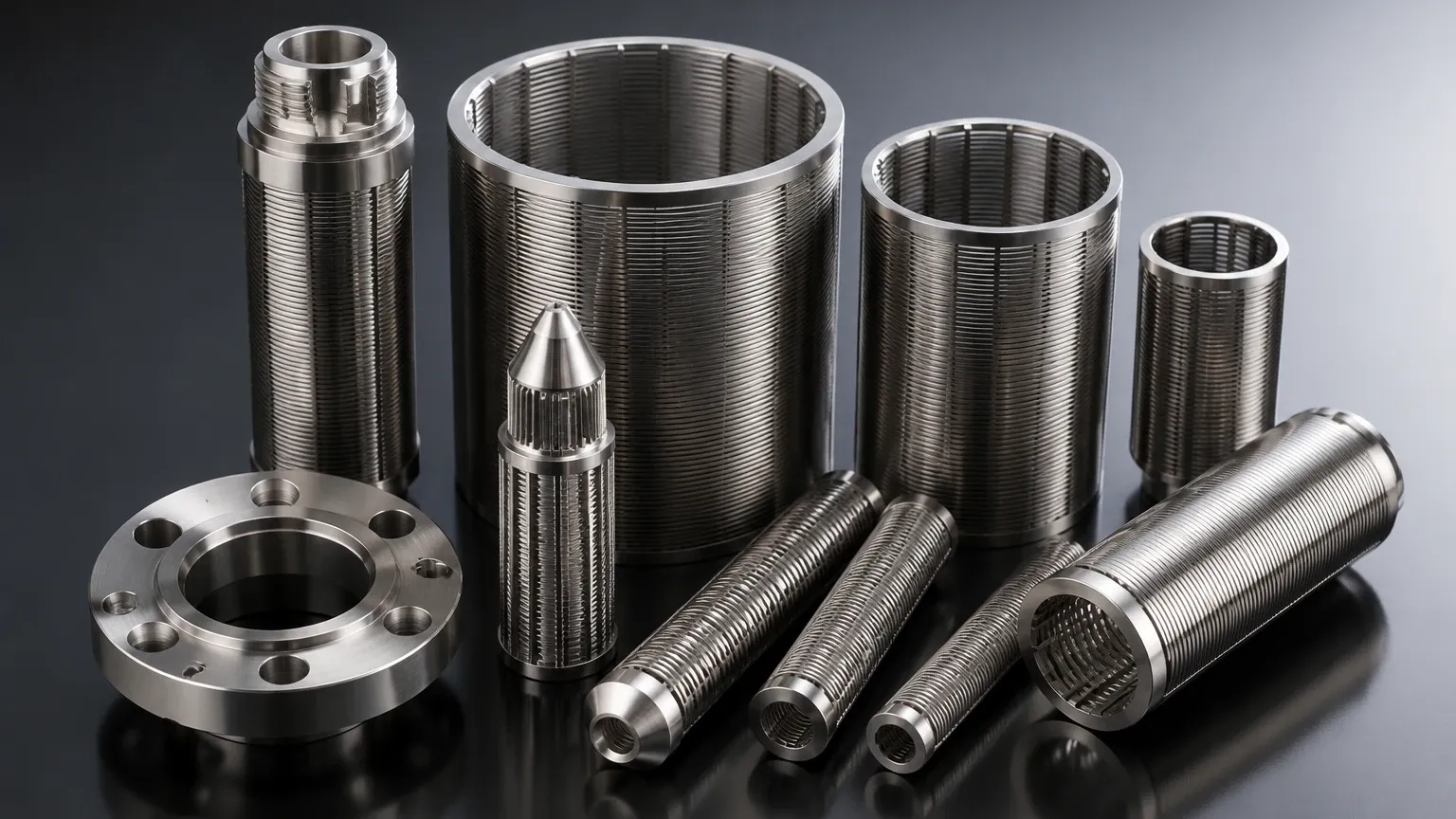
Vision Wedge Wire Screens
In the landscape of industrial separation and filtration, precision is the primary driver of efficiency. Among the various technologies available, wedge wire screens have established themselves as a critical component for high-performance applications. When discussing vision wedge wire screens, the focus shifts toward a higher tier of manufacturing accuracy, where slot uniformity and surface integrity are paramount. These components are not merely filters; they are engineered structures designed to handle demanding mechanical loads while providing precise aperture control for industries ranging from food processing to high-end architectural installations.
Understanding the Engineering Principles of Wedge Wire Screens
The fundamental advantage of Wedge Wire Screens lies in their geometric design. Unlike traditional woven wire mesh, which consists of intersecting wires that can shift or trap particles at the cross-points, wedge wire is constructed using a series of V-shaped profile wires. These wires are resistance-welded onto support rods at each intersection, creating a rigid, non-clogging surface.
The V-shaped profile is oriented such that the narrowest part of the slot is at the filtration surface. As particles pass through the aperture, the distance between the wires increases. This "opening-out" effect ensures that any particle capable of entering the slot will pass through without becoming wedged—a phenomenon known as blinding. For engineers, this translates to lower maintenance requirements and more consistent flow rates over the lifecycle of the equipment.
Defining Vision Wedge Wire Screens in Industrial Applications
The term "vision" in the context of these screens often refers to two distinct but related industrial requirements: optical precision and aesthetic uniformity. In automated sorting and inspection systems, vision wedge wire screens provide the necessary consistency for optical sensors or high-speed cameras to function without interference from structural irregularities.
In these applications, the slot width tolerance must be exceptionally tight. If a screen is used in a sorting line where vision systems identify defects in grain or plastic pellets, any deviation in the slot width can lead to false positives or mechanical jams. Furthermore, in architectural applications, "vision" refers to the visual consistency of the screen when used for facades, grilles, or lighting diffusers. In both cases, the manufacturing process must ensure that every wire is perfectly aligned and every weld is structurally sound without causing thermal deformation.
Material Selection and Durability Factors
Selecting the correct alloy is the first step in ensuring the longevity of a vision wedge wire screen. Because these screens are often deployed in corrosive or high-temperature environments, the material properties must align with the chemical profile of the process fluid.
1. Stainless Steel 304: The standard choice for general-purpose applications. It offers good corrosion resistance and is suitable for most food-grade environments where aggressive chemicals are not present.
2. Stainless Steel 316L: Preferred for pharmaceutical and marine applications. The addition of molybdenum provides enhanced resistance to chlorides and pitting, which is essential for maintaining the precision of the slot edges over time.
3. Duplex Stainless Steels: For high-pressure hydraulic systems or aggressive chemical processing, duplex alloys offer superior mechanical strength and stress-corrosion cracking resistance.
Beyond the alloy, the surface finish plays a vital role in performance. For vision-grade applications, electropolishing is often employed. This electrochemical process removes a fine layer of surface material, smoothing out microscopic peaks and valleys. The result is a mirror-like finish that further reduces the risk of bacterial growth in food applications and improves the clarity of the screen for optical systems.
Key Performance Metrics for Precision Filtration
When evaluating vision wedge wire screens, engineers must look beyond the basic dimensions. Several technical metrics determine the suitability of a screen for a specific process:
Slot Width and Tolerance
Precision is measured in microns. For critical separation tasks, slot widths can be as fine as 20 microns. However, the true measure of quality is the tolerance. A screen specified at 100 microns with a +/- 5-micron tolerance performs significantly differently than a standard commercial grade screen. High-precision manufacturing ensures that the open area remains consistent across the entire surface.
Percentage of Open Area
The open area is the ratio of the total slot area to the total screen surface. It is calculated using the formula:
*Open Area % = (Slot Width / (Slot Width + Wire Width)) x 100*
A higher open area reduces the approach velocity of the fluid, which minimizes pressure drop and reduces the risk of particle impingement or screen erosion. However, increasing the open area often requires thinner profile wires, which can compromise the structural integrity of the screen under high differential pressure.
Flow Direction and Orientation
Vision wedge wire screens can be configured for different flow patterns:
* Radial Flow (FOTI – Flow Out to In): The profile wires are on the outside, and the support rods are on the inside. This is common in cartridge filters.
* Radial Flow (FITO – Flow In to Out): The profile wires are on the inside, allowing for internal cleaning or centrifugal separation.
* Axial Flow: The wires run parallel to the axis of the cylinder, often used in screw press separators.
Common Challenges and Risk Mitigation in Screen Selection
Even the most precisely manufactured screen can fail if the application parameters are not correctly defined. Engineers should be aware of several common risks:
Mechanical Fatigue: In systems with high-frequency pressure pulsations (such as reciprocating pumps), the welds between the profile wire and the support rods can experience fatigue. Specifying a higher density of support rods can mitigate this risk, though it may slightly reduce the open area.
Erosion and Abrasion: In slurry handling or mining applications, abrasive particles can wear down the leading edges of the V-wire. This gradually increases the slot width, leading to a loss of filtration accuracy. Hard-facing or the use of abrasion-resistant alloys is necessary in these environments.
Differential Pressure Collapse: Every screen has a maximum collapse pressure. If a screen becomes blinded due to an unexpected process upset, the resulting pressure differential can crush the screen. It is vital to confirm the structural calculations based on the maximum possible pump pressure, not just the operating pressure.
Customization and OEM Integration
Because industrial processes vary significantly, off-the-shelf solutions are rarely sufficient for high-precision requirements. Customization of vision wedge wire screens involves more than just sizing. It includes the engineering of specific end-fittings, such as NPT threads, flanges, or custom machined rings, to ensure a leak-proof integration into the existing housing.
For OEM manufacturers, partnering with a specialist like Kaifil allows for the development of proprietary filtration components. This includes optimizing the wire profile shape—some applications benefit from a "heavy-duty" wire with a wider base for strength, while others require a "high-relief" wire with a sharper angle to maximize flow.
Technical Checklist for Engineers and Procurement
Before moving forward with a purchase or a custom design project, technical teams should confirm the following data points to ensure the vision wedge wire screens meet the intended performance standards:
* Exact Slot Opening: Define the required micron rating and the allowable tolerance.
* Profile Wire Geometry: Specify the height and width of the V-wire based on the required mechanical strength and flow characteristics.
* Support Rod Configuration: Determine the spacing and shape (round, rectangular, or teardrop) of the support rods to handle the expected pressure loads.
* Material Certification: Request mill test reports (MTRs) to verify the alloy composition, especially for pharmaceutical or high-corrosion environments.
* Flow Direction: Clearly define whether the filtration occurs from the outside-in or inside-out.
* Surface Treatment: Decide if standard pickling and passivation are sufficient, or if electropolishing is required for vision-critical applications.
* Operational Environment: Provide details on the operating temperature, chemical concentration, and the presence of abrasive solids.
Conclusion
Vision wedge wire screens represent the intersection of mechanical engineering and precision manufacturing. By utilizing the inherent benefits of the V-shaped wire—such as its non-clogging nature and structural rigidity—and combining them with high-tolerance production techniques, industries can achieve superior separation results. Whether the goal is to protect downstream equipment, ensure the purity of a food product, or provide a consistent surface for optical inspection, the selection of the right screen parameters is essential. For those seeking to optimize their filtration systems, reviewing Wedge Wire Screens options and consulting with engineering experts ensures that the final component is perfectly aligned with the technical demands of the application.