


Wedge Wire Screen
In industrial filtration and separation, the efficiency of a process often hinges on the mechanical integrity and precision of the filter media. Among the various solutions available, the wedge wire screen stands out as a high-performance component engineered for demanding environments. Unlike traditional woven wire mesh, which relies on an interlocking weave of wires, wedge wire is a welded structure characterized by its V-shaped profile wires and longitudinal support rods. This design provides a unique combination of mechanical strength, precise slot openings, and non-clogging characteristics that are essential for heavy-duty industrial applications.
For engineers and procurement teams, selecting the right Wedge Wire Screens involves a deep understanding of fluid dynamics, material science, and structural engineering. Whether used in chemical processing, water treatment, or food and beverage production, these screens must be tailored to specific operational parameters to ensure longevity and process stability.
Understanding the Engineering Principles of Wedge Wire
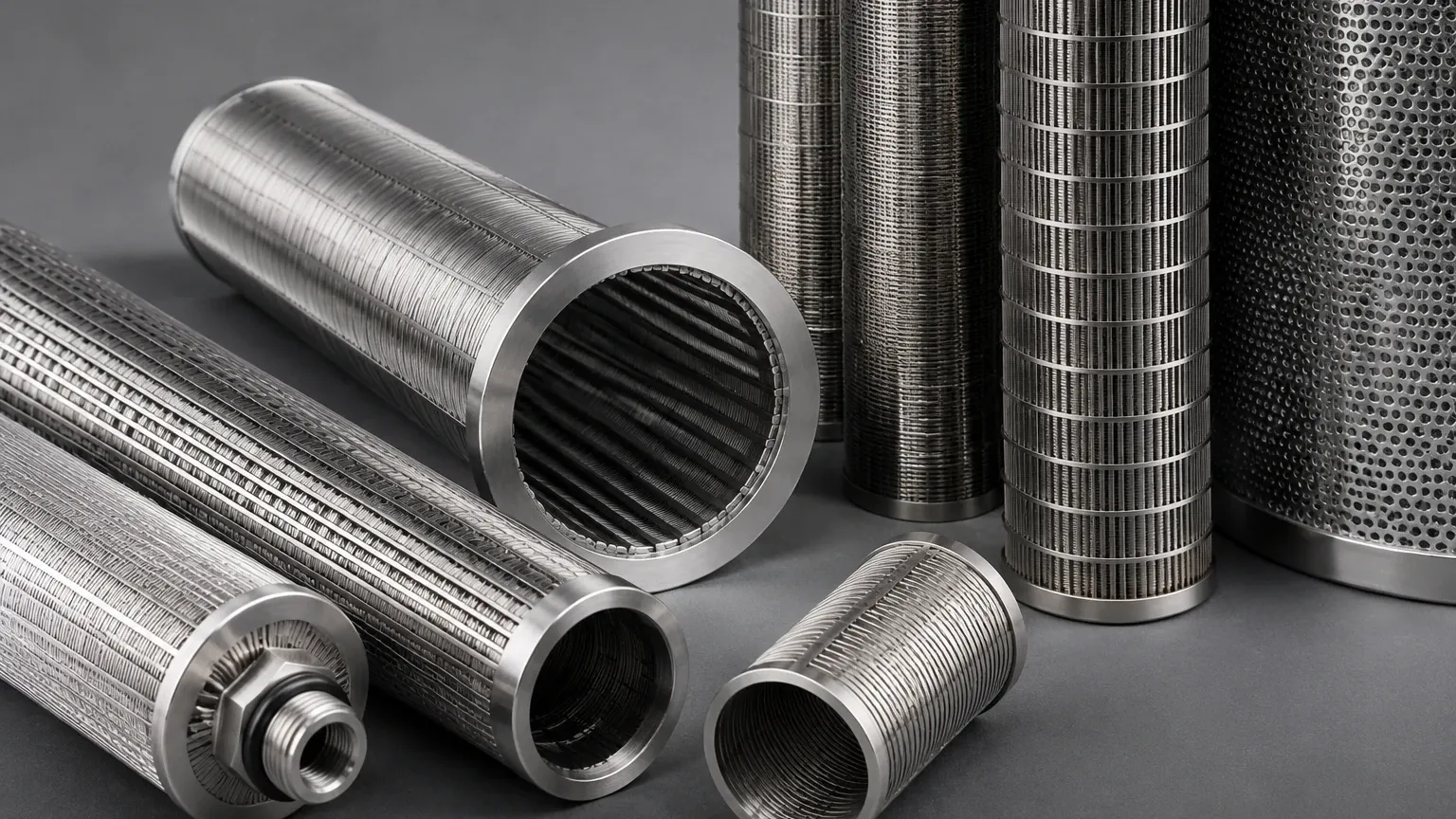
The fundamental advantage of a wedge wire screen lies in its geometric configuration. The profile wire, which forms the surface of the screen, is typically triangular or "wedge" shaped. These wires are resistance-welded onto support rods at every intersection, creating a rigid, one-piece construction.
The V-Shaped Profile and Non-Clogging Mechanism
One of the most critical features of this design is the V-shaped opening that widens inwardly. In surface filtration, particles that are slightly smaller than the slot width can sometimes become lodged in the media—a phenomenon known as "blinding" or "pegging." In a wedge wire screen, the two-point contact provided by the V-shape ensures that any particle passing through the narrowest part of the slot (the surface) will continue to move freely through the widening gap. This self-cleaning property is vital for continuous processes where downtime for manual cleaning must be minimized.
Structural Rigidity
Because the profile wires are welded to support rods, the resulting structure is significantly more robust than woven mesh or perforated plates of similar open areas. This rigidity allows the screens to withstand high differential pressures and mechanical loads without deforming. In applications such as catalyst bed supports or heavy-duty vibratory shakers, this structural integrity prevents media migration and maintains the precision of the filtration gap over long service cycles.
Material Selection and Corrosion Resistance
Industrial filtration often occurs in chemically aggressive or high-temperature environments. Therefore, the choice of material is as important as the physical design of the wedge wire screen. As a specialized manufacturer, Kaifil emphasizes the use of high-grade alloys to meet these challenges.
1. Stainless Steel 304: The standard choice for general industrial applications. It offers good corrosion resistance and mechanical properties at a cost-effective price point, suitable for many food and beverage or water treatment applications.
2. Stainless Steel 316L: Containing molybdenum, 316L provides superior resistance to chlorides and acids. This is the preferred material for pharmaceutical and chemical processing where the risk of pitting corrosion is higher.
3. Duplex Stainless Steels: For extreme environments involving high stress and highly corrosive media (such as seawater or concentrated acids), Duplex alloys offer higher yield strength and exceptional resistance to stress corrosion cracking.
4. Specialty Alloys: In specific cases involving extreme temperatures or unique chemical profiles, alloys like Monel or Hastelloy may be utilized to ensure the filter component does not fail prematurely.
Selecting the correct material requires an analysis of the fluid's pH, temperature, chloride content, and the presence of any abrasive solids that might cause erosive wear on the profile wires.
Technical Specifications: Slot Width and Open Area
The performance of a wedge wire screen is primarily defined by its slot width and the resulting percentage of open area. These factors determine the filtration accuracy and the pressure drop across the screen.
Slot Width Precision
Slot widths in wedge wire screens can range from as small as 20 microns to several millimeters. The precision of these slots is maintained through advanced manufacturing processes that control the spacing between profile wires during the welding phase. For engineers, confirming the tolerance of the slot width is essential, as even minor deviations can lead to the passage of oversized contaminants or an unexpected increase in backpressure.
Calculating Open Area
The open area is the ratio of the total slot area to the total screen surface area. It is calculated using the formula:
Open Area (%) = [Slot Width / (Slot Width + Wire Width)] × 100
A higher open area results in lower fluid velocity through the slots, which reduces the pressure drop and minimizes the risk of particle impingement damage. However, increasing the open area often requires using thinner profile wires, which may reduce the mechanical strength of the screen. Engineering a wedge wire solution requires balancing these two competing factors to achieve optimal flow rates without compromising the screen's lifespan.
Mechanical Integrity and Load-Bearing Capacity
Unlike mesh filters that may require internal cages or external housings for support, a wedge wire screen is often a self-supporting structural element. When designing these components, engineers must account for several mechanical factors:
* Collapse Pressure: In cylindrical screen applications (such as well screens or intake filters), the external pressure exerted by the fluid or surrounding media must not exceed the collapse strength of the screen. This is managed by adjusting the frequency and size of the internal support rods.
* Burst Pressure: Conversely, for flow-in-to-out applications, the internal pressure must be managed to prevent the screen from bursting.
* Vibration Fatigue: In applications involving vibratory separators or high-turbulence flows, the welded joints must be able to withstand cyclic loading. High-quality resistance welding is critical here to ensure that the wires do not detach from the support rods over time.
Industrial Applications and Flow Configurations
The versatility of the wedge wire screen allows it to be manufactured in various shapes and flow configurations, depending on the specific industrial equipment it serves.
Flat Panels and Sieve Bends
Flat panels are commonly used in stationary or vibratory screening equipment. Sieve bends, which are curved wedge wire panels, utilize the "Coanda effect" to separate solids from liquids. As the slurry flows over the curved surface, the sharp leading edge of the V-wire cuts a thin layer of liquid, directing it through the slots while the solids continue across the surface.
Cylindrical Cartridges
Cylindrical screens can be designed for two primary flow directions:
* FOTI (Flow Out To In): The filtration occurs on the exterior surface. This is common in suction strainers and well screens.
* FITO (Flow In To Out): The filtration occurs on the interior surface. This is often used in automatic self-cleaning filters where an internal scraper or backwash arm removes the collected solids.
Radial and Axial Flow
In reactor internals, wedge wire screens are used as center pipes or outer baskets. These configurations manage the flow of gases or liquids through catalyst beds, ensuring uniform distribution while preventing the catalyst beads from escaping the vessel.
Maintenance and Operational Longevity
From a total cost of ownership (TCO) perspective, wedge wire screens are often more economical than cheaper alternatives due to their durability and ease of maintenance. Because the surface is smooth and the slots are non-clogging, these screens are highly responsive to cleaning techniques such as:
* Backwashing: Reversing the flow of fluid to flush out accumulated solids.
* Mechanical Cleaning: Using scrapers or brushes to physically remove debris from the screen surface without damaging the rigid wires.
* Chemical Cleaning: Utilizing CIP (Clean-In-Place) cycles with caustic or acidic solutions, provided the material selection (e.g., 316L) is compatible.
Because the screens do not fray or tear like woven mesh, the replacement cycle is significantly longer, reducing both the cost of spare parts and the labor associated with frequent filter changes.
Procurement Considerations: What to Confirm Before Ordering
When partnering with a manufacturer like Kaifil for custom filtration solutions, providing detailed technical specifications is the first step toward a successful installation. Engineers should confirm the following data points before finalizing a design:
1. Fluid Characteristics: Viscosity, density, and chemical composition.
2. Solids Loading: The concentration, size distribution, and shape of the particles to be removed.
3. Operating Conditions: Normal and maximum operating pressures, temperatures, and flow rates.
4. Dimensional Constraints: Exact length, diameter, or panel dimensions, including any required end fittings, flanges, or reinforcement rings.
5. Direction of Flow: Clarifying whether the smooth surface should be on the interior or exterior of the component.
By addressing these variables during the design phase, purchasing teams can ensure they receive a wedge wire screen that is optimized for their specific process, providing reliable performance and a high return on investment. Kaifil’s expertise in OEM and customized filtration ensures that each component is manufactured to meet the exact rigors of the intended industrial environment.
