


Johnson Wedge Wire Screens
In industrial filtration and separation, the efficiency of a system often depends on the mechanical integrity and precision of the filter media. Johnson wedge wire screens, characterized by their V-shaped profile wires and continuous slot design, have become a standard for demanding applications where durability and non-clogging performance are critical. For engineers and procurement teams, understanding the technical nuances of these screens is essential for optimizing process flow, reducing downtime, and ensuring the longevity of filtration equipment.
Kaifil specializes in the manufacturing of high-performance Wedge Wire Screens, providing customized solutions that address the specific hydraulic and mechanical requirements of modern industrial processes. This guide examines the engineering principles, material selections, and application-specific considerations necessary for selecting the correct wedge wire configuration.
Technical Principles of Wedge Wire Construction
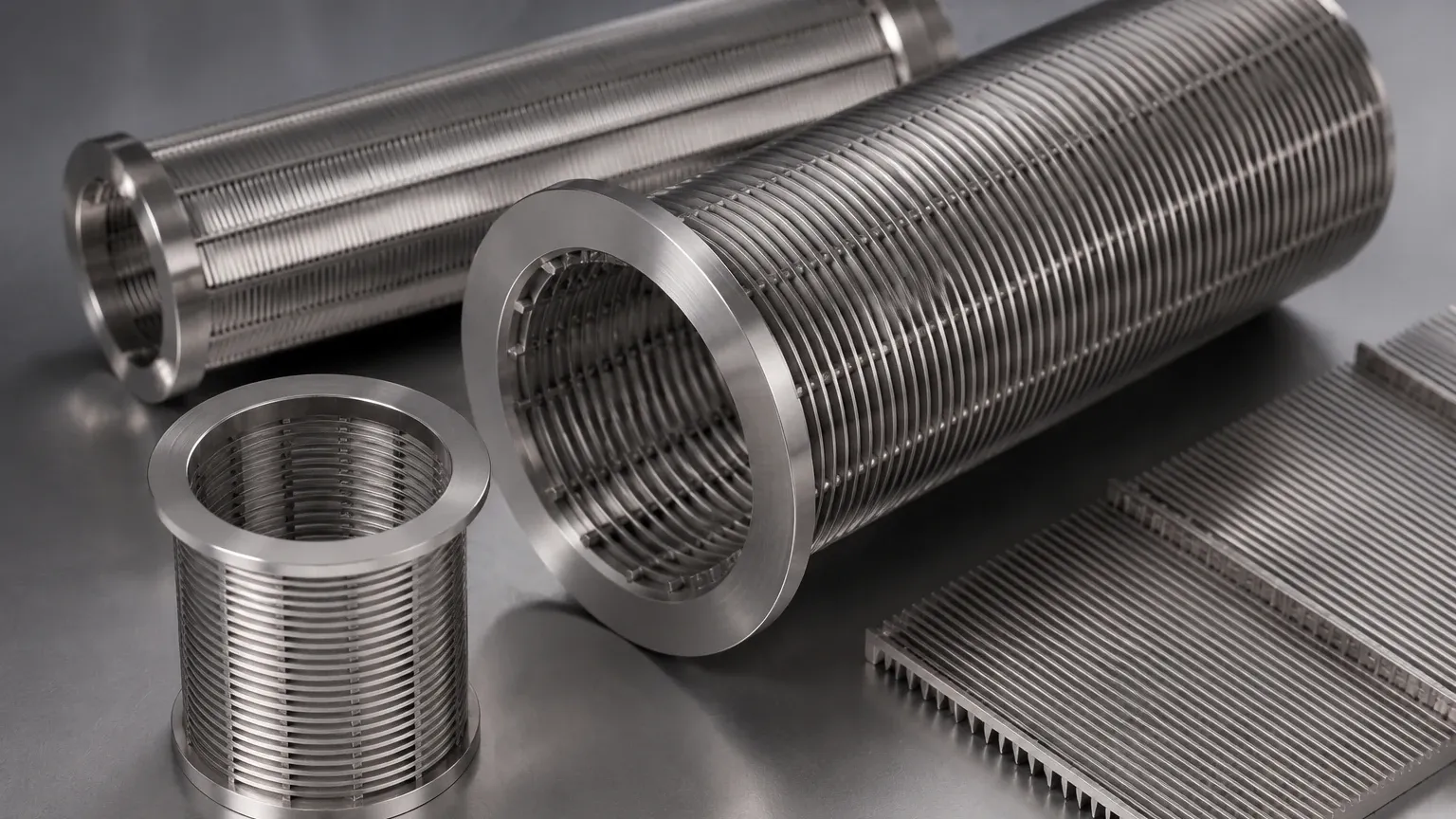
The fundamental advantage of johnson wedge wire screens lies in their geometric design. Unlike woven wire mesh or perforated plates, wedge wire is constructed by resistance-welding V-shaped stainless steel profiles onto support rods. This creates a screen that is inherently more robust and resistant to the stresses of high-pressure environments.
The V-Wire Profile and Non-Clogging Geometry
The "V" shape of the profile wire is the defining feature of this technology. The wire is oriented so that the widest part of the V faces the incoming flow. As particles pass through the narrowest point of the slot, the opening widens immediately behind the contact point. This geometry ensures that any particle capable of passing through the initial opening will clear the screen entirely, significantly reducing the risk of "blinding" or clogging that often plagues standard mesh filters.
Continuous Slot Design
The welding process allows for a continuous slot across the entire surface of the screen. This maximizes the open area compared to perforated metals, where the space between holes is often significant. For engineers, a higher open area translates to a lower pressure drop across the filter media and a higher flow capacity for a given surface area.
Material Selection and Chemical Compatibility
Material choice is a primary factor in determining the service life of a wedge wire screen, especially in corrosive or high-temperature environments. Kaifil utilizes advanced stainless steel alloys to ensure that screens maintain their structural integrity under diverse chemical loads.
1. AISI 304 Stainless Steel: This is the standard material for most general industrial applications. It offers excellent mechanical strength and good corrosion resistance for water treatment and food processing environments.
2. AISI 316L Stainless Steel: For applications involving chlorides, acids, or high-salinity environments, 316L is the preferred choice. The addition of molybdenum provides superior resistance to pitting and crevice corrosion, which is vital in chemical processing and marine applications.
3. Duplex and Super Duplex Alloys: In extreme cases where both high mechanical stress and severe corrosion are present—such as in deep-well oil and gas applications—specialty alloys may be required to prevent stress corrosion cracking.
When specifying materials, engineers must consider the pH levels, temperature fluctuations, and the presence of abrasive particles in the fluid stream. A mismatch in material selection can lead to premature failure due to erosion or chemical degradation.
Flow Direction and Structural Configurations
One of the most critical decisions in the design phase is determining the flow direction relative to the wire orientation. Johnson wedge wire screens can be manufactured in several configurations to suit different vessel designs and cleaning requirements.
Flow-Out-To-In (FOTI)
In this configuration, the profile wires are wrapped around the outside of the support rods. The filtration occurs on the exterior surface, and the filtrate moves inward toward the center of the cartridge or cylinder. This is common in radial flow reactors and standard intake screens.
Flow-In-To-Out (FITO)
Here, the support rods are on the outside, and the profile wires are on the inside. This is often used in screw press separators or internal drum filters where solids are collected on the interior surface for mechanical removal.
Axial vs. Radial Wire Orientation
While radial (circumferential) wire wrapping is standard for cylindrical screens, axial (longitudinal) wire orientation is also available. Axial wires are frequently used in applications where a mechanical scraper or brush is used to clean the screen surface. The scraper moves parallel to the wires, preventing the blade from catching on the slots and ensuring a more effective cleaning cycle.
Engineering Considerations for Slot Precision
The performance of a wedge wire screen is measured by its slot tolerance. In precision filtration, even a minor deviation in slot width can allow oversized particles to pass through, potentially damaging downstream equipment like high-pressure pumps or sensitive membranes.
Manufacturing precision is achieved through computer-controlled resistance welding, which ensures that the gap between each profile wire remains consistent throughout the length of the screen. Common slot sizes range from as small as 20 microns for fine filtration to several millimeters for heavy-duty dewatering or intake applications. Engineers should specify slot widths based on the minimum particle size that must be retained, while also accounting for the desired flow rate and allowable pressure differential.
Applications Across Industrial Sectors
Due to their versatility and strength, johnson wedge wire screens are utilized across a broad spectrum of industries, each with unique performance requirements.
Water Treatment and Intake
In municipal and industrial water treatment, wedge wire is used for well screens and intake systems. The high open area allows for low-velocity intake, which protects aquatic life (meeting Clean Water Act Section 316(b) requirements in the US) and prevents the entrainment of silt and debris.
Food and Beverage Processing
Hygiene and cleanability are paramount in food production. Wedge wire screens are used in mash tuns for brewing, sugar juice filtration, and vegetable processing. The smooth surface of the stainless steel and the absence of crevices make these screens easy to sanitize using CIP (Clean-In-Place) systems.
Petrochemical and Refining
In refinery applications, wedge wire is used in catalyst bed supports and reactor internals. These components must withstand extreme temperatures and pressures while maintaining a precise slot to prevent catalyst migration, which can lead to significant process inefficiencies and equipment damage.
Pulp and Paper
Screens are used for fiber recovery, dewatering, and fractionation. The ability to handle high-consistency slurries without clogging makes wedge wire superior to traditional perforated plates in these high-volume environments.
Maintenance, Cleaning, and Total Cost of Ownership
While the initial capital expenditure for stainless steel wedge wire may be higher than for disposable media or woven mesh, the Total Cost of Ownership (TCO) is often significantly lower due to the screen's durability and cleanability.
Cleaning Mechanisms
Wedge wire screens support various cleaning methods:
* Backwashing: Reversing the flow of fluid to dislodge particles from the surface.
* Mechanical Scraping: Using a blade to physically remove solids, which is highly effective for viscous or sticky substances.
* Ultrasonic Cleaning: For fine-slot screens where microscopic particles may become lodged over long periods.
Durability and Replacement Cycles
Unlike wire mesh, which can fray or tear under mechanical stress, wedge wire is a rigid structure. It can withstand repeated cleaning cycles and high-pressure differentials without deforming. In many industrial settings, a well-maintained wedge wire screen can last for several years, whereas mesh filters might require replacement every few months. This longevity reduces both the cost of replacement parts and the labor costs associated with frequent maintenance shutdowns.
Specifying Wedge Wire: A Checklist for Engineers
To ensure the successful integration of a wedge wire screen into a process, engineers should confirm the following parameters before procurement:
* Slot Opening: What is the specific micron or millimeter rating required for particle retention?
* Flow Rate and Pressure: What is the maximum operating pressure and the required flow capacity (GPM or m³/h)?
* Mechanical Load: Will the screen be subjected to high burst or collapse pressures? This dictates the size and spacing of the support rods.
* Connection Type: Does the application require NPT threads, ANSI/DIN flanges, or custom weld ring fittings?
* Surface Finish: Is a specific Ra (Roughness Average) required for sanitary applications, or is a standard pickled and passivated finish sufficient?
By addressing these technical details during the design phase, purchasing teams can avoid common pitfalls such as undersized filtration area or material incompatibility.
Conclusion
Johnson wedge wire screens represent a critical component in the infrastructure of modern industrial filtration. Their unique combination of mechanical strength, high open area, and non-clogging characteristics makes them indispensable for processes that demand reliability and efficiency. Whether used in water intake, chemical separation, or food processing, the precision of the V-wire design ensures consistent performance under the most challenging conditions.
As a professional manufacturer, Kaifil provides the engineering expertise and manufacturing precision required to deliver customized filtration solutions. By focusing on material quality and exacting slot tolerances, Kaifil helps industrial operators achieve optimized flow dynamics and long-term operational stability. For those seeking to improve their filtration systems, evaluating the specific advantages of wedge wire technology is a vital step toward achieving superior process results.
