


Wedge Wire Screen Sheet
In the landscape of industrial filtration and separation, the wedge wire screen sheet represents a pinnacle of engineering efficiency. Unlike traditional woven wire mesh or perforated plates, these components are engineered to provide a unique combination of structural integrity and precise filtration. For engineers and procurement professionals in sectors such as chemical processing, water treatment, and food production, selecting the right screen medium is critical to optimizing throughput and minimizing downtime. This guide examines the technical characteristics, engineering advantages, and selection criteria for industrial wedge wire screen sheets.
Technical Construction and the V-Wire Principle
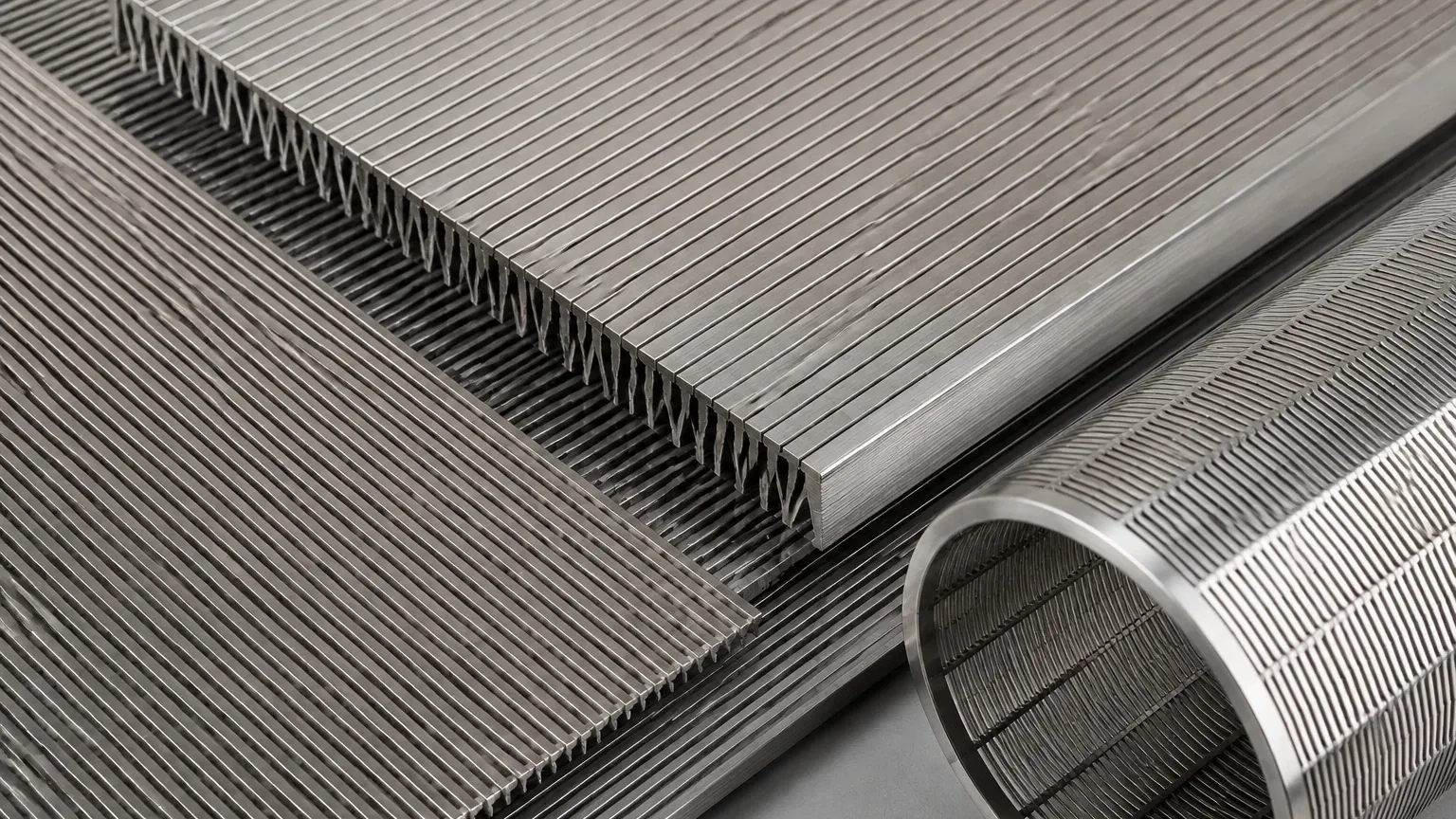
A wedge wire screen sheet is a flat panel constructed from V-shaped profile wires that are resistance-welded onto perpendicular support rods. This specific geometry is what distinguishes Wedge Wire Screens from other filtration media. The "wedge" or "V" shape of the profile wire creates a slot that widens inwardly.
From an engineering perspective, this design addresses the primary challenge of industrial filtration: blinding or clogging. In a standard perforated plate, a particle that is slightly larger than the hole can become wedged, blocking the flow. In a wedge wire screen sheet, the two-point contact between the particle and the wire means that any particle passing through the narrowest point of the slot (the aperture) will continue to move freely through the widening gap. This self-cleaning characteristic is vital for continuous processes where manual cleaning is impractical.
The manufacturing process involves precision-controlled welding at every intersection of the profile wire and the support rod. This creates a rigid, single-piece structure that can withstand significant mechanical stress, high pressure, and heavy loads without deforming. For applications involving vibrating screens or high-velocity fluid flow, this structural rigidity ensures that the slot width remains consistent over the entire service life of the component.
Key Engineering Advantages of Flat Screen Panels
When evaluating a wedge wire screen sheet for a specific application, several mechanical advantages become apparent compared to alternative materials:
1. High Open Area and Flow Rates
By adjusting the width of the profile wire and the spacing of the slots, manufacturers can optimize the open area of the screen. A higher open area translates to lower pressure drops across the filter and higher flow rates. Because the V-wire design is inherently strong, thinner wires can often be used to achieve the same structural requirements as thicker perforated plates, further increasing the available filtration area.
2. Exceptional Mechanical Strength
The fusion-welded construction provides a high strength-to-weight ratio. This is particularly important in heavy-duty applications such as mining or aggregate processing, where the sheet must support the weight of the material being processed while simultaneously enduring constant vibration or impact.
3. Precision Slot Tolerances
Modern manufacturing techniques allow for extremely tight tolerances in slot widths, often measured in microns. This precision ensures that the separation process is accurate and repeatable, which is a non-negotiable requirement in pharmaceutical and fine chemical industries where product purity is paramount.
4. Longevity and Maintenance
Because the screens are typically made from high-grade stainless steel, they offer excellent resistance to corrosion and abrasion. The non-clogging nature of the V-wire reduces the frequency of backwashing or mechanical cleaning, leading to lower total cost of ownership (TCO) over the lifecycle of the equipment.
Material Selection and Environmental Compatibility
The performance of a wedge wire screen sheet is heavily dependent on the material grade selected. Industrial environments often involve corrosive chemicals, extreme temperatures, or abrasive slurries.
* Stainless Steel 304: The standard choice for general industrial applications. It provides good corrosion resistance and is cost-effective for water treatment and general filtration.
* Stainless Steel 316/316L: Contains molybdenum, which provides superior resistance to chlorides and pitting. This is the preferred material for marine environments, chemical processing, and pharmaceutical applications.
* Duplex Stainless Steels: For extremely demanding environments involving high stress and highly corrosive media, duplex grades offer nearly twice the yield strength of standard austenitic steels and exceptional resistance to stress corrosion cracking.
* Specialty Alloys: In cases of extreme heat or highly specific chemical exposure, alloys like Monel or Hastelloy may be utilized, though these are typically reserved for specialized OEM requirements.
Engineers must also consider the surface finish. For food and beverage applications, a smooth, polished surface is required to prevent bacterial growth and facilitate Clean-in-Place (CIP) procedures.
Industrial Applications for Wedge Wire Screen Sheets
The versatility of the flat panel format allows it to be integrated into a wide range of industrial machinery. Some of the most common applications include:
Water and Wastewater Treatment
In municipal and industrial water treatment, these sheets are used in intake screens to protect pumps from debris and in secondary treatment phases for sludge dewatering. Their durability ensures they can handle the constant exposure to moisture and varying organic loads.
Food and Beverage Processing
Wedge wire is the industry standard for malting floors in breweries and for juice extraction in the sugar and fruit processing industries. The precision slots allow for efficient liquid-solid separation while maintaining the hygienic standards required by the industry.
Mining and Aggregate
Flat panels are used as vibratory screen decks to sort minerals and ores by size. The high abrasion resistance of stainless steel wedge wire ensures that the screen does not wear down quickly under the friction of heavy rocks and minerals.
Pulp and Paper
In the recycling and processing of paper pulp, wedge wire screen sheets are used to remove contaminants and to thicken the pulp. The ability to handle high-consistency fluids without clogging is a major advantage here.
Architectural and Drainage
Beyond filtration, the aesthetic and structural properties of wedge wire make it popular for high-end architectural grates, trench drains, and ventilation covers. In these contexts, the focus is often on the load-bearing capacity and the uniform appearance of the wires.
Critical Selection Criteria for Engineers
When specifying a wedge wire screen sheet, engineers should confirm several technical parameters to ensure the component meets the application's demands:
1. Slot Opening (Aperture): This is the most critical dimension. It must be sized based on the minimum particle size that needs to be retained. It is common practice to select a slot size that is approximately 50% to 70% of the size of the smallest particle to be removed, depending on the particle shape and concentration.
2. Profile Wire Shape: Different "V" profiles exist. A sharper angle may provide better self-cleaning but might be less resistant to wear. A wider profile increases the strength of the screen but reduces the open area.
3. Support Rod Spacing: The distance between support rods determines the load-bearing capacity of the sheet. For high-pressure applications, closer spacing is required to prevent the profile wires from bowing or spreading.
4. Flow Direction: It is essential to specify whether the flow will be from the "wire side" to the "rod side" (standard) or vice versa. This affects how the V-shape interacts with the fluid and particles.
5. Overall Dimensions and Framing: Sheets can be supplied as raw panels or with custom-fabricated frames, bolt holes, or flanges for easy installation into existing equipment.
Customization and OEM Integration
Every industrial process has unique requirements, which is why customization is a core aspect of wedge wire production. Manufacturers like Kaifil specialize in providing tailored solutions that go beyond standard catalog sizes. This includes developing custom wire profiles for specific abrasive materials or designing complex framing systems for rapid replacement during maintenance shutdowns.
When working with an OEM partner, it is beneficial to provide data on the fluid viscosity, particle distribution, operating temperature, and chemical composition. This allows the engineering team to recommend the optimal combination of material, wire profile, and slot width to maximize the efficiency of the filtration system.
Maintenance and Operational Best Practices
While wedge wire screen sheets are designed for low maintenance, their lifespan can be extended through proper operational practices. Regular inspection for mechanical damage or localized wear is recommended, especially in abrasive applications.
Cleaning, when necessary, can often be achieved through high-pressure water jetting or backwashing. Because the slots widen inwardly, debris is usually easily dislodged. In chemical applications, ensuring that the cleaning agents are compatible with the stainless steel grade is vital to prevent accidental corrosion or passivation layer damage.
Conclusion
The wedge wire screen sheet is a fundamental component for any industry requiring reliable, high-capacity, and low-maintenance separation. By understanding the technical nuances of V-wire geometry, material science, and structural design, engineers can significantly improve the performance of their filtration systems. Whether it is for a new installation or an upgrade to an existing process, selecting a high-quality wedge wire solution ensures long-term operational stability and cost-effectiveness. For those seeking specific configurations or technical support, exploring the range of Wedge Wire Screens and consulting with manufacturing experts is the most effective path toward optimizing industrial filtration outcomes.
