


Wedge Wire Screen Strainer
In industrial filtration, the selection of a screening medium is a critical engineering decision that directly impacts process efficiency, equipment longevity, and maintenance overhead. Among the various technologies available, the wedge wire screen strainer has established itself as a premier solution for demanding liquid-solid separation tasks. Characterized by its unique V-shaped profile wire and continuous slot design, this filtration component offers mechanical advantages that traditional woven mesh or perforated plates cannot match.
For engineers and procurement professionals, understanding the technical nuances of Wedge Wire Screens is essential for optimizing system performance. This guide examines the engineering principles, material considerations, and application-specific configurations that define high-quality wedge wire strainers.
The Engineering Principles of Wedge Wire Technology
The core of a wedge wire screen strainer lies in its structural design. Unlike woven wire mesh, which consists of intersecting wires, wedge wire is manufactured through a specialized resistance welding process. Surface wires (the "wedge" or V-shape) are welded at each intersection to support rods (the "base").
The V-Shaped Profile
The most significant feature of this technology is the V-shaped cross-section of the profile wire. The wire is oriented so that the widest part of the "V" faces the incoming flow. This creates a slot that widens inwardly. In practice, any particle small enough to pass through the initial slot opening will continue to flow through the strainer without becoming wedged or trapped. This "non-clogging" characteristic is vital for continuous industrial processes where downtime for manual cleaning must be minimized.
Continuous Slot Design
Because the surface wires are arranged in a parallel, longitudinal, or radial fashion, they create a continuous slot. This design provides a significantly higher open area percentage compared to perforated metal or woven mesh with similar filtration ratings. A higher open area translates to lower entrance velocities and reduced pressure drop across the strainer, which in turn lowers energy consumption for pumping systems.
Key Advantages of the Wedge Wire Screen Strainer
When evaluating a wedge wire screen strainer against alternative filtration media, several technical advantages become apparent:
1. Structural Integrity: The welded construction creates a rigid, self-supporting structure. Unlike mesh, which may require a backup perforated cage to withstand high differential pressures, wedge wire screens are inherently strong and resistant to collapse or bursting.
2. Precise Slot Widths: Manufacturing processes allow for extremely tight tolerances in slot widths, often down to 20 microns. This precision ensures consistent particle retention and reliable filtration performance.
3. Ease of Cleaning: The smooth surface and widening slots make these strainers ideal for backwashing or mechanical cleaning (such as scraper systems). Debris is easily dislodged from the surface because there are no "pockets" or intersections where particles can hide.
4. Longevity: Made primarily from corrosion-resistant stainless steel, these components are designed for multi-year service lives in harsh chemical or high-temperature environments.
Material Selection and Environmental Resistance
Material compatibility is a primary concern for engineers in the chemical, pharmaceutical, and food and beverage sectors. Kaifil specializes in utilizing high-grade alloys to ensure that each wedge wire screen strainer meets the specific demands of its operating environment.
* Stainless Steel 304: The standard choice for general industrial applications, providing good corrosion resistance and mechanical strength at a cost-effective price point.
* Stainless Steel 316L: Preferred for marine environments, pharmaceutical production, and food processing. The addition of molybdenum and lower carbon content provides superior resistance to pitting and crevice corrosion, particularly in chloride-rich environments.
* Duplex Stainless Steels: For extreme conditions involving high pressure and highly corrosive media, duplex alloys offer nearly double the yield strength of standard austenitic steels and exceptional resistance to stress corrosion cracking.
Beyond metallurgy, the surface finish of the strainer is also a critical factor. For food and beverage or pharmaceutical applications, electropolishing is often employed to achieve a Ra (Roughness Average) value that prevents bacterial growth and facilitates thorough CIP (Clean-in-Place) cycles.
Technical Specifications and Sizing
To specify the correct wedge wire screen strainer, engineers must provide several key parameters to the manufacturer. Sizing is not merely about the pipe diameter; it is about the fluid dynamics within the strainer housing.
Flow Rate and Pressure Drop
The relationship between the flow rate (GPM or m³/h) and the allowable pressure drop (ΔP) determines the required surface area of the screen. An undersized strainer will lead to high velocities, which can cause premature wear (erosion) and force soft particles through the slots. Generally, a clean pressure drop should not exceed 2-3 psi (0.14-0.21 bar) in most industrial liquid applications.
Slot Opening (Micron Rating)
The slot opening must be selected based on the smallest particle size that needs to be removed. However, specifying a slot that is significantly smaller than necessary will result in a lower open area and more frequent cleaning cycles. It is standard engineering practice to select a slot size that is approximately 50% to 70% of the size of the smallest particle intended for removal.
Mechanical Loading
The strainer must be designed to withstand the maximum differential pressure that could occur if the screen becomes 100% blinded. This "collapse pressure" rating ensures that the internal components do not fail and migrate downstream, potentially damaging pumps, valves, or sensitive process equipment.
Applications Across Industries
The versatility of the wedge wire screen strainer makes it a staple in various sectors:
* Water Treatment: Used in intake screens for power plants and municipal water works to protect pumps from debris and aquatic life. They are also essential in ion exchange units as resin traps.
* Food and Beverage: Utilized in the processing of juices, syrups, and dairy products. The sanitary design and ease of cleaning are critical for maintaining food safety standards.
* Petrochemical and Chemical: Employed in catalyst recovery and as reactor internals where high temperatures and corrosive fluids are common.
* Pulp and Paper: Used in fiber recovery and wastewater treatment processes where high solids loading is a challenge for other filter types.
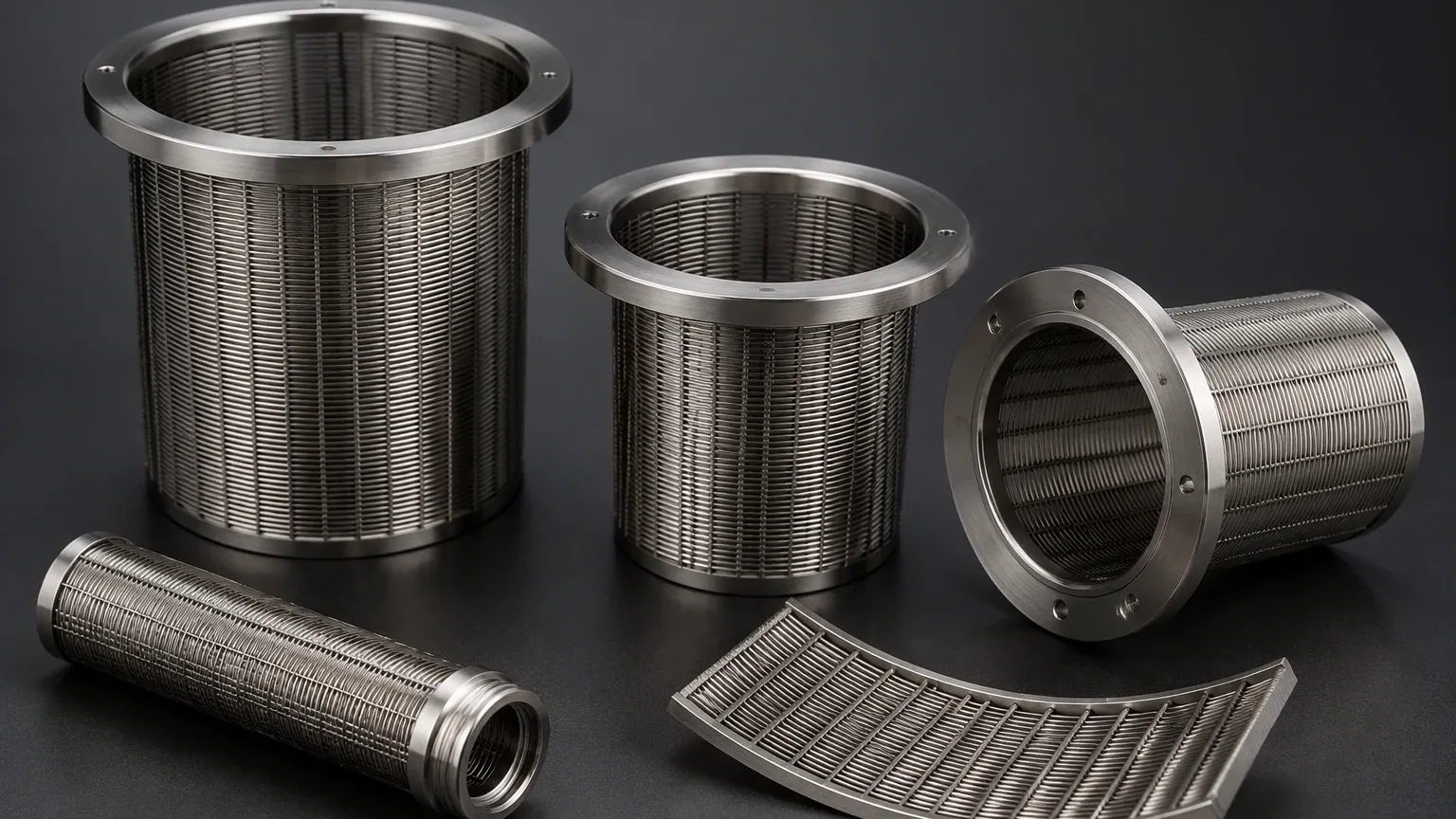
Customization and OEM Capabilities
Every industrial system has unique constraints, ranging from space limitations to specific flow patterns. Kaifil provides extensive customization for Wedge Wire Screens to ensure seamless integration into existing infrastructure. Customization options include:
* Flow Direction: Designs can be configured for "outside-to-inside" (FOTI) or "inside-to-outside" (FITO) flow, depending on where the solids should be collected.
* End Fittings: Strainers can be supplied with flanged ends (ANSI, DIN, JIS), threaded connections, or custom machined rings to fit specific housing designs.
* Reinforcement: For high-vibration or high-pressure applications, additional support rods or external cages can be integrated into the design without compromising the filtration surface.
Maintenance and Total Cost of Ownership (TCO)
While the initial capital expenditure for a wedge wire screen strainer may be higher than for disposable cartridges or simple woven mesh, the Total Cost of Ownership is significantly lower.
Cleaning Cycles
The durability of the V-wire allows for aggressive cleaning methods. Whether using high-pressure water jets, ultrasonic cleaning, or chemical baths, the strainer maintains its dimensional stability. In automated systems, the predictable nature of the backwash cycle allows for optimized PLC programming, reducing water and energy waste.
Replacement Frequency
In many applications, a well-engineered wedge wire strainer can last for a decade or more. This eliminates the recurring costs of purchasing, stocking, and disposing of filter cartridges. Furthermore, it reduces the labor costs associated with frequent filter changes and the environmental impact of waste generation.
Selection Checklist for Engineers
Before finalizing a purchase order for a wedge wire screen strainer, technical teams should confirm the following data points with the manufacturer:
1. Fluid Properties: Viscosity, density, and chemical composition (including pH and chloride levels).
2. Solids Loading: The concentration and nature of the contaminants (e.g., abrasive, fibrous, or gelatinous).
3. Operating Conditions: Normal and maximum operating temperature and pressure.
4. Cleaning Method: Manual, backwash, or mechanical scraper.
5. Regulatory Compliance: Requirements for FDA, 3A, or ASME pressure vessel codes.
Conclusion
The wedge wire screen strainer represents a sophisticated balance of mechanical strength and filtration precision. By leveraging the non-clogging V-wire design and the durability of stainless steel construction, industrial facilities can achieve more reliable process outcomes with lower operational costs. As a specialized manufacturer, Kaifil remains committed to providing the engineering support and high-performance components necessary to solve the most complex filtration challenges. Whether for a new installation or an OEM replacement, selecting the right wedge wire configuration is a foundational step toward industrial efficiency.
