


Wedge Wire Screen Tender
In industrial procurement, the acquisition of high-performance filtration components requires a rigorous evaluation of technical specifications, manufacturing capabilities, and long-term operational reliability. A wedge wire screen tender is a critical document that outlines the requirements for precision-engineered screening media used in demanding sectors such as water treatment, petrochemical processing, mining, and food production. Because these components often serve as the primary barrier in a filtration system, the accuracy of the tender process directly influences the efficiency, maintenance frequency, and lifespan of the industrial equipment.
Selecting the right partner for Wedge Wire Screens involves more than a simple price comparison. It requires an in-depth understanding of the engineering principles behind the V-shaped profile wire, the structural integrity of support rods, and the metallurgical properties of the stainless steel alloys used. This guide provides a technical framework for engineers and procurement professionals to navigate the complexities of a wedge wire screen tender, ensuring that the final selection aligns with specific application demands.
Understanding Technical Requirements in a Wedge Wire Screen Tender
The foundation of any successful tender is a clearly defined set of technical specifications. Wedge wire screens are unique because of their "non-clogging" design, which is achieved through the use of V-shaped profile wires. When drafting a tender, the following geometric and structural parameters must be specified to ensure the manufacturer can meet the performance expectations.
Profile Wire and Support Rod Geometry
The profile wire (surface wire) determines the filtration accuracy and the flow characteristics. Tenders should specify the wire width and height (e.g., 1.5mm x 2.5mm or 2.2mm x 3.5mm). A narrower profile wire increases the open area, which reduces pressure drop and increases flow capacity, but may sacrifice structural strength. Conversely, the support rods provide the framework for the screen. Their shape (round, rectangular, or teardrop) and spacing (pitch) are vital for determining the collapse strength and burst pressure of the screen, especially in high-pressure hydraulic or oil and gas applications.
Slot Opening Precision
The slot opening, or the distance between two adjacent profile wires, is the most critical factor for filtration efficiency. In a professional wedge wire screen tender, tolerances for slot openings must be clearly defined. For precision applications, such as resin traps or catalyst support grids, a tolerance of ±0.05mm may be required. Manufacturers must demonstrate their ability to maintain consistent slot widths across the entire surface of the screen to prevent bypass or premature clogging.
Material Selection and Chemical Compatibility
Industrial filtration often occurs in aggressive environments where corrosion, temperature fluctuations, and abrasion are constant threats. A comprehensive tender must specify the material grade based on the chemical composition of the fluid being processed.
Stainless Steel Grades
Most industrial wedge wire screens are manufactured from austenitic stainless steels.
- Grade 304/304L: Suitable for general-purpose applications with low corrosive risk, such as municipal water treatment.
- Grade 316/316L: Contains molybdenum, providing superior resistance to chlorides and pitting. This is the standard for marine environments, chemical processing, and pharmaceutical applications.
- Duplex and Super Duplex: For extreme environments involving high pressure and highly corrosive media, such as desalination plants or deep-sea oil extraction, duplex steels offer higher mechanical strength and corrosion resistance.
Surface Treatments
The tender should also address the required surface finish. For food and beverage applications, a smooth, electropolished surface is often mandatory to prevent bacterial growth and ensure ease of cleaning. In other industrial contexts, pickling and passivation are standard procedures to restore the chromium oxide layer after the welding process, ensuring the screen maintains its corrosion-resistant properties.
Engineering Standards and Precision Manufacturing
The manufacturing process for wedge wire involves specialized resistance welding, where the profile wire is welded at every intersection with the support rods. This creates a robust, single-piece construction. When evaluating a wedge wire screen tender, it is essential to assess the manufacturer’s adherence to international engineering standards.
Welding Quality and Structural Integrity
A critical point of failure in low-quality screens is the weld point. A tender should require documentation regarding the welding technology used. Advanced CNC-controlled resistance welding ensures that the integrity of the metal is not compromised by excessive heat, which can lead to "heat-affected zones" (HAZ) prone to stress corrosion cracking. The tender should ask for evidence of weld strength testing and dimensional inspections.
Customization and Design Flexibility
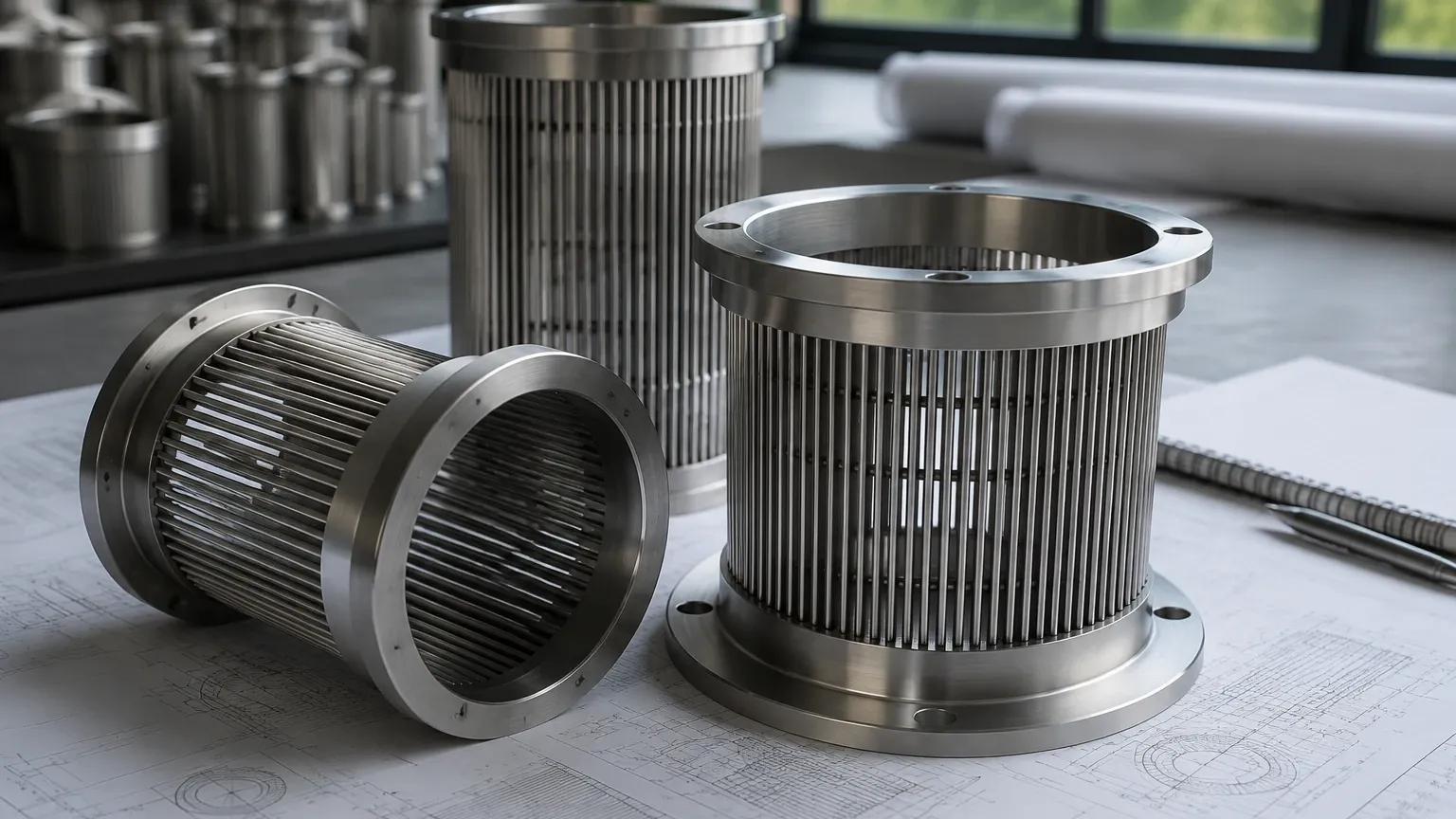
Industrial systems rarely use "off-the-shelf" filtration components. Whether the requirement is for a flat panel, a cylindrical cartridge, or a complex conical shape, the manufacturer must provide engineering support. The tender should evaluate the supplier's ability to provide CAD drawings, flow simulations, and customized end fittings (such as flanges, threaded couplings, or reinforced rings) that integrate seamlessly with existing infrastructure.
Evaluation Metrics for Tender Submissions
Once the bids are received, the evaluation process should go beyond the initial capital expenditure (CAPEX). A technical scoring matrix is often used to weight different aspects of the proposal.
1. Technical Compliance: Does the proposal meet all the specified slot sizes, wire profiles, and material grades? Any deviations should be flagged and justified.
2. Manufacturing Capacity: Can the vendor handle the volume required within the project timeline? This includes an assessment of their machinery, workforce, and quality control protocols.
3. Quality Assurance (QA): Look for ISO 9001 certification and specific testing procedures, such as material traceability (MTRs), PMI (Positive Material Identification) testing, and pressure testing.
4. Reference Projects: A reputable manufacturer should be able to provide case studies or references from similar industries. This proves their experience in handling the specific challenges of your sector.
Application-Specific Design Considerations
The intended application dictates the priorities of the wedge wire screen tender. For instance:
* Water Treatment: Focus on the open area to maximize flow and reduce energy costs associated with pumping. The ability to withstand backwashing cycles is also paramount.
* Mining and Aggregates: Focus on abrasion resistance. This may involve specifying thicker profile wires or specialized coatings to extend the wear life of the screen.
* Food and Beverage: Focus on hygiene. The screen must be free of burrs, crevices, and sharp edges where organic matter could accumulate. Material certification for food contact is a non-negotiable requirement.
Mitigating Risks in Industrial Procurement
Procuring industrial filters involves several risks that can be mitigated through a well-structured tender.
Material Fraud and Quality Variance
One of the biggest risks in global sourcing is the substitution of inferior materials. A robust tender mandates that every batch of stainless steel is accompanied by Mill Test Certificates. Furthermore, third-party inspections can be written into the tender requirements for large-scale projects to verify that the delivered product matches the technical submittal.
Lead Times and Logistics
In many industrial projects, a delay in the delivery of filtration components can halt the entire production line. The tender should require a detailed production schedule and a clear logistics plan. For international sourcing, understanding Incoterms and the manufacturer's experience with export documentation is vital to avoid customs delays.
Total Cost of Ownership and Long-Term Value
While the bid price is a significant factor in any wedge wire screen tender, the Total Cost of Ownership (TCO) provides a more accurate picture of value. A high-quality wedge wire screen may have a higher initial cost but offers significant savings over its lifecycle through:
* Reduced Energy Consumption: Higher open areas lead to lower pressure drops, requiring less pump power.
* Lower Maintenance Costs: The non-clogging nature of the V-wire reduces the frequency of manual cleaning and downtime.
* Durability: Precision-welded stainless steel screens can last for years, even in harsh environments, reducing the frequency of replacement.
Engineers should ask bidders to provide data on the expected lifespan and maintenance requirements of their products. A supplier who provides comprehensive technical support and a clear warranty policy often delivers better long-term value than a low-cost provider with no after-sales service.
Conclusion: Confirming Requirements Before Final Selection
Before finalizing a wedge wire screen tender, the procurement team should conduct a final technical review with the shortlisted vendors. This is the time to confirm the exact dimensions, the orientation of the flow (inside-to-outside or outside-to-inside), and the specific environmental conditions the screen will face.
By following a structured, fact-based approach to the tender process, industrial organizations can ensure they receive filtration solutions that are not only compliant with technical standards but also optimized for their specific operational goals. The goal is to establish a partnership with a manufacturer that understands the nuances of filtration engineering and can provide the reliability required for modern industrial processes.
