


Aquaphor Water Filter Cartridges
In the landscape of point-of-use (POU) and point-of-entry (POE) water treatment, Aquaphor water filter cartridges have established a significant presence through the integration of proprietary material science and multi-stage filtration mechanics. For engineers and procurement professionals evaluating filtration solutions, understanding the technical specifications and performance boundaries of these cartridges is essential for ensuring water quality and system longevity. While often associated with residential and light commercial applications, the underlying principles of these Filter Cartridges provide a useful benchmark for comparing consumer-grade media against heavy-duty industrial filtration components.
Selecting the appropriate filtration technology requires a deep dive into material compatibility, contaminant load, and the specific hydraulic requirements of the application. This guide examines the engineering behind Aquaphor cartridges, their operational parameters, and how they contrast with industrial-grade stainless steel filtration solutions.
Understanding the Technology Behind Aquaphor Water Filter Cartridges
The performance of Aquaphor water filter cartridges is largely derived from the use of specialized composite materials. Unlike standard granulated activated carbon (GAC) filters, which can suffer from "channeling"—where water finds the path of least resistance and bypasses the filter media—these cartridges utilize a dense carbon block structure often enhanced with proprietary fibers.
Aqualen Ion-Exchange Fibers
One of the defining technical features of these cartridges is the inclusion of Aqualen, a patented ion-exchange fiber. In a traditional carbon block, the surface area is high, but the kinetics of heavy metal removal can be limited by the flow velocity. Aqualen fibers are integrated into the carbon matrix to create a synergistic effect. These fibers have a high affinity for heavy metal ions (such as lead, copper, and mercury) and help distribute water flow more evenly across the entire volume of the cartridge. This reduces the risk of bypass and ensures consistent filtration performance throughout the service life of the unit.
Carbon Block and Hollow Fiber Membranes
Many Aquaphor systems employ a multi-stage approach within a single cartridge or a series of cartridges. This often includes:
* Activated Carbon Block: Provides high-capacity adsorption for chlorine, volatile organic compounds (VOCs), and organic impurities.
* Hollow Fiber Microfiltration: In high-specification models, hollow fiber membranes are used to provide a physical barrier against bacteria and cysts, typically rated at 0.1 microns. This mechanical filtration stage is critical for applications where microbiological safety is a primary concern.
Key Performance Metrics for Filter Cartridges in Water Treatment
When specifying filter cartridges, engineers must look beyond brand names and focus on quantifiable performance data. The effectiveness of a filtration system is measured by its ability to maintain effluent quality under varying influent conditions.
Filtration Accuracy and Micron Ratings
Filtration accuracy is typically defined by the micron rating, which indicates the size of particles the media can effectively trap. It is important to distinguish between "nominal" and "absolute" ratings. A nominal rating refers to the ability of the filter to retain a major percentage of particles of a certain size, whereas an absolute rating implies that nearly 100% of particles above that size are captured. Aquaphor water filter cartridges often provide sub-micron filtration, which is necessary for removing fine sediments and microbial contaminants.
Flow Rate and Pressure Drop
Every filter cartridge introduces a degree of resistance to the fluid flow, known as pressure drop ($ΔP$). As the filter accumulates debris, the $ΔP$ increases. For industrial and commercial systems, it is vital to calculate the initial clean pressure drop to ensure that the pump or gravity feed can maintain the required flow rate. If the flow rate is too high for the cartridge's design, the contact time with the carbon media is reduced, potentially compromising the adsorption of chemical contaminants.
Dirt-Holding Capacity
The dirt-holding capacity (DHC) determines how much particulate matter a cartridge can retain before the pressure drop becomes unacceptable. Cartridges with a graded density structure—where the outer layers trap larger particles and the inner layers trap finer ones—generally offer a higher DHC and a longer service life compared to uniform-density filters.
Comparing Consumer-Grade and Industrial-Grade Filter Cartridges
While Aquaphor water filter cartridges are highly effective for their intended use cases, industrial environments often demand different material properties. Understanding where these technologies diverge is key for engineers designing systems for chemical processing, food and beverage production, or high-temperature applications.
Material Limits: Plastic vs. Stainless Steel
Most POU cartridges, including those from Aquaphor, utilize plastic housings and carbon-based media. These are ideal for ambient temperature water and standard municipal pressures. However, in industrial settings involving aggressive chemicals, high temperatures (above 50°C), or high-pressure surges, stainless steel filter cartridges are the standard. Stainless steel wire mesh or sintered metal filters provide the structural integrity required to withstand mechanical stress that would cause a standard carbon block to fail or bypass.
Cleanability and Reusability
Consumer-grade cartridges are almost exclusively disposable. Once the carbon is saturated or the hollow fibers are clogged, the entire cartridge must be replaced. In contrast, many industrial Filter Cartridges are designed to be cleaned via backwashing, ultrasonic cleaning, or chemical baths. This reusability is a significant factor in the total cost of ownership for large-scale industrial filtration systems.
Chemical Compatibility
Carbon-based cartridges are excellent for removing organics and chlorine but may not be suitable for filtering strong acids, bases, or certain industrial solvents. In these instances, precision-engineered metal filters or specialized polymer membranes are required to ensure the filter media does not degrade and introduce impurities into the process stream.
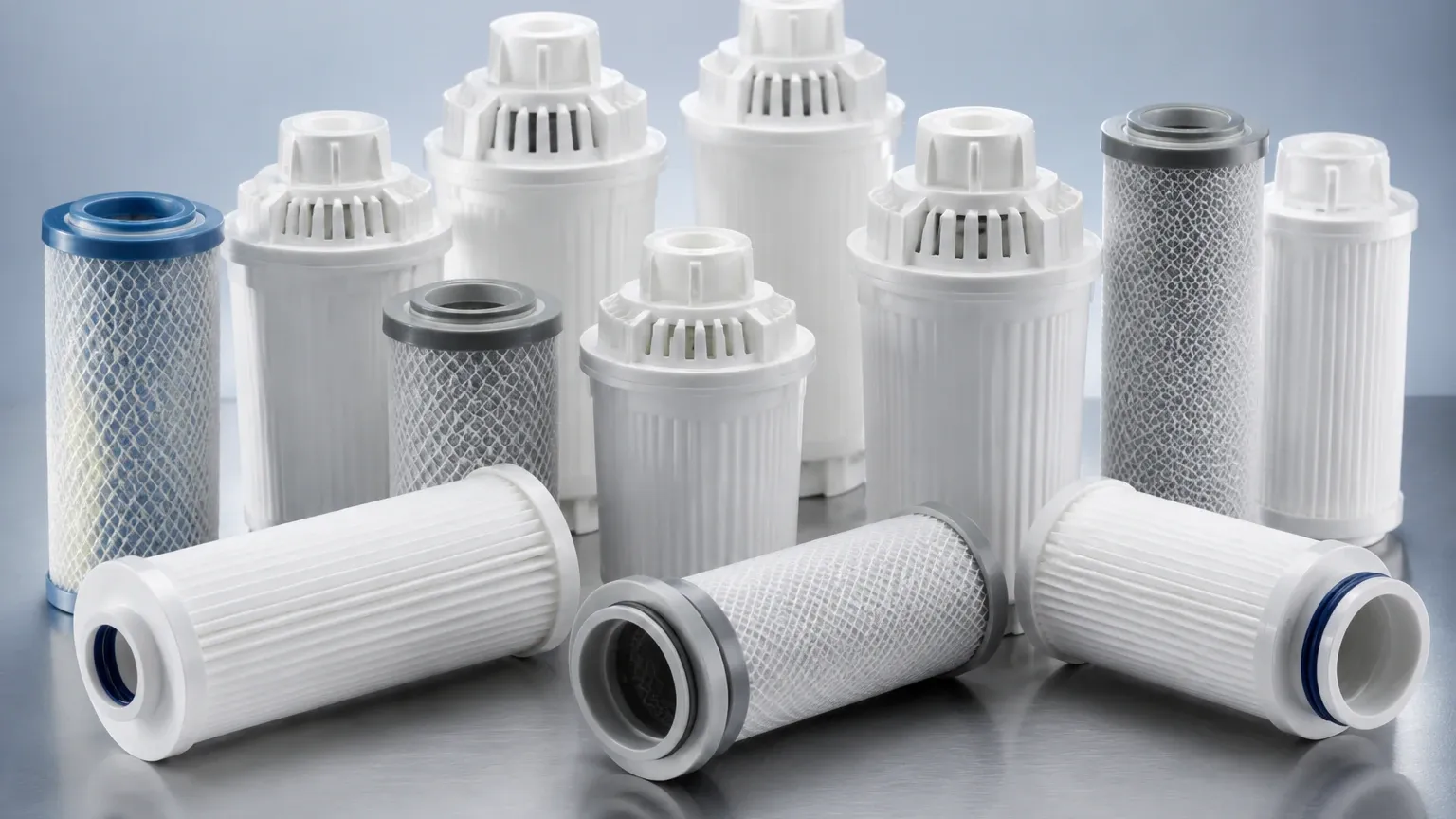
Engineering Considerations: Micron Ratings and Flow Dynamics
To optimize a filtration system, one must balance the desired purity level with the operational costs. Finer filtration (lower micron ratings) generally leads to more frequent cartridge changes and higher energy costs due to increased pressure requirements.
Impact of Source Water Quality
The longevity of Aquaphor water filter cartridges is highly dependent on the turbidity of the source water. High levels of suspended solids will prematurely clog the fine pores of a carbon block or hollow fiber membrane. In such cases, engineers often implement a pre-filtration stage using a coarse wire mesh or sediment filter. This protects the more expensive finishing cartridges and ensures they can focus on chemical and microbial removal rather than bulk sediment capture.
Contact Time and Adsorption
For cartridges relying on activated carbon, the "Empty Bed Contact Time" (EBCT) is a critical design parameter. The slower the water moves through the carbon matrix, the more time contaminants have to be adsorbed onto the carbon surfaces. If a system is pushed beyond its rated flow capacity, the effectiveness of the cartridge in removing chlorine or lead may drop significantly, even if the physical filtration of sediment remains intact.
Maintenance, Replacement Cycles, and Operational Efficiency
A common challenge in managing filtration systems is determining the optimal replacement interval. Replacing cartridges too early leads to unnecessary costs, while replacing them too late risks breakthrough (where contaminants pass through the exhausted media) or system failure due to excessive pressure drop.
Monitoring Pressure Differential
In professional installations, the most reliable way to monitor filter health is through pressure gauges installed before and after the filter housing. A significant increase in the differential pressure indicates that the cartridge is reaching the end of its mechanical life. For Aquaphor water filter cartridges used in commercial settings, following the manufacturer's gallon-rating is a baseline, but real-time pressure monitoring provides a more accurate reflection of the cartridge's condition based on actual water quality.
Microbiological Growth Concerns
In systems where water may sit stagnant for periods, there is a risk of bacterial growth on the filter media. Many modern cartridges incorporate bacteriostatic agents, such as silver ions, to inhibit this growth. However, regular replacement remains the primary defense against biofilm development within the filter housing.
Total Cost of Ownership (TCO)
When evaluating the cost of filtration, procurement teams should consider:
1. Initial Purchase Price: The cost of the cartridge and housing.
2. Replacement Frequency: Based on water volume and contaminant load.
3. Labor Costs: The time required for technicians to perform change-outs.
4. Disposal Costs: Especially relevant if the cartridges have captured hazardous materials.
Sourcing and Customization for Specialized Filtration Needs
While standard Aquaphor water filter cartridges meet the needs of many users, certain applications require a more tailored approach. Customization is often necessary when dealing with unique flow rates, non-standard housing dimensions, or specific material requirements.
OEM and Custom Filtration Solutions
For manufacturers of industrial equipment, sourcing OEM filtration components is a strategic necessity. Custom-designed Filter Cartridges allow for the integration of filtration directly into the machine's architecture, optimizing space and ensuring that the filtration performance is perfectly matched to the equipment's requirements. This may involve specifying unique end-cap configurations, reinforced cores for high-pressure applications, or specialized mesh weaves for precise particulate control.
The Role of Material Selection
In demanding industrial environments, the choice of material—whether it be 304 or 316L stainless steel, Monel, or specialized polymers—can determine the success of the filtration process. Working with a manufacturer that understands these metallurgical and chemical nuances is essential for developing reliable filtration components. For example, in food and beverage applications, ensuring that all components meet FDA or equivalent regulatory standards is a non-negotiable requirement that influences the entire design and manufacturing process.
In conclusion, whether utilizing Aquaphor water filter cartridges for point-of-use applications or engineering complex industrial systems with stainless steel components, the fundamental goals remain the same: achieving precise filtration, maintaining flow efficiency, and ensuring long-term reliability. By understanding the technical specifications and limitations of different cartridge technologies, engineers can make informed decisions that optimize both performance and cost-effectiveness.
