


Mesh Filter Size
In industrial engineering, the selection of filtration components is rarely a matter of simple replacement. For engineers and procurement specialists managing complex systems in chemical processing, pharmaceuticals, or hydraulic power, understanding the nuances of mesh filter size is critical to maintaining system integrity and operational efficiency. The performance of a filtration system is fundamentally dictated by the physical dimensions of the media, which determines not only what particles are removed but also how the system handles fluid dynamics and pressure.
When specifying Wire Mesh Filter Cylinders & Tubes, the "size" of the mesh is a multi-dimensional concept involving mesh count, wire diameter, and micron ratings. This guide provides a technical deep dive into these metrics, offering actionable insights for selecting the optimal filtration media for demanding industrial environments.
Defining Mesh Filter Size: Mesh Count vs. Micron Rating
The most common point of confusion in industrial filtration is the distinction between mesh count and micron rating. While they both describe the fineness of a filter, they measure different physical attributes.
Mesh Count
Mesh count refers to the number of openings per linear inch of the wire cloth. For example, a 100-mesh screen has 100 openings per inch in both directions. As the mesh count increases, the size of the openings decreases. However, mesh count alone does not provide the exact size of the aperture because it does not account for the thickness of the wire used to weave the mesh.
Micron Rating
The micron rating (micrometer) is a more precise measurement of the actual distance between the wires, representing the size of the particle that the mesh is intended to intercept. One micron is equal to one-millionth of a meter (0.001 mm). In industrial applications, engineers often distinguish between nominal and absolute micron ratings:
* Nominal Rating: Indicates the ability of the filter to retain the majority of particles of a specific size (usually 60% to 90%).
* Absolute Rating: Represents the diameter of the largest hard spherical particle that will pass through the filter under specified test conditions. For high-precision applications, such as pharmaceutical processing, absolute ratings are often required to ensure safety and consistency.
The Relationship Between Wire Diameter and Open Area
When calculating the efficiency of mesh filter size, engineers must consider the "Open Area Percentage." This is the ratio of the total area of the openings to the total area of the mesh. The open area is a function of both the mesh count and the wire diameter.
For a given mesh count, using a thicker wire will increase the mechanical strength and durability of the filter but will simultaneously decrease the open area. Conversely, a thinner wire increases the open area and flow capacity but reduces the structural integrity of the filter media.
The Formula for Open Area
The percentage of open area (OA) can be calculated using the following formula:
OA = (A / (A + d))² x 100
*Where A is the width of the opening and d is the wire diameter.*
In applications involving high-viscosity fluids or high flow rates, maximizing the open area is essential to minimize the initial pressure drop. However, in high-pressure hydraulic systems, the wire diameter must be sufficient to withstand the mechanical stress without deforming. This balance is a primary consideration when designing custom Wire Mesh Filter Cylinders & Tubes.
Engineering Selection: Matching Particle Size to Filter Media
Selecting the correct mesh filter size requires a detailed analysis of the Particle Size Distribution (PSD) within the process fluid. If the mesh opening is significantly larger than the target contaminants, the filtration efficiency will be insufficient. If the opening is too small, the filter will clog prematurely, leading to excessive maintenance costs.
The "Bridge" Effect
In many industrial processes, a phenomenon known as "cake filtration" occurs. As particles slightly smaller than the mesh opening begin to accumulate, they form a bridge across the aperture. This effectively creates a secondary filtration layer that can trap even finer particles. While this improves filtration efficiency over time, it also increases the resistance to flow. Engineers must decide whether to select a mesh size based on the initial clean state or the anticipated performance once a filter cake has formed.
Weave Types and Their Impact
The method of weaving also influences the effective size and performance:
* Plain Weave: The most common, providing a straight-through path and consistent aperture size.
* Dutch Weave: Uses different wire diameters in the warp and shute directions, resulting in a much finer filtration capability and higher mechanical strength, often used for high-pressure applications.
* Twill Weave: Allows for heavier wires in a given mesh count, increasing the durability of the media for abrasive environments.
Structural Integrity in Wire Mesh Filter Cylinders & Tubes
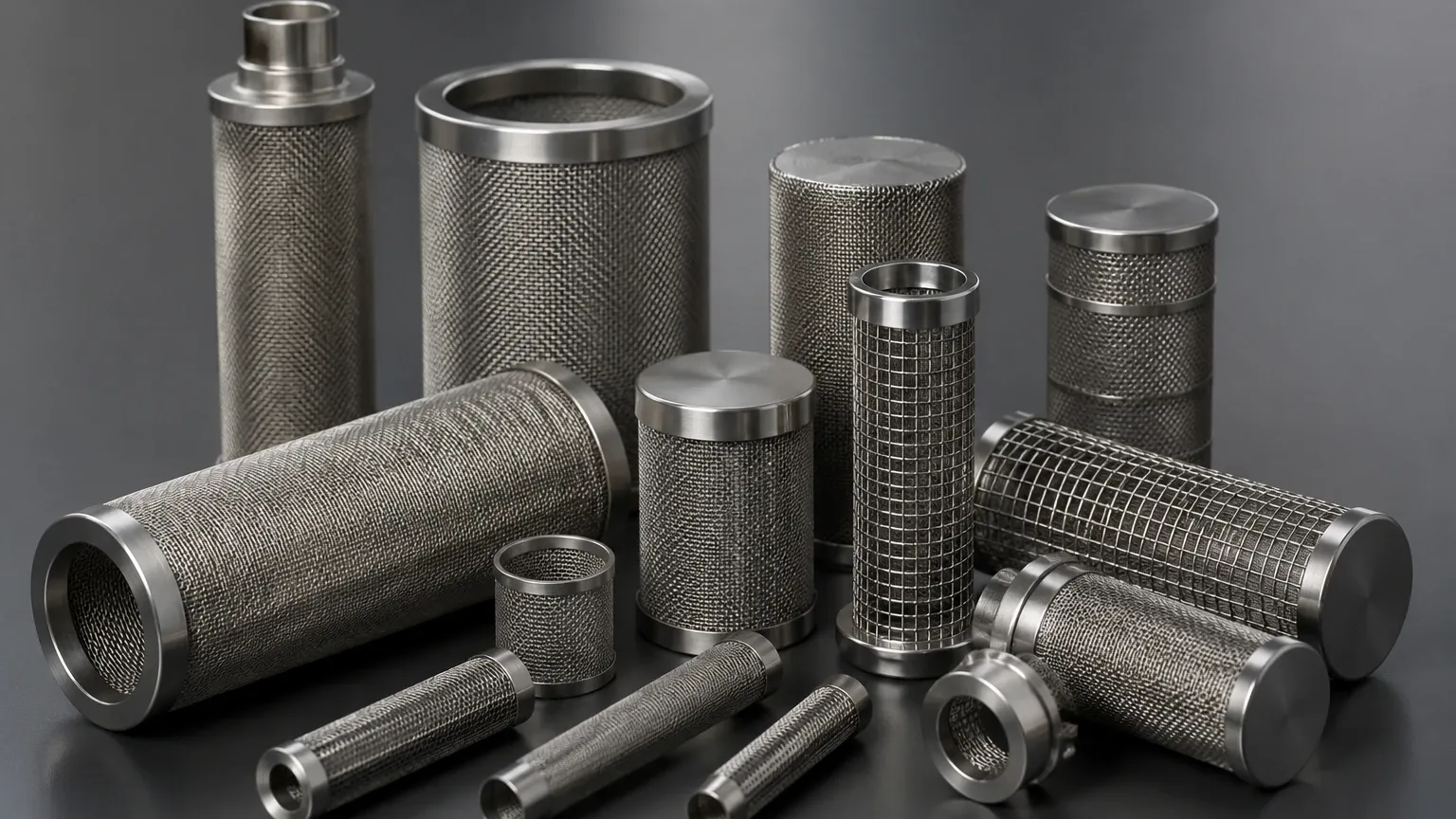
For industrial applications, the filter media is rarely used as a flat sheet. It is typically fabricated into Wire Mesh Filter Cylinders & Tubes to provide a larger surface area within a compact footprint. The process of forming these shapes introduces several engineering challenges related to mesh size.
Seam Integrity
The longitudinal seam of a filter cylinder is a potential point of failure. Precision welding techniques, such as plasma or laser welding, are required to ensure that the seam does not bypass contaminants. The mesh size must be compatible with the welding process; extremely fine meshes require specialized handling to prevent burning or warping the material.
Support Structures
In many high-pressure environments, a single layer of wire mesh lacks the rigidity to prevent collapse. Engineers often specify multi-layer constructions where a fine filtration mesh is supported by a coarser, heavier backup mesh or a perforated metal core. This configuration allows for a very fine mesh filter size to be used in applications that would otherwise require much bulkier equipment.
Operational Challenges: Pressure Drop and Blinding Risks
One of the most critical factors in filter selection is the "Clean Pressure Drop" (ΔP). Every filter media introduces resistance to the flow. As the mesh filter size becomes finer, the resistance increases.
Managing Blinding
Blinding occurs when particles become lodged in the openings of the mesh, or when a layer of sticky or gelatinous material coats the surface, rendering the filter impermeable. To mitigate blinding, engineers may choose:
1. A larger surface area: Using pleated designs to reduce the face velocity of the fluid.
2. Specific material treatments: Such as electropolishing to create a smoother surface that is easier to clean.
3. Backwashing systems: Where the flow is periodically reversed to dislodge accumulated debris.
If the selected mesh filter size is too fine for the specific gravity or viscosity of the fluid, the system may reach its terminal pressure drop within minutes of operation, necessitating frequent shutdowns for cleaning or replacement.
Customization and Procurement: A Checklist for Technical Buyers
When sourcing filtration components from a manufacturer like Kaifil, providing precise technical specifications is essential for ensuring the longevity of the component. International buyers should confirm the following parameters before finalizing an order for Wire Mesh Filter Cylinders & Tubes:
1. Material Grade: Is SS304 sufficient, or does the chemical environment require the superior corrosion resistance of SS316L or a specialty alloy like Hastelloy?
2. Dimensional Tolerances: What are the allowable variances in length, diameter, and concentricity? In automated assembly lines, even a millimeter of deviation can cause installation failure.
3. Filtration Direction: Will the fluid flow from the inside-out or outside-in? This determines where the support layers should be placed.
4. End Fittings: Does the application require NPT threads, flanges, or custom machined end caps? The method of attachment must be as robust as the filter media itself.
5. Operating Environment: What are the maximum operating temperatures and pressures? This influences the choice of wire diameter and the method of construction (e.g., sintering vs. mechanical binding).
Conclusion: The Importance of Precision Sizing
Selecting the right mesh filter size is a balancing act between filtration precision, mechanical strength, and flow capacity. By understanding the technical relationship between mesh count, micron ratings, and open area, engineers can specify filtration solutions that optimize the lifespan of downstream equipment and reduce the total cost of ownership.
Whether you are designing a new system or optimizing an existing process, the integration of high-quality stainless steel components ensures that your filtration performance remains consistent under the most demanding industrial conditions. For specialized requirements, custom-engineered Wire Mesh Filter Cylinders & Tubes provide the versatility needed to meet exact micron targets while maintaining structural durability.
