


Understanding the 100 Mesh Filter in Microns: A Technical Guide for Industrial Filtration
In industrial engineering, selecting the appropriate filtration media requires a precise understanding of how different measurement systems correlate. For engineers and procurement specialists sourcing stainless steel filtration components, the conversion of "mesh" to "microns" is a fundamental calculation that dictates the efficiency of a system. Specifically, understanding the properties of a 100 mesh filter in microns is critical when designing or replacing elements within Wire Mesh Filter Cylinders & Tubes.
This guide examines the technical relationship between mesh count and micron ratings, the engineering considerations for wire mesh structures, and the factors that influence performance in demanding industrial environments.
Defining the Relationship Between Mesh Count and Micron Rating
The term "mesh" refers to the number of openings per linear inch of a wire cloth. A 100 mesh screen, therefore, has 100 openings per inch in both the warp and shute directions. However, mesh count alone does not define the size of the particles that can pass through the filter. To determine the filtration accuracy, one must account for the wire diameter.
The Micron Conversion Logic
A micron (micrometer) is a unit of length equal to one-millionth of a meter (0.001 mm). In the context of a 100 mesh filter, the micron rating is the distance between two adjacent parallel wires. The standard conversion for a typical stainless steel 100 mesh filter results in an opening of approximately 149 to 150 microns.
This calculation follows a simple formula:
1. Calculate the total space per mesh unit: 1 inch (25.4 mm) divided by the mesh count (100) = 0.254 mm per unit.
2. Subtract the wire diameter: If the wire diameter is 0.10 mm (a common standard for 100 mesh), the remaining opening is 0.254 mm – 0.10 mm = 0.154 mm.
3. Convert to microns: 0.154 mm = 154 microns.
Because wire diameters vary based on the required structural strength and the manufacturer’s specifications, the "100 mesh filter in microns" value can fluctuate. For most industrial applications, 149 microns is the recognized nominal value for standard 100 mesh wire cloth.
Technical Specifications of Wire Mesh Filter Cylinders & Tubes
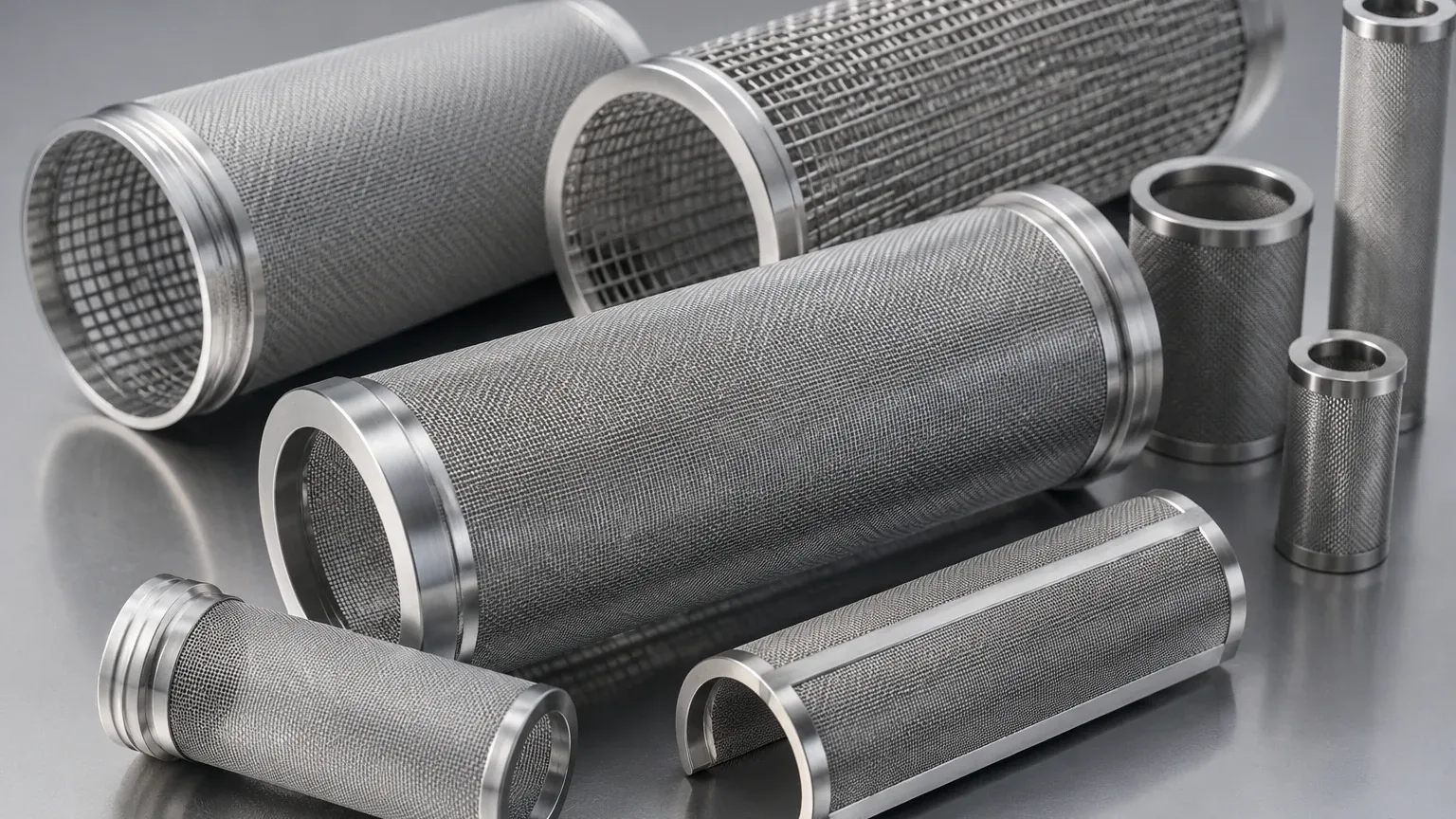
When 100 mesh wire cloth is fabricated into Wire Mesh Filter Cylinders & Tubes, the geometry of the component introduces additional engineering variables. These cylindrical filters are often the primary defense in hydraulic systems, chemical processing lines, and water treatment plants.
Construction and Geometry
Industrial filter tubes are rarely composed of a single layer of mesh if they are subjected to high differential pressures. To maintain the integrity of the 150-micron openings, manufacturers like Kaifil utilize several construction methods:
* Single-Layer Cylinders: Best for low-pressure applications where ease of cleaning is a priority. The mesh is rolled and longitudinal-seam welded.
* Multi-Layer Sintered Mesh: Several layers of mesh (including the 100 mesh functional layer and coarser support layers) are fused together under heat and pressure. This creates a robust, fixed-pore structure that prevents media migration.
* Perforated Metal Support: For high-flow environments, the 100 mesh screen is wrapped around or inserted into a perforated stainless steel core. This provides the mechanical strength necessary to resist collapsing under vacuum or high-pressure surges.
Effective Filtration Area (EFA)
The EFA is a critical metric for engineers. A 100 mesh screen provides a specific percentage of open area (typically around 30% to 40% depending on wire gauge). When designing cylinders, the total surface area must be calculated to ensure that the flow velocity through the mesh does not exceed the limits that would cause particle breakthrough or excessive pressure drop.
Factors Affecting Filtration Performance at 100 Mesh
Selecting a 100 mesh filter in microns is only the first step. Engineers must also evaluate how the filter will behave under operational loads.
Pressure Drop ($ΔP$)
As fluid passes through the 150-micron openings, resistance is encountered. This pressure drop increases as the filter captures contaminants. Because 100 mesh is considered a relatively "coarse" to "medium" filtration grade, it is often used as a pre-filter. If the $ΔP$ across the Wire Mesh Filter Cylinders & Tubes rises too quickly, it indicates either an undersized filter surface area or an unexpectedly high concentration of solids in the process stream.
Nominal vs. Absolute Ratings
Standard wire mesh is typically considered a "nominal" filter. This means it will retain the majority of particles 150 microns or larger, but elongated or spherical particles slightly smaller or larger might pass through depending on their orientation. For applications requiring an "absolute" rating—where 99.9% of particles at a specific micron size must be captured—engineers may need to specify specialized weaves, such as Dutch Twill, which can achieve much finer ratings while maintaining the structural benefits of a 100 mesh base.
Material Selection for Industrial Environments
The performance of a 100 mesh filter is heavily dependent on the alloy used. Stainless steel is the industry standard due to its balance of cost, durability, and resistance to environmental degradation.
Stainless Steel 304 vs. 316L
* Grade 304: Suitable for general industrial use, water filtration, and food processing where high acidity or chloride levels are not present. It provides excellent physical strength for filter tubes.
* Grade 316L: The "L" stands for low carbon, which improves weldability and prevents intergranular corrosion. 316L contains molybdenum, making it essential for chemical processing, pharmaceutical manufacturing, and marine environments where resistance to pitting and chloride-induced stress corrosion cracking is required.
Temperature and Chemical Compatibility
Unlike synthetic or paper filters, stainless steel Wire Mesh Filter Cylinders & Tubes can operate at extreme temperatures (up to 800°F or 425°C depending on the alloy) and are compatible with a wide range of solvents, caustic cleaning agents, and high-viscosity fluids. When specifying a 100 mesh filter, engineers must confirm that the gaskets and end-cap adhesives (if any) match the chemical resistance of the stainless steel mesh.
Applications of 100 Mesh Filtration in Industrial Systems
The 150-micron threshold provided by a 100 mesh filter is a "sweet spot" for many industrial processes. It is fine enough to protect sensitive downstream equipment but coarse enough to allow high flow rates with minimal maintenance.
Hydraulic and Lube Oil Systems
In hydraulic circuits, 100 mesh suction strainers are frequently used to protect pumps from large debris, such as metal shavings or scale, that could cause catastrophic mechanical failure. These are often fabricated as cylindrical tubes with internal reinforcement to handle the suction pressure.
Food and Beverage Processing
For the filtration of syrups, juices, and oils, 100 mesh filters remove unwanted pulp or particulates while ensuring the fluid retains its required consistency. Because stainless steel is non-leaching and easy to sterilize, it meets the stringent hygienic standards of the industry.
Chemical and Petrochemical Refinement
In chemical plants, 100 mesh filters serve as primary stages for removing catalysts or solid reactants from liquid streams. The durability of stainless steel mesh ensures that the filter can be cleaned via backwashing or ultrasonic baths, extending the service life and reducing the total cost of ownership compared to disposable cartridges.
Selection Criteria for International Buyers and Engineers
When sourcing Wire Mesh Filter Cylinders & Tubes, international procurement teams should provide manufacturers with a detailed set of specifications to ensure the final product meets the application's demands. At Kaifil, we recommend confirming the following parameters:
1. Micron Requirement: Confirm if 149-150 microns (standard 100 mesh) is sufficient or if a custom wire diameter is needed to shift the micron rating.
2. Flow Rate and Viscosity: High-viscosity fluids (like heavy oils) require a larger surface area to maintain a low pressure drop, even at 100 mesh.
3. Mechanical Interface: Specify the end-cap style (DOE – Double Open End, SOE – Single Open End with O-ring, or threaded NPT/BSP connections) to ensure a leak-proof fit in the filter housing.
4. Cleaning Protocol: If the filter will be cleaned and reused, specify a construction method (like pleating or sintering) that can withstand repeated high-pressure backpulsing or chemical soaking.
Conclusion: Optimizing Filtration with 100 Mesh Components
The use of a 100 mesh filter in microns (approximately 150 μm) offers a versatile solution for a wide array of industrial challenges. By understanding the nuances of mesh-to-micron conversion and the structural requirements of Wire Mesh Filter Cylinders & Tubes, engineers can design systems that balance filtration efficiency with operational longevity.
As a specialist manufacturer, Kaifil provides the technical expertise and manufacturing precision required to produce custom stainless steel filtration solutions. Whether your application involves high-pressure hydraulics, corrosive chemical processing, or sanitary food production, selecting the right mesh specifications and construction methods is the key to achieving reliable, cost-effective filtration performance.
