


Filter Cartridge Dust
In industrial filtration, the management of particulate matter—often referred to as filter cartridge dust—is a critical factor in maintaining system efficiency, ensuring product purity, and protecting downstream equipment. Whether in gas-phase dust collection or liquid-phase slurry filtration, the interaction between the filter media and the accumulated dust determines the operational lifespan and the total cost of ownership for the filtration system.
For engineers and procurement professionals, understanding the technical nuances of how Filter Cartridges handle dust loading is essential for selecting the correct media, pore size, and structural design. This guide explores the engineering principles of dust filtration, material considerations for harsh environments, and the performance metrics that define high-quality industrial filtration components.
Mechanisms of Dust Capturing in Industrial Cartridges
To effectively manage filter cartridge dust, it is necessary to understand the physical mechanisms at play when particles encounter the filter media. Industrial filtration does not rely on a single process; rather, it is a combination of several mechanical actions that vary based on particle size and flow velocity.
Interception and Inertial Impaction
Interception occurs when a dust particle follows a fluid streamline but comes within one particle radius of a filter fiber or wire mesh strand, causing it to adhere. Inertial impaction, conversely, happens with larger, heavier particles. These particles have enough inertia that they cannot follow the fluid's abrupt change in direction around a filter fiber, causing them to strike the media directly. In stainless steel wire mesh filters, these mechanisms are highly predictable due to the precise geometric regularity of the weave.
Diffusion and Sieving
For sub-micron dust particles, Brownian motion (diffusion) causes the particles to move erratically, increasing the likelihood of contact with the filter media. For particles larger than the pore openings of the filter, sieving is the primary mechanism. In high-precision applications, such as pharmaceutical or fine chemical processing, the sieving accuracy of the filter cartridge is paramount to prevent downstream contamination.
Material Selection for Challenging Dust Environments
The nature of the filter cartridge dust—its temperature, acidity, abrasiveness, and moisture content—dictates the material requirements of the filter. While polymer-based filters are common in light-duty applications, demanding industrial environments often require the durability of stainless steel.
Stainless Steel 304 and 316L
Stainless steel is the preferred material for applications involving high temperatures or corrosive chemicals. 316L stainless steel, in particular, offers superior resistance to pitting and crevice corrosion in chloride-rich environments. For industrial dust collection involving hot gases or aggressive solvents, stainless steel filter cartridges maintain structural integrity where synthetic fibers would melt or degrade.
Sintered Metal vs. Wire Mesh
When dealing with fine filter cartridge dust, engineers must choose between different metal structures:
* Sintered Metal Fiber Felt: Provides a high porosity and high dirt-holding capacity, making it ideal for depth filtration where dust is trapped within the thickness of the media.
* Stainless Steel Wire Mesh: Offers precise, surface-level filtration. It is easier to clean via backwashing or ultrasonic methods, making it suitable for processes where the filter must be reused multiple times.
Evaluating Filter Cartridge Performance for Dust Loading
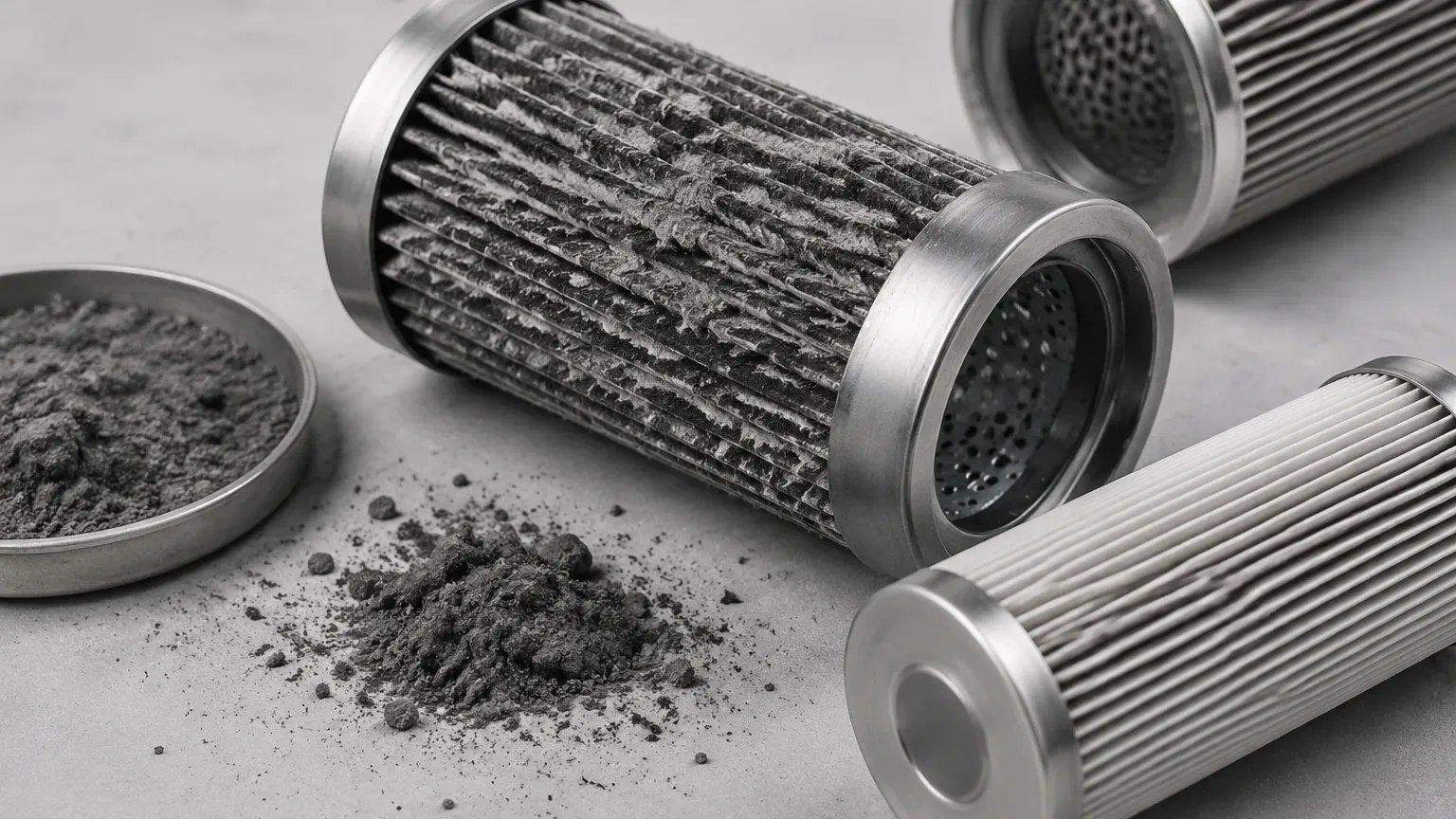
The performance of a filter is not static; it changes as filter cartridge dust accumulates on the surface or within the media. Monitoring these changes is vital for process stability.
Pressure Drop (Delta P)
As dust builds up, the available flow area decreases, leading to an increase in differential pressure (Delta P). A well-designed filter cartridge will exhibit a slow, linear increase in pressure drop during the majority of its service life, followed by a rapid rise (the "terminal pressure") signaling the need for cleaning or replacement. High-quality stainless steel cartridges are engineered to maximize the surface area—often through pleating—to keep the initial pressure drop low and extend the time between maintenance cycles.
Filtration Efficiency and Beta Ratio
Efficiency is often measured by the Beta Ratio, which compares the number of particles of a given size upstream of the filter to the number downstream. In dust-heavy applications, the formation of a "dust cake" on the surface of the filter can actually increase filtration efficiency, as the dust layer itself acts as a secondary filter medium. However, this must be balanced against the resulting increase in flow resistance.
Maintenance and Cleaning of Metal Filter Cartridges
One of the primary advantages of utilizing stainless steel Filter Cartridges in dust-intensive applications is their ability to be cleaned and returned to service. This significantly reduces the total cost of ownership compared to disposable cartridges.
Back-Pulsing and Back-Washing
In automated systems, back-pulsing (using compressed air) or back-washing (using a clean fluid) can dislodge the accumulated filter cartridge dust. The structural rigidity of stainless steel allows the cartridge to withstand the reverse pressure required for effective cleaning without deforming the pleats or damaging the media.
Ultrasonic and Chemical Cleaning
For stubborn or hazardous dust that cannot be removed by back-washing, ultrasonic cleaning provides a deep-clean solution. By using high-frequency sound waves in a cleaning solvent, microscopic bubbles implode against the dust particles, stripping them away from the metal fibers. Chemical cleaning is also an option for removing organic or mineral scales that may bind the dust to the filter surface.
Engineering Considerations for Customization
Every industrial process presents a unique set of challenges regarding filter cartridge dust. Customization is often required to optimize the balance between filtration fineness and service life.
Pleated vs. Cylindrical Designs
Pleating the filter media significantly increases the effective filtration area within the same footprint. For high-flow applications with high dust concentrations, pleated stainless steel cartridges are often the most efficient choice because they distribute the dust load over a larger surface, reducing the face velocity and extending the time before the terminal pressure drop is reached.
Structural Reinforcement
In high-pressure hydraulic systems or high-velocity gas streams, the filter must resist collapse. Custom-engineered cartridges often include internal support cores (perforated tubes) and external shrouds made of heavy-duty stainless steel to ensure the filter media remains intact even under heavy dust loading and high differential pressures.
Common Risks in Dust Filtration Management
Failure to properly account for the characteristics of filter cartridge dust can lead to several operational risks:
1. Media Blinding: This occurs when sticky or oily dust particles penetrate deep into the media and cannot be removed by standard cleaning, leading to a permanent increase in pressure drop.
2. Bypass Leakage: If the seals or end caps of the cartridge are not compatible with the process temperature or chemicals, dust can bypass the filter entirely, contaminating the downstream system.
3. Structural Failure: Using a filter with insufficient mechanical strength for the expected dust load can result in media rupture, leading to catastrophic system failure.
Conclusion: Selecting the Right Solution
Managing filter cartridge dust effectively requires a technical approach that considers the physical properties of the particulate, the chemical environment of the process, and the long-term maintenance strategy. By opting for high-performance stainless steel filtration solutions, industrial operators can achieve higher precision, greater durability, and lower long-term costs.
Before finalizing a filter selection, engineers should confirm the exact particle size distribution of the dust, the maximum operating temperature, and the required flow rate. For specialized applications requiring custom dimensions or specific alloy compositions, working with a manufacturer like Kaifil ensures that the filtration components are engineered to meet the rigorous demands of the application.
For more information on technical specifications and customized filtration options, you can Review product options and application support to find the optimal configuration for your specific industrial dust management needs.
