


2mm Mesh Filter
In industrial filtration, the selection of the correct aperture size is the most critical factor in balancing system protection with operational efficiency. A 2mm mesh filter, often classified as a coarse filter or a high-capacity strainer, serves as a primary line of defense in fluid systems. While finer filtration is necessary for polishing or sterile applications, the 2mm aperture is indispensable for removing large particulates, protecting pumps, and ensuring the longevity of downstream equipment.
Selecting the right Wire Mesh Filter Cylinders & Tubes involves more than simply choosing a hole size. Engineers must evaluate material compatibility, structural integrity under pressure, and the specific flow dynamics of the medium. This guide provides a technical overview of the engineering considerations required when implementing 2mm mesh filtration in industrial environments.
Technical Specifications of 2mm Mesh Filtration
To understand a 2mm mesh filter, one must distinguish between aperture size, mesh count, and wire diameter. In the context of wire cloth, the aperture is the clear distance between two adjacent warp or weft wires.
Aperture vs. Mesh Count
For a 2mm aperture, the mesh count (the number of openings per linear inch) typically ranges between 8 and 10, depending on the wire diameter used. For example, if a filter uses a 0.5mm wire diameter with a 2mm aperture, the center-to-center distance (pitch) is 2.5mm. This results in approximately 10 mesh. If a heavier 0.8mm wire is used for increased structural strength, the mesh count decreases to maintain the 2mm opening.
Open Area Percentage
The open area is a critical metric for calculating flow resistance. It is determined by the formula:
* Open Area % = (Aperture² / (Aperture + Wire Diameter)²) x 100
For a 2mm mesh filter with a 0.6mm wire, the open area is approximately 59%. A higher open area reduces the initial pressure drop across the filter but may result in a more fragile mesh if the wire diameter is too thin for the operating pressure.
Structural Configurations: Wire Mesh Filter Cylinders & Tubes
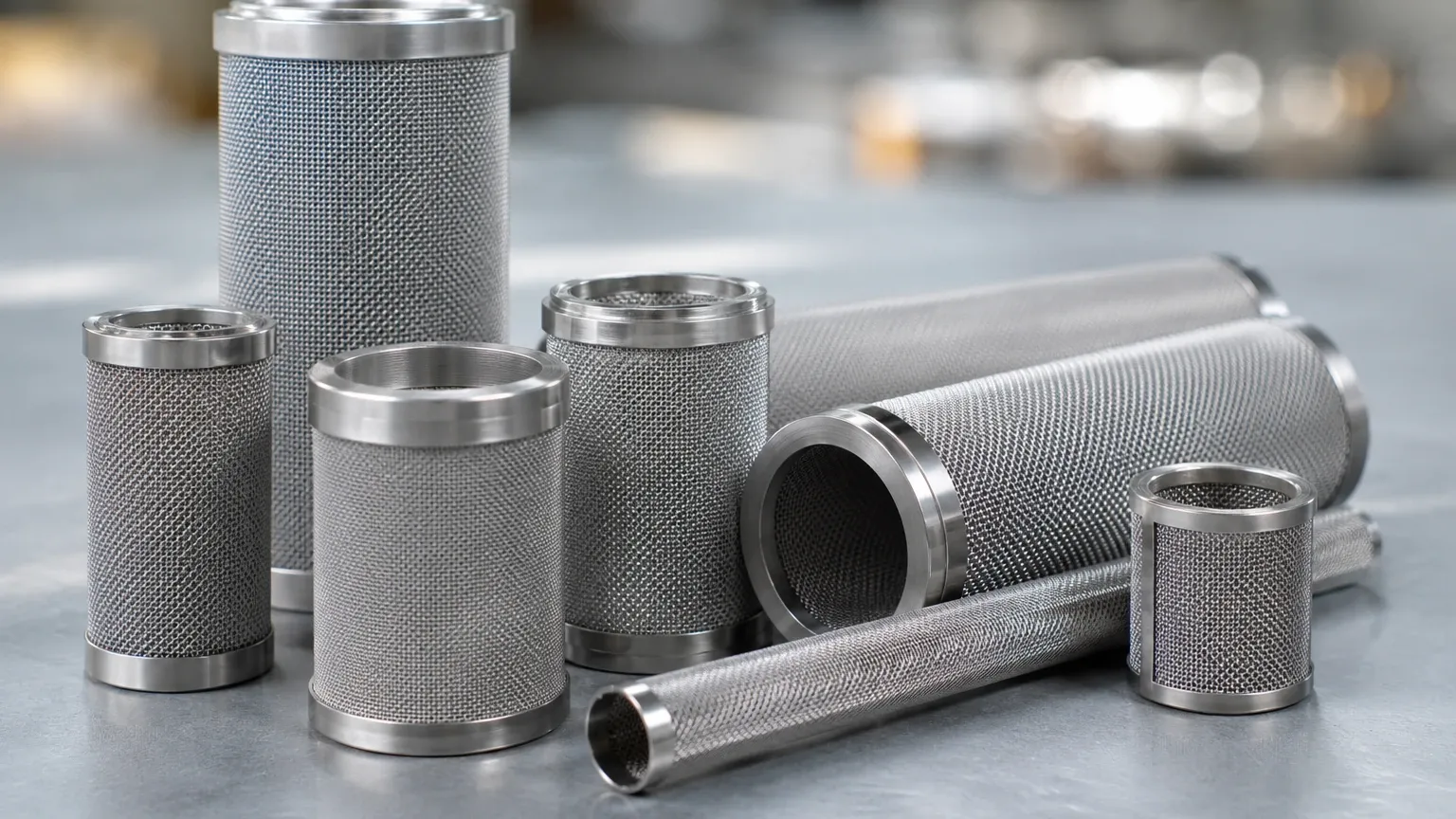
In most industrial applications, the mesh is not used as a flat sheet but is fabricated into rigid shapes. The most common forms are Wire Mesh Filter Cylinders & Tubes, which provide a high surface-area-to-volume ratio and can be easily integrated into existing piping systems.
Single-Layer vs. Multi-Layer Construction
* Single-Layer Cylinders: These are suitable for low-pressure applications where the primary goal is simple straining. They are cost-effective and easy to clean via backwashing or manual rinsing.
* Multi-Layer Reinforced Tubes: For high-pressure hydraulic or chemical processing, a 2mm mesh may be bonded to a perforated metal core or a coarser support mesh. This prevents the 2mm mesh from deforming or collapsing under high differential pressure (ΔP).
Pleated Designs
When the installation footprint is limited but high flow rates are required, the mesh is pleated. Pleating increases the effective filtration area by 3 to 5 times compared to a smooth cylinder of the same dimensions. This significantly extends the time between cleaning cycles and reduces the velocity of the fluid passing through the mesh, which minimizes wire erosion.
Material Selection for Industrial Environments
The durability of a 2mm mesh filter depends heavily on the alloy selected. Since these filters are often exposed to corrosive fluids or high temperatures, stainless steel is the industry standard.
1. AISI 304 Stainless Steel: The standard choice for general industrial use, offering good corrosion resistance and mechanical strength. It is commonly used in food processing and water treatment where chemical exposure is moderate.
2. AISI 316L Stainless Steel: Contains molybdenum, which provides superior resistance to chlorides and pitting corrosion. This is the preferred material for marine environments, pharmaceutical manufacturing, and aggressive chemical processing.
3. Specialty Alloys: In highly acidic or high-temperature environments (exceeding 400°C), alloys like Monel, Inconel, or Hastelloy may be required to prevent stress corrosion cracking or oxidation.
Engineering Considerations: Flow Rate and Pressure Drop
When specifying a 2mm mesh filter, the primary engineering concern is the "clean pressure drop." As fluid passes through the mesh, energy is lost due to turbulence and friction. If the initial pressure drop is too high, the system's pump efficiency will decrease, and the filter will reach its terminal pressure drop (the point where cleaning is required) much faster.
Factors Influencing Pressure Drop:
* Viscosity of the Fluid: Higher viscosity fluids (like heavy oils or resins) require larger surface areas or coarser mesh to maintain flow.
* Flow Velocity: Doubling the flow velocity typically results in a fourfold increase in pressure drop.
* Contaminant Loading: The nature of the debris (spherical vs. fibrous) affects how quickly the 2mm openings become blinded. Fibrous materials tend to bridge across the 2mm gaps more easily than granular solids.
Industrial Applications of 2mm Mesh Filters
The 2mm aperture is a versatile size used across various sectors where "trash straining" or "scalping" is required.
1. Water Treatment and Intake Protection
In municipal and industrial water intake systems, 2mm mesh cylinders protect downstream membranes and fine filters from aquatic life, twigs, and large debris. They are often used as the first stage in a multi-stage filtration train.
2. Chemical and Petrochemical Processing
In these industries, 2mm mesh tubes are used to recover catalysts or to protect heat exchangers from scale buildup. The robust nature of stainless steel wire mesh allows these filters to withstand the aggressive cleaning solvents often used in these sectors.
3. Food and Beverage Production
During the initial processing of raw ingredients—such as fruit pulping or grain washing—2mm filters separate large skins, seeds, or husks from the liquid stream. Compliance with food-grade standards (such as FDA or EU regulations) is mandatory here, making smooth-welded stainless steel the only viable option.
4. Hydraulic and Lubrication Systems
Large hydraulic reservoirs use 2mm strainers on the suction side to prevent large metallic chips or accidental debris from entering the pump. While the main filtration happens at the 10-20 micron level, the 2mm "suction strainer" is the last line of defense against catastrophic pump failure.
Maintenance, Cleaning, and Longevity
One of the primary advantages of a stainless steel 2mm mesh filter is its cleanability. Unlike disposable synthetic filters, metal mesh can be refurbished multiple times.
* Manual Cleaning: For 2mm apertures, manual brushing or high-pressure water hosing is often sufficient to remove trapped solids.
* Ultrasonic Cleaning: For sticky or hardened contaminants, ultrasonic baths use high-frequency sound waves to create cavitation bubbles that dislodge particles from the wire intersections.
* Backwashing: In automated systems, a portion of the filtered fluid is pulsed back through the mesh in the reverse direction. The 2mm aperture is particularly well-suited for backwashing because the large openings allow for high-velocity reverse flow without excessive pressure.
Procurement Checklist: What Engineers Need to Confirm
When ordering custom Wire Mesh Filter Cylinders & Tubes, providing precise technical data ensures the component will perform as expected. International buyers should confirm the following parameters:
1. Dimensional Tolerances: Specify the outer diameter (OD), inner diameter (ID), and overall length. For cylindrical filters fitting into housings, a tolerance of +/- 0.5mm is often required.
2. End Fitting Requirements: Will the filter be held in place by flanges, threaded connectors, or simple O-ring seals? The integrity of the end-cap welding is vital to prevent particulate bypass.
3. Seam Integrity: For tubes, specify the type of seam weld (e.g., plasma or TIG welding). A smooth, continuous weld is necessary to prevent weak spots that could fail under vibration.
4. Operating Conditions: Provide the maximum operating temperature and the maximum expected differential pressure. This allows the manufacturer to determine if reinforcement (such as an internal support cage) is necessary.
5. Certification: If the application is in the pharmaceutical or food industry, request material test reports (MTRs) to verify the stainless steel grade and compliance with safety standards.
Conclusion
A 2mm mesh filter is a fundamental component in industrial fluid management. By selecting high-quality Wire Mesh Filter Cylinders & Tubes and carefully considering the material and structural requirements, engineers can significantly reduce maintenance costs and protect expensive downstream equipment. Whether used for simple water straining or complex chemical processing, the 2mm mesh provides a reliable, cleanable, and durable solution for coarse filtration needs.
