


4 Mesh Filter
In industrial filtration, the selection of mesh size is a critical engineering decision that dictates flow efficiency, pressure management, and the protection of downstream equipment. The 4 mesh filter represents a specific category of coarse filtration, serving as a primary line of defense in systems handling high flow rates and large particulate matter. Understanding the technical specifications, structural configurations, and material performance of these components is essential for engineers and procurement teams looking to optimize system longevity.
Understanding 4 Mesh Technical Specifications
The term "mesh" refers to the number of openings per linear inch of the wire cloth. A 4 mesh specification indicates there are four openings in every 25.4mm (1 inch) of the material. However, the mesh count alone does not define the filtration capability; the wire diameter is a secondary, equally vital variable.
Aperture and Wire Diameter
In a standard 4 mesh configuration, the wire diameter typically ranges from 1.2mm (0.047") to 1.6mm (0.063"). To calculate the clear opening (aperture), the formula is:
* Aperture = (1 / Mesh Count) – Wire Diameter
For a 4 mesh filter using a 1.6mm wire, the resulting aperture is approximately 4.75mm (0.187 inches). This size makes it ideal for capturing large debris, such as scale, wood chips, or aggregate, while maintaining a very low pressure drop.
Open Area Percentage
The open area percentage is a measure of the filter's porosity and directly impacts flow capacity and the rate of blinding (clogging). A 4 mesh filter typically offers an open area between 55% and 75%, depending on the wire gauge chosen. Higher open areas reduce the initial differential pressure but may sacrifice the mechanical strength of the mesh under high-load conditions.
Structural Configurations: Wire Mesh Filter Cylinders & Tubes
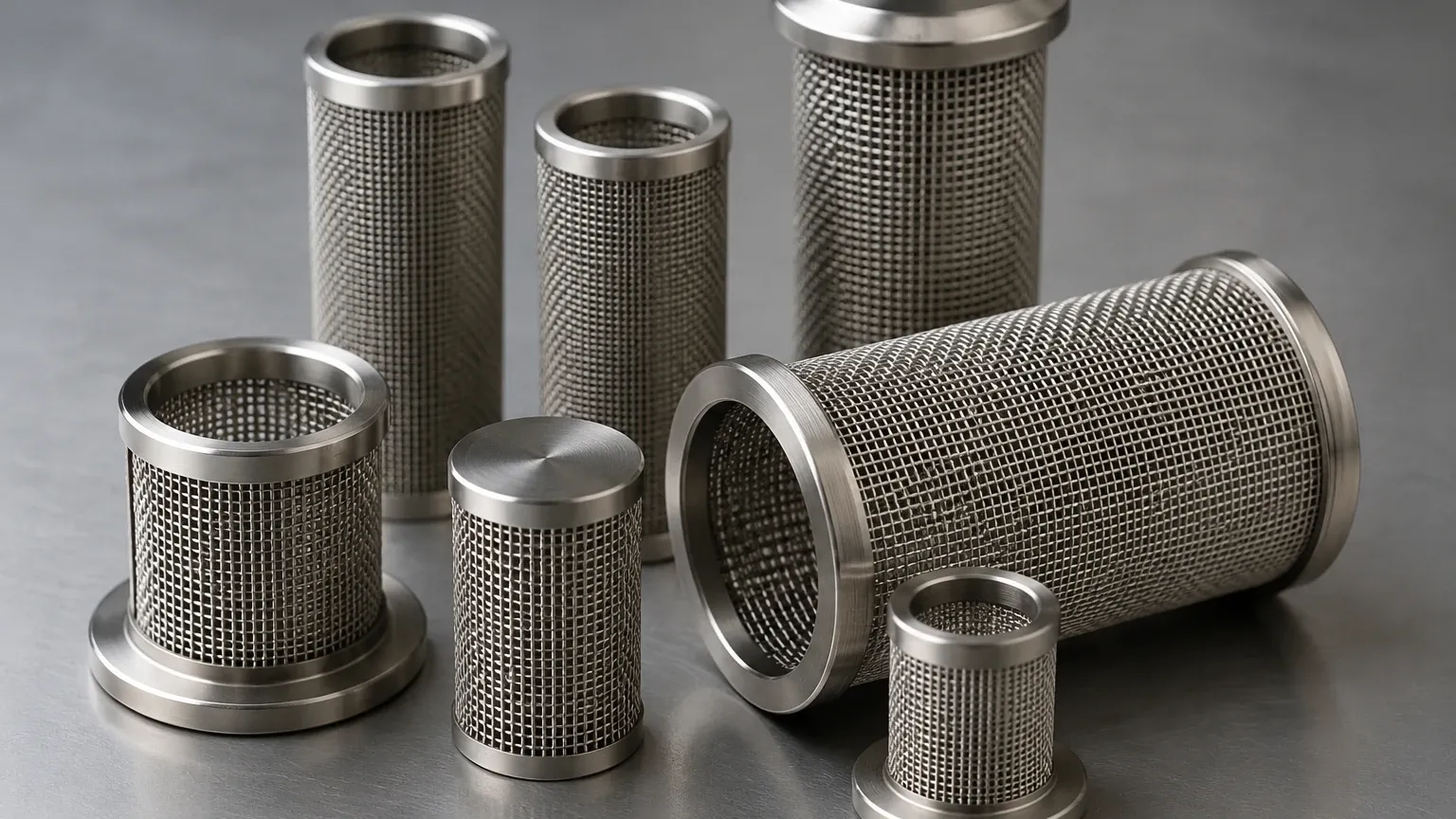
While flat mesh sheets are used in some applications, most industrial processes require the mesh to be formed into specific geometries to fit housing units. Wire Mesh Filter Cylinders & Tubes are the most common configurations for 4 mesh media, providing a high surface-area-to-volume ratio and structural rigidity.
Cylinder Construction and Welding
Manufacturing a 4 mesh cylinder involves rolling the mesh and securing the seam. Because 4 mesh uses relatively thick wire, specialized welding techniques are required to ensure the seam does not become a point of mechanical failure. Resistance welding or TIG (Tungsten Inert Gas) welding is typically employed to create a robust, leak-proof longitudinal seam.
Support and Reinforcement
In many high-pressure hydraulic or chemical processing environments, a 4 mesh layer serves as a "support mesh" or "drainage layer." In these multi-layer designs, the 4 mesh provides the structural skeleton for finer filtration media (such as 100 or 500 mesh). This prevents the finer, more delicate mesh from collapsing under the force of the fluid flow. When used as a standalone filter, 4 mesh tubes often incorporate internal or external perforated metal cores to withstand high differential pressures without deforming.
Material Selection for Industrial Environments
The performance of a 4 mesh filter is heavily dependent on the alloy from which it is manufactured. Stainless steel is the industry standard due to its balance of mechanical strength and chemical resistance.
* Stainless Steel 304: The most common grade, suitable for general industrial applications, water treatment, and food processing where high-level corrosion from acids or chlorides is not a primary concern.
* Stainless Steel 316/316L: Contains molybdenum, which provides superior resistance to pitting and crevice corrosion in chloride-rich environments, such as marine applications or chemical processing plants handling saline solutions or organic acids.
* High-Nickel Alloys: For extreme environments involving high temperatures or highly corrosive chemicals (e.g., sulfuric acid), alloys like Monel or Inconel may be utilized, though these are less common for standard 4 mesh coarse filtration.
Performance Metrics and Engineering Considerations
When integrating a 4 mesh filter into a system, engineers must evaluate several performance factors to ensure the component meets the application's demands.
Pressure Drop (ΔP)
One of the primary advantages of a 4 mesh filter is its minimal impact on system pressure. Because the openings are large and the wire-to-opening ratio is favorable, the initial clean pressure drop is negligible even at high velocities. This makes 4 mesh an excellent choice for suction-side pump protection, where preventing cavitation is a priority.
Dirt Holding Capacity
While 4 mesh does not capture fine particles, its dirt-holding capacity for large debris is significant. However, engineers must consider the nature of the contaminants. Fibrous materials, for example, can wrap around the thick wires of a 4 mesh screen, leading to a faster-than-expected increase in differential pressure.
Flow Velocity and Turbulence
In high-velocity systems, the physical impact of large solids against the filter mesh can cause erosion or mechanical fatigue. A 4 mesh filter must be designed with a wire diameter sufficient to withstand the kinetic energy of the incoming fluid and the debris it carries. If the velocity is too high, the mesh may vibrate, leading to work-hardening and eventual wire breakage at the weld points.
Application Risks and Mitigation
Despite its simplicity, the application of a 4 mesh filter involves risks that must be managed through proper design and maintenance protocols.
1. Bypass and Seal Integrity: A filter is only as effective as its seals. If the 4 mesh cylinder is not properly seated within its housing, fluid will take the path of least resistance, allowing large debris to bypass the filter and damage downstream pumps or valves. Using high-quality gaskets (EPDM, Viton, or PTFE) is essential.
2. Blinding and Cleaning: While 4 mesh is easier to clean than fine mesh, "near-size" particles (particles roughly the same size as the 4.75mm opening) can become wedged in the mesh. This is known as blinding. Mechanical cleaning via backwashing or ultrasonic baths is often required to restore the filter’s original flow characteristics.
3. Mechanical Stress: In systems with frequent pressure surges or water hammer, the mesh can undergo cyclic loading. Engineers should specify reinforced end caps and potentially a double-layered mesh construction to mitigate the risk of structural failure.
Buyer’s Guide: Confirming Technical Details
For international buyers and procurement teams, sourcing a 4 mesh filter requires clear communication of technical requirements to the manufacturer. Before finalizing a purchase, the following data points should be confirmed:
* Exact Wire Diameter: Do not simply specify "4 mesh." Specify the wire diameter (e.g., 1.2mm) to ensure the aperture and open area meet your flow calculations.
* Edge Treatment: Determine if the cylinder needs finished edges, such as a metal binding or U-edging, to prevent fraying and ensure a secure fit in the housing.
* Tolerances: In precision industrial equipment, the outer diameter (OD) and length of the filter tube must adhere to strict tolerances (e.g., +/- 0.5mm) to ensure compatibility with existing hardware.
* Certification: For food, beverage, or pharmaceutical applications, verify that the materials are FDA-compliant and that the manufacturing process avoids contaminants like non-food-grade lubricants.
Conclusion
The 4 mesh filter is a foundational component in industrial filtration, providing essential protection for pumps, nozzles, and finer filtration stages. By focusing on the relationship between mesh count, wire diameter, and material grade, engineers can select a solution that balances durability with flow efficiency. Whether used as a standalone strainer or as a structural support in complex Wire Mesh Filter Cylinders & Tubes, the 4 mesh configuration remains a versatile and cost-effective tool for managing coarse particulate in demanding industrial environments.
When selecting a manufacturer, prioritize those who offer customization in wire gauge and welding techniques, as these factors ultimately determine the total cost of ownership through reduced maintenance and extended service life.
