


5 Micron Filter Mesh
In industrial filtration, the transition from coarse separation to fine particle retention often centers on the 5-micron threshold. Achieving a reliable 5-micron rating requires a sophisticated understanding of wire diameters, weave patterns, and structural support. For engineers and procurement specialists, selecting a 5 micron filter mesh is not merely a matter of choosing a pore size; it involves balancing flow rates, pressure drops, and mechanical durability within specific chemical and thermal environments.
This guide examines the technical nuances of 5-micron stainless steel mesh, its integration into Wire Mesh Filter Cylinders & Tubes, and the critical factors that determine its performance in demanding B2B applications.
Understanding 5 Micron Filter Mesh in Industrial Contexts
A micron (micrometer) is one-millionth of a meter. To put a 5-micron rating in perspective, a human hair is typically 50 to 70 microns in diameter, and the lower limit of human visibility is approximately 40 microns. At 5 microns, a filter is designed to capture microscopic silt, carbon fines, and certain types of bacteria or yeast.
Unlike coarse meshes where the opening is visible to the naked eye, a 5 micron filter mesh often utilizes a "zero-open-area" weave. This does not mean fluid cannot pass through; rather, it means there is no straight-through path for a particle. The fluid must navigate a tortuous path through the overlapping wires, ensuring that any particle larger than the rated size is trapped on the surface or within the weave structure.
Engineering the Weave: How 5 Micron Precision is Achieved
Standard square weaves (Plain Weave) are generally unsuitable for 5-micron filtration because the wire diameters required would be too thin to maintain structural integrity. Instead, industrial manufacturers like Kaifil utilize specialized weaving techniques:
Plain Dutch Weave (PDW)
In this weave, the warp wires remain thicker than the shute (weft) wires. The shute wires are driven close together, creating a dense filter medium. While PDW can reach fine levels, it is more commonly used for slightly larger micron ratings.
Twilled Dutch Weave (TDW)
For a true 5 micron filter mesh, Twilled Dutch Weave is the industry standard. In this configuration, each shute wire passes over and under two warp wires. This allows for the use of even finer wires and a higher density of wires per inch. The result is a mesh that can provide absolute filtration ratings down to 1 or 5 microns while maintaining enough thickness to handle industrial pressures.
Sintered Metal Mesh
To enhance the stability of a 5-micron weave, multiple layers of mesh are often sintered together. Sintering involves bonding the contact points of the wires using heat and pressure without melting the material. This prevents "pore migration," where the wires shift under pressure and allow larger particles to pass through.
Material Selection and Chemical Compatibility
The performance of a 5-micron filter is heavily dependent on the alloy used. Since these filters are frequently used in aggressive chemical processing or high-temperature steam applications, material selection is a primary engineering constraint.
* Stainless Steel 304: The standard for general-purpose filtration. It offers good corrosion resistance and is cost-effective for water treatment or basic hydraulic oil filtration.
* Stainless Steel 316L: The preferred choice for pharmaceutical and food & beverage applications. The addition of molybdenum provides superior resistance to chlorides and pitting corrosion.
* 904L and Hastelloy: In highly acidic environments or specialized chemical synthesis, these high-performance alloys are used to prevent premature filter failure due to chemical erosion.
When specifying a 5 micron filter mesh, engineers must confirm the operating temperature and the pH level of the fluid to ensure the alloy's passive layer remains intact during the filtration cycle.
Structural Support: Integrating Mesh into Wire Mesh Filter Cylinders & Tubes
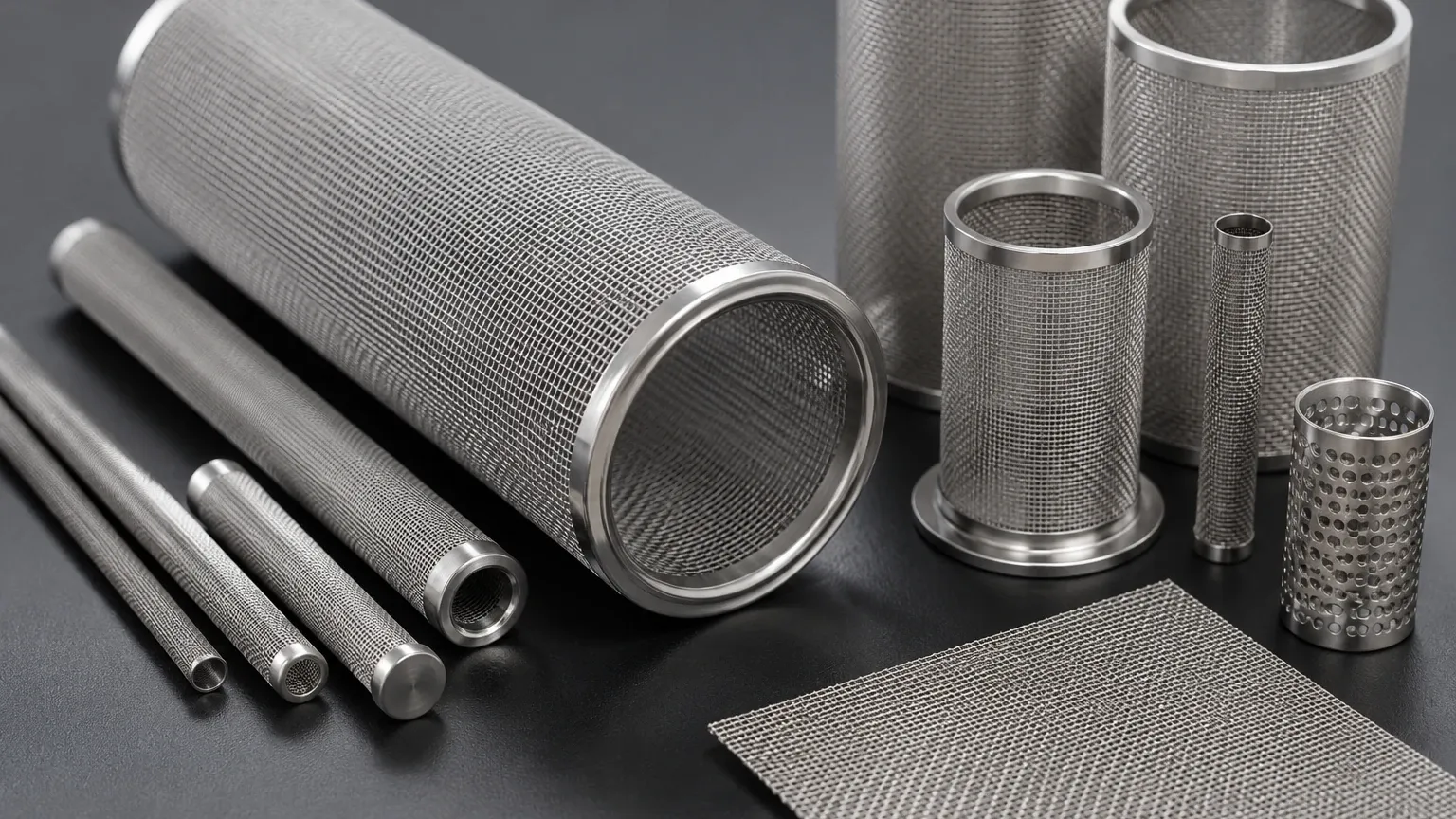
A 5-micron mesh is relatively delicate. If used as a single layer without support, the differential pressure $(\Delta P)$ across the filter would quickly cause the mesh to deform or burst. Therefore, in industrial settings, this mesh is almost always integrated into Wire Mesh Filter Cylinders & Tubes.
Support Layers and Pleating
To maximize the surface area and structural strength, the 5-micron media is often sandwiched between coarser "support meshes." This composite structure can then be pleated. Pleating significantly increases the effective filtration area within the same cylindrical footprint, which lowers the face velocity of the fluid and extends the time between cleaning cycles.
Core and Outer Guard
In a typical filter cartridge construction, the 5-micron mesh is wrapped around a perforated stainless steel core. This core provides the mechanical strength to withstand high collapse pressures. An outer guard or cage may also be added to protect the fine mesh from mechanical damage during installation or handling.
Performance Evaluation: Absolute vs. Nominal Ratings
One of the most common points of confusion in B2B procurement is the distinction between nominal and absolute micron ratings. For critical processes, this distinction is vital.
1. Nominal Rating: This is an indicative value. A 5-micron nominal filter might capture 60% to 90% of particles at that size. It is suitable for non-critical applications where some bypass is acceptable.
2. Absolute Rating: This indicates that the filter will capture 99.9% (or a specified Beta Ratio) of particles at 5 microns. For applications like protecting high-pressure hydraulic valves or ensuring the purity of injectable pharmaceuticals, an absolute-rated 5 micron filter mesh is mandatory.
Engineers should request Bubble Point Test data from the manufacturer. The bubble point test measures the pressure required to force air through a liquid-saturated mesh; it is a standardized method to verify the maximum pore size and ensure the integrity of the weave.
Maintenance, Cleaning, and Service Life Optimization
Unlike disposable polymer filters, stainless steel 5-micron filters are an investment intended for long-term use. Their total cost of ownership is often lower because they can be cleaned and reused.
Cleaning Methods
* Ultrasonic Cleaning: High-frequency sound waves create cavitation bubbles that dislodge fine particles trapped deep within the Twilled Dutch Weave.
* Backwashing: Reversing the flow of clean fluid through the filter can remove surface cakes. However, for 5-micron meshes, backwashing must be carefully controlled to avoid exceeding the reverse burst pressure.
* Chemical Cleaning: Using specialized solvents or acids to dissolve organic or mineral buildup, provided the chemical is compatible with the stainless steel grade.
Monitoring Differential Pressure
Service life is typically measured by the increase in differential pressure. A clean 5-micron filter will have a baseline $\Delta P$. As particles accumulate, the $\Delta P$ rises. Most industrial systems are designed with a "terminal $\Delta P$" at which point the filter must be removed for cleaning. Operating beyond this limit risks "media migration" or structural failure of the filter element.
Technical Procurement: Verification Steps for International Buyers
When sourcing 5-micron filtration components for global industrial projects, buyers must move beyond price-per-unit and focus on technical verification. To ensure the reliability of the filtration system, the following information should be confirmed with the manufacturer:
* Material Certification: Ensure the supplier provides Mill Test Reports (MTRs) to verify the chemical composition of the stainless steel (e.g., confirming 316L vs. 304).
* Filtration Efficiency: Ask for the Beta Ratio or the specific test standard used to determine the 5-micron rating (e.g., ISO 16889).
* Structural Integrity: For Wire Mesh Filter Cylinders & Tubes, confirm the collapse pressure rating to ensure it matches the system's pump capacity.
* Sealing Options: A 5-micron mesh is only as effective as its seals. Ensure the end caps are welded or bonded with high-temperature gaskets (Viton, PTFE, or EPDM) that match the process fluid.
By focusing on these technical boundaries, engineers can ensure that their choice of 5 micron filter mesh provides the necessary precision for their application while maintaining the durability required for industrial environments. Whether used in hydraulic systems, chemical processing, or fine water treatment, the combination of high-quality weaving and robust cylindrical support remains the gold standard for fine-particle separation.
