


5 Mesh Filter
In industrial filtration, selecting the appropriate mesh size is a critical engineering decision that directly impacts flow efficiency, equipment protection, and overall process reliability. A 5 mesh filter represents a specific category of coarse filtration media designed to remove large particulates while maintaining high flow rates with minimal pressure drop. For engineers and procurement specialists, understanding the technical nuances of this specification is essential when integrating Wire Mesh Filter Cylinders & Tubes into complex industrial systems.
This guide examines the technical specifications, material considerations, and engineering applications of 5 mesh filtration components, providing the factual foundation necessary for informed selection and procurement.
Understanding the Geometry of a 5 Mesh Filter
The term "mesh" refers to the number of openings per linear inch of the wire cloth. A 5 mesh filter, therefore, contains five openings across one inch of the material. However, the mesh count alone does not fully define the filtration capability; the wire diameter is the secondary variable that determines the actual aperture size and the percentage of open area.
Aperture and Wire Diameter
In a standard industrial 5 mesh configuration, the wire diameter typically ranges from 0.8 mm to 1.2 mm (approximately 0.032 to 0.047 inches). Using the standard formula for aperture calculation—*Aperture = (1 / Mesh Count) – Wire Diameter*—a 5 mesh screen with a 1.0 mm wire diameter would result in an aperture of approximately 4.08 mm. This makes it an ideal solution for primary screening where the objective is to capture debris larger than 4 mm.
Open Area Percentage
The open area is a vital metric for calculating flow velocity and potential pressure drop. For a 5 mesh filter, the open area typically falls between 60% and 75%. A higher open area reduces the resistance to fluid flow, which is critical in gravity-fed systems or high-volume suction lines where pump cavitation must be avoided.
Material Engineering and Chemical Compatibility
Industrial filtration environments often involve exposure to corrosive chemicals, high temperatures, or stringent hygiene requirements. Consequently, the material selection for 5 mesh filters is almost exclusively focused on stainless steel alloys.
1. Stainless Steel 304: The most common grade for general industrial use. It offers excellent mechanical properties and good corrosion resistance in atmospheric conditions and mild chemical environments. It is frequently used in food processing and general water treatment.
2. Stainless Steel 316/316L: Containing molybdenum, these grades provide superior resistance to chlorides and pitting. This makes 316L the preferred choice for marine applications, chemical processing, and pharmaceutical manufacturing where chemical stability is paramount.
3. High-Temperature Alloys: For specialized applications involving extreme heat, such as hot gas filtration or molten polymer processing, alloys like Inconel or Monel may be utilized, though stainless steel remains the standard for the majority of B2B industrial needs.
When specifying Wire Mesh Filter Cylinders & Tubes, engineers must match the alloy to the pH levels, temperature fluctuations, and cleaning agents present in the operating environment.
Structural Configurations: Cylinders and Tubes
A 5 mesh filter is rarely used as a flat sheet in industrial settings. Instead, it is fabricated into structural components designed to fit into housings, pipelines, or intake valves. The most common forms are cylindrical and tubular structures.
Single-Layer vs. Multi-Layer Construction
For low-pressure applications where the primary goal is coarse debris removal, a single layer of 5 mesh may suffice. However, in high-pressure hydraulic or process lines, the mesh is often supported by an internal or external perforated metal core. In some cases, a 5 mesh layer serves as the structural support for a finer mesh layer (sintered or layered), providing the mechanical rigidity needed to withstand differential pressure.
Seam Welding and Finishing
The integrity of a filter cylinder depends on the quality of its longitudinal seam. Industrial-grade filters utilize TIG (Tungsten Inert Gas) welding or plasma welding to ensure a smooth, burr-free joint that maintains the cylinder's circularity. For the food and pharmaceutical industries, these welds are often ground and polished to meet sanitary standards, preventing bacterial growth in crevices.
Engineering Performance Factors
When integrating a 5 mesh filter into a system, engineers must evaluate several performance parameters to ensure the component does not become a bottleneck or a failure point.
Flow Rate and Pressure Drop (ΔP)
Because of its large aperture, a 5 mesh filter exhibits a very low initial pressure drop. However, as particles accumulate on the surface, the effective open area decreases, leading to an increase in ΔP. Engineers should calculate the "clean" pressure drop and establish a "terminal" pressure drop at which the filter must be cleaned or replaced.
Particle Retention and Efficiency
A 5 mesh filter is a "nominal" filter, meaning it is designed to retain a high percentage of particles larger than its aperture size. It is not intended for absolute filtration of fine particulates. It serves as a "trash screen" or "scalping screen," protecting downstream equipment like high-pressure pumps, spray nozzles, and finer secondary filters from catastrophic damage caused by large debris.
Mechanical Strength
In high-viscosity fluid applications, the drag force exerted on the wire mesh can be significant. The 5 mesh specification, with its relatively thick wire diameter, offers excellent inherent strength. Nevertheless, the structural design must account for "burst pressure"—the maximum pressure the cylinder can withstand before deforming.
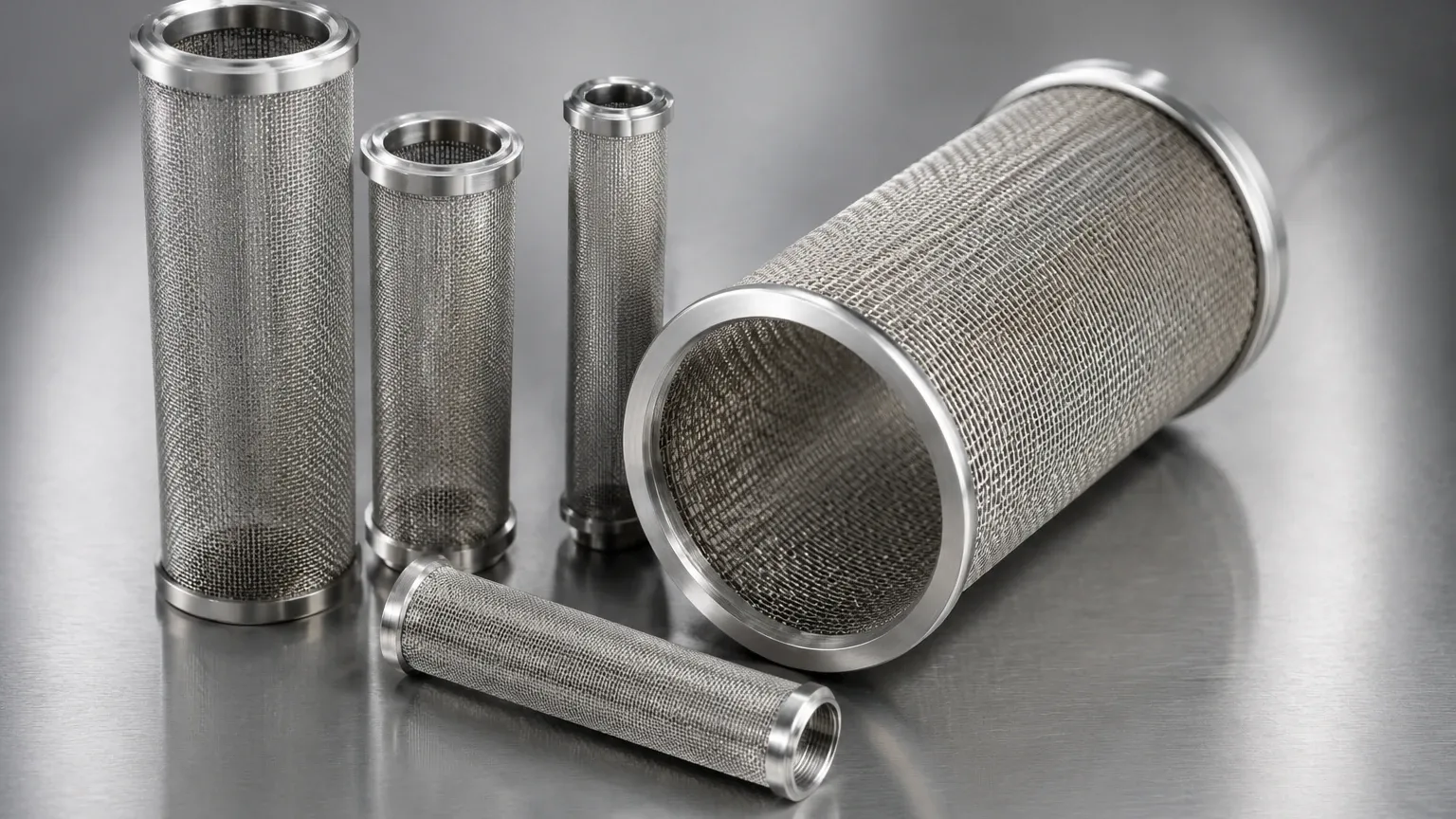
Industrial Application Scenarios
The 5 mesh filter is utilized across diverse sectors where coarse particulate separation is the first line of defense.
* Water Treatment: Used in intake structures for power plants or municipal water works to prevent leaves, twigs, and aquatic life from entering the system.
* Chemical Processing: Acts as a strainer for raw chemical feedstock, removing undissolved solids or large contaminants before the fluid enters reactors.
* Food and Beverage: Employed in the processing of juices, pulps, and oils to remove seeds, skins, or large impurities while allowing the liquid phase to pass freely.
* Oil and Gas: Integrated into suction strainers for heavy oil transport to protect pumping stations from scale and large debris found in pipelines.
* Hydraulic Systems: Used in reservoir breathers or suction lines to ensure that large environmental contaminants do not enter the hydraulic circuit.
Selection and Procurement Checklist for Engineers
To ensure the successful procurement of Wire Mesh Filter Cylinders & Tubes, international buyers and technical teams should confirm the following specifications with the manufacturer:
1. Dimensional Accuracy: Confirm the Outer Diameter (OD), Inner Diameter (ID), and overall length. Tolerances should be clearly defined, especially for filters that must fit into precision-machined housings.
2. End Cap Configuration: Determine if the filter requires open ends, closed ends, or specific fittings such as NPT threads, flanges, or bayonet mounts.
3. Reinforcement Requirements: Assess whether the operating pressure necessitates a perforated metal support tube or an external cage.
4. Cleaning Compatibility: Verify if the filter can withstand the intended cleaning method, whether it be backwashing, ultrasonic cleaning, or chemical CIP (Clean-In-Place) cycles.
5. Certification: For specialized industries, check for compliance with standards such as FDA (for food contact), 3-A (sanitary design), or specific ISO quality management certifications.
Maintenance and Total Cost of Ownership
One of the primary advantages of a stainless steel 5 mesh filter is its durability and reusability. Unlike disposable polymer cartridges, stainless steel mesh can be cleaned and returned to service multiple times, significantly reducing the total cost of ownership (TCO).
Cleaning Protocols
For a 5 mesh filter, manual cleaning with a high-pressure water jet or a stiff brush is often sufficient to remove trapped debris. In more demanding applications, ultrasonic cleaning can be used to remove microscopic buildup from the wire intersections. Because the 5 mesh has large openings, it is less prone to "blinding" (permanent clogging) than finer meshes, provided the cleaning schedule is maintained.
Replacement Cycles
While highly durable, these filters are not infinite. Fatigue from pressure pulsations or erosion from abrasive slurries will eventually degrade the wire. Regular inspection should look for broken wires, thinning of the mesh, or deformation of the cylinder shape. A well-maintained 5 mesh stainless steel filter can last for several years in standard industrial service, making it a highly cost-effective component of the filtration train.
Conclusion
The 5 mesh filter is a foundational component in industrial filtration, balancing high flow capacity with robust mechanical protection. By selecting the correct material grade and structural configuration—specifically through the use of high-quality Wire Mesh Filter Cylinders & Tubes—engineers can ensure the longevity and efficiency of their fluid handling systems. When sourcing these components, focusing on technical precision, weld quality, and material certification will result in a filtration solution that meets the rigorous demands of modern industrial environments.
