


Of Water Filter Cartridges
In industrial water treatment and process engineering, the selection and implementation of filtration components are critical to maintaining system integrity, protecting downstream equipment, and ensuring product quality. Among the various technologies available, the performance and durability of water filter cartridges represent a primary concern for engineers managing high-stakes environments. While residential applications often rely on disposable polymer-based media, industrial sectors—ranging from chemical processing to food and beverage production—increasingly turn to stainless steel and precision-engineered metal solutions to meet rigorous operational demands.
Understanding the technical nuances of water filter cartridges requires a deep dive into material science, fluid dynamics, and mechanical design. For professionals tasked with optimizing filtration systems, the goal is to balance filtration efficiency with long-term cost-effectiveness and structural reliability.
Engineering Fundamentals of Water Filter Cartridges
The fundamental purpose of any industrial filter is the removal of suspended solids from a liquid stream. However, the efficacy of water filter cartridges is dictated by the specific architecture of the filter media and the materials used in construction. In demanding industrial environments, stainless steel is often the material of choice due to its inherent resistance to corrosion, high temperatures, and mechanical stress.
Material Selection: 304 vs. 316L Stainless Steel
Most high-performance Filter Cartridges are manufactured using either Grade 304 or Grade 316L stainless steel.
* Grade 304: This is the standard industrial grade, providing excellent durability and resistance to oxidation. It is suitable for general water treatment, hydraulic fluids, and many food-grade applications where the chemical environment is relatively neutral.
* Grade 316L: The "L" stands for low carbon, which enhances weldability and prevents sensitization to intergranular corrosion. Grade 316L contains molybdenum, making it significantly more resistant to chlorides and acidic environments. In seawater desalination, pharmaceutical processing, or aggressive chemical filtration, 316L is the preferred specification for the construction of water filter cartridges.
Mechanical Integrity
Unlike polypropylene or pleated paper filters, metal filter cartridges offer high collapse pressure ratings. This structural rigidity is essential in systems where pressure spikes are common or where high-viscosity fluids are processed. The ability to withstand significant differential pressure ($ΔP$) without deformation ensures that the filtration bypass—a common failure point in softer media—is effectively eliminated.
Filtration Mechanics: Surface vs. Depth Filtration
When evaluating the design of water filter cartridges, engineers must choose between surface filtration and depth filtration mechanisms, each offering distinct advantages depending on the particle size distribution of the influent.
Wire Mesh and Surface Filtration
Stainless steel wire mesh filters primarily operate via surface filtration. Particles larger than the mesh opening are trapped on the upstream side of the media. This design is highly predictable and allows for easy cleaning through backwashing or ultrasonic treatment. Because the filtration occurs on a single plane, the pressure drop remains relatively low until the surface is nearly fully blinded.
Sintered Metal and Depth Filtration
Sintered metal cartridges, created by fusing multiple layers of wire mesh or metal fibers under high heat and pressure, provide a tortuous path for fluid. This creates a depth filtration effect where particles are trapped within the thickness of the media. Sintered designs offer superior filtration accuracy (down to sub-micron levels) and are ideal for removing fine contaminants that might pass through a single layer of mesh.
Key Performance Indicators: Micron Ratings and Flow Dynamics
The specification of water filter cartridges is governed by two primary metrics: the micron rating and the flow rate capacity. Misunderstanding these values can lead to either insufficient filtration or excessive energy consumption due to high pressure drops.
Nominal vs. Absolute Micron Ratings
* Nominal Rating: This indicates the ability of the filter to retain a major percentage (usually 60% to 90%) of particles of a specific size. It is a general guideline rather than a guarantee of purity.
* Absolute Rating: This represents the diameter of the largest hard spherical particle that will pass through the filter under specified test conditions. For critical applications, such as pharmaceutical water or fine chemical processing, absolute-rated filter cartridges are mandatory to ensure consistent output quality.
Pressure Drop and Flow Rate
The "clean pressure drop" is the initial resistance the filter offers to the fluid flow. As the filter accumulates debris, the pressure drop increases. Engineers must size the filter housing and the number of cartridges to ensure that the initial $ΔP$ is minimized, typically aiming for less than 2-5 PSI in a clean state. High flow rates through a small surface area will accelerate the blinding of the media, leading to shorter service cycles and increased maintenance costs.
Structural Variations in Industrial Filter Cartridges
To meet diverse application requirements, the physical configuration of water filter cartridges can be customized. The choice of structure directly impacts the available surface area and the dirt-holding capacity of the system.
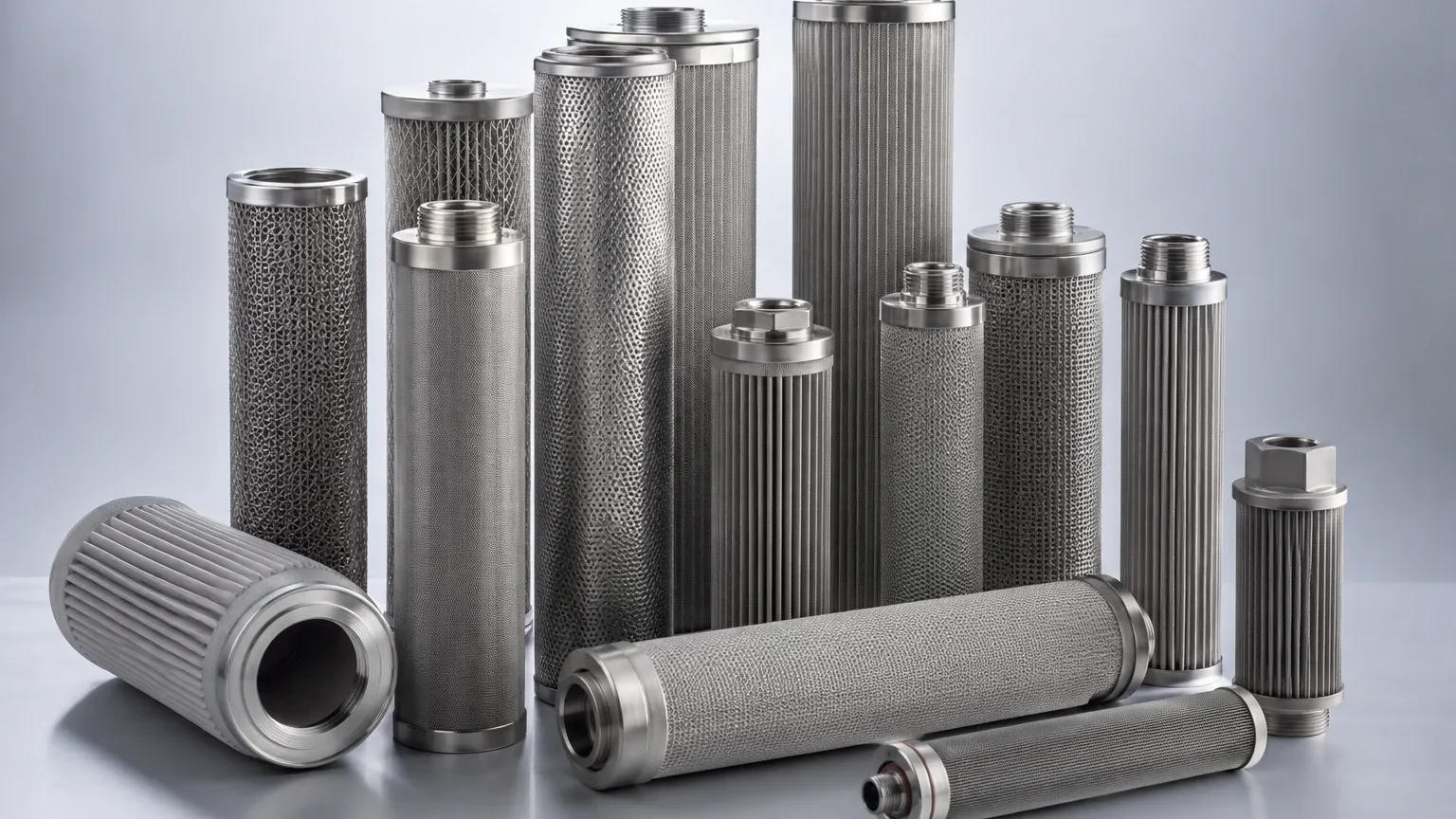
Pleated Filter Cartridges
Pleating the stainless steel mesh or fiber felt significantly increases the effective filtration area within the same footprint. For example, a pleated cartridge may offer 3 to 5 times the surface area of a standard cylindrical cartridge. This increased area results in:
* Lower flux (flow per unit area), which improves filtration efficiency.
* Lower initial pressure drop.
* Extended service life between cleaning cycles.
Cylindrical and Wedge Wire Designs
For heavy-duty applications involving high solids loading, cylindrical mesh or wedge wire designs are often used. Wedge wire, in particular, features a V-shaped profile that is extremely resistant to clogging and is ideal for self-cleaning automatic filters. These are frequently used in the primary stages of water intake or for large-scale industrial cooling loops.
Selection Criteria for Industrial Water Filtration
Selecting the appropriate specification of water filter cartridges requires a comprehensive analysis of the operating environment. Engineers should confirm the following parameters before procurement:
1. Fluid Compatibility: Beyond the water itself, what chemicals are present? Are there trace amounts of hydrocarbons, acids, or chlorine that could degrade the seals or the metal media?
2. Temperature Extremes: Metal cartridges excel in high-temperature steam or hot water loops where polymer filters would melt or lose structural integrity. Confirm the maximum operating temperature to select the appropriate O-ring material (e.g., Viton, EPDM, or PTFE).
3. Particle Characteristics: Is the contaminant hard and abrasive, or soft and gelatinous? Hard particles are easily handled by surface mesh, while gelatinous contaminants often require depth filtration or pleated media to prevent rapid blinding.
4. Regulatory Compliance: In the food, beverage, and pharmaceutical industries, components must meet FDA or 3-A Sanitary Standards. Stainless steel is naturally non-leaching and can be polished to high sanitary finishes to prevent bacterial growth.
Maintenance, Cleaning, and Total Cost of Ownership
One of the most significant advantages of stainless steel water filter cartridges is their cleanability. While the initial capital expenditure (CAPEX) for metal cartridges is higher than for disposable types, the total cost of ownership (TCO) is often lower over the life of the equipment.
Cleaning Methodologies
Unlike disposable filters that contribute to industrial waste streams, metal cartridges can be regenerated using several methods:
* Backwashing: Reversing the flow of fluid to dislodge surface contaminants.
* Ultrasonic Cleaning: Using high-frequency sound waves in a cleaning solvent to remove deeply embedded particles from sintered media.
* Chemical Cleaning: Using mild acids or bases to dissolve organic or mineral scaling, provided the chemical is compatible with the stainless steel grade.
* Burn-off/Calcination: For organic contaminants, controlled heating can oxidize the debris without damaging the metal structure.
Environmental and Operational Impact
By utilizing cleanable filter cartridges, facilities reduce their environmental footprint by eliminating the disposal of contaminated plastic media. Operationally, this reduces the frequency of system shutdowns for filter changes, provided the system is designed for in-place cleaning (CIP) or has a redundant duplex filter arrangement.
Customization and OEM Solutions
In many industrial projects, standard off-the-shelf filter cartridges do not meet the specific spatial or performance constraints of the machinery. Customization is a vital aspect of industrial filtration procurement. Manufacturers like Kaifil provide OEM services to tailor the dimensions, end-cap configurations (such as DOE, SOE, or threaded connections), and filtration layers to specific process needs.
Customization allows for the optimization of the filtration stages—for instance, combining a coarse mesh outer guard with a fine sintered inner core in a single cartridge. This multi-stage approach can protect sensitive downstream components while maintaining a compact housing design.
Conclusion: Optimizing the Filtration Lifecycle
The implementation of water filter cartridges in an industrial setting is not merely a matter of replacement; it is an engineering decision that affects the efficiency, safety, and profitability of the entire process. By prioritizing high-quality materials like 304 and 316L stainless steel and carefully calculating the required micron ratings and flow dynamics, technical teams can ensure reliable performance in the most demanding environments.
Whether dealing with high-pressure hydraulic systems, corrosive chemical streams, or high-purity food processing water, the durability and cleanability of metal filtration solutions provide a level of security that disposable media cannot match. As industrial standards continue to evolve toward greater sustainability and higher precision, the role of engineered metal filter cartridges remains central to modern fluid management strategies.
