


Filter Cartridge Pp
In industrial liquid filtration, the selection of media is a critical engineering decision that dictates the efficiency, longevity, and cost-effectiveness of a process. Among the various polymers used in the production of disposable filtration elements, polypropylene (PP) stands as the most versatile and widely utilized. A filter cartridge pp (polypropylene) is often the first line of defense in complex filtration trains, providing essential pre-filtration or final clarification across industries ranging from chemical processing to food and beverage production.
Understanding the technical nuances of polypropylene filtration media—including its chemical compatibility, structural variations, and performance limits—is essential for engineers and procurement teams tasked with optimizing fluid purity. This guide examines the engineering principles behind polypropylene filter cartridges and provides a framework for evaluating their role within industrial systems.
Understanding Polypropylene as a Filtration Medium
Polypropylene is a thermoplastic polymer known for its excellent balance of chemical resistance and mechanical strength. In the context of Filter Cartridges, PP is favored because it is naturally hydrophobic and chemically inert to a wide range of substances. This inertness ensures that the filter media does not react with the process fluid or leach extractables, which is a paramount concern in high-purity applications like pharmaceutical manufacturing or electronics rinsing.
Chemical Compatibility
One of the primary reasons for the dominance of the filter cartridge pp in industrial settings is its broad chemical resistance. It is highly resistant to most organic solvents, as well as strong acids and bases. For instance, in metal finishing and plating applications, where aggressive acidic baths are common, PP cartridges maintain their structural integrity where other materials might degrade. However, engineers must note that PP has limited resistance to strong oxidizing agents and certain aromatic or chlorinated hydrocarbons, particularly at elevated temperatures.
Thermal Limitations
While PP is robust, it is a thermoplastic with defined thermal boundaries. Most standard polypropylene cartridges are rated for continuous operation at temperatures up to 60°C (140°F), with some reinforced designs reaching 80°C (176°F). Exceeding these limits can lead to the softening of the fibers, which may cause pore bypass or structural collapse under differential pressure. For applications involving steam sterilization or high-temperature solvents, engineers typically transition from polymer-based media to stainless steel filtration solutions.
Construction Types: Melt-Blown vs. Pleated PP
Not all polypropylene cartridges are created equal. The manufacturing process determines the filtration mechanism—either depth filtration or surface filtration—which significantly impacts how the cartridge handles solids loading.
Melt-Blown (Depth) Filter Cartridges
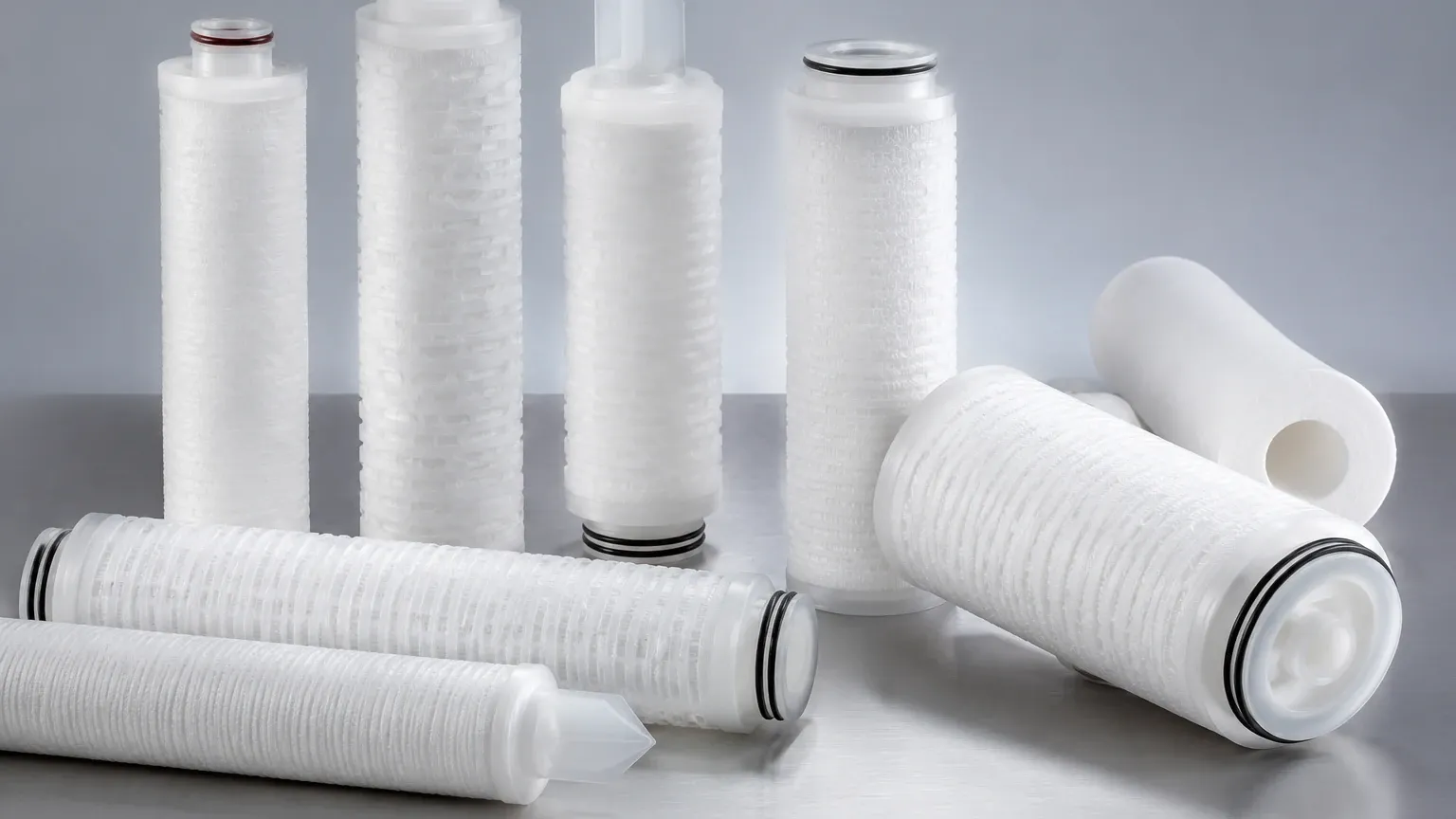
Melt-blown cartridges are produced by extruding molten polypropylene through high-velocity air streams to create fine fibers that are collected on a rotating mandrel. This process creates a complex, three-dimensional matrix. High-quality melt-blown filters feature a "gradient density" structure, where the outer layers have larger pores to catch coarse particles, while the inner layers are more densely packed to capture finer contaminants.
This depth filtration mechanism is ideal for fluids with a broad distribution of particle sizes. Because the entire thickness of the filter wall is used to trap debris, these cartridges offer high dirt-holding capacity and are frequently used as pre-filters to protect more expensive downstream components.
Pleated (Surface) Filter Cartridges
Pleated PP cartridges are constructed using thin sheets of melt-blown or membrane-like polypropylene media that are folded to increase the available surface area. These pleats are then supported by internal cores and external cages, usually also made of PP, and thermally bonded to end caps.
Because of the significantly higher surface area compared to depth filters, pleated cartridges offer lower initial pressure drops and higher flow rates. They are typically used for more precise filtration tasks where a specific, absolute micron rating is required. In a B2B procurement context, pleated filters are often chosen for final polishing stages where the fluid has already undergone primary clarification.
Key Performance Metrics for Engineers
When specifying a filter cartridge pp, technical professionals must look beyond the simple micron rating. Several key metrics define the actual performance of the filter in a pressurized system.
Nominal vs. Absolute Micron Ratings
* Nominal Rating: This is an arbitrary value indicating that the filter will trap a large percentage (often 60% to 90%) of particles at the stated micron size. Nominal filters are best suited for non-critical pre-filtration.
* Absolute Rating: This indicates that the filter has been tested to remove 99.9% (Beta 5000) or 99.98% (Beta 5000) of particles at the specified size. For critical applications where downstream equipment or product quality is at risk, absolute-rated pleated PP cartridges are the standard.
Differential Pressure (Delta P)
Differential pressure is the difference between the inlet and outlet pressure of the filter housing. A new filter cartridge will have a "clean pressure drop," which increases as the filter becomes loaded with contaminants. Engineers must design systems to handle the maximum allowable differential pressure—usually around 2.0 to 2.5 bar (30-35 psi)—before the cartridge requires replacement. Monitoring Delta P is the most reliable method for determining the end-of-life for a disposable PP element.
Dirt Holding Capacity (DHC)
DHC refers to the total mass of contaminants a filter can retain before reaching its terminal differential pressure. Depth filters generally have higher DHC for gelatinous or deformable particles, while pleated filters excel at capturing hard, spherical particles due to their large surface area.
Industrial Applications and Compatibility
The versatility of the filter cartridge pp allows it to serve as a staple in numerous industrial sectors. Its FDA-compliant versions (CFR Title 21) make it particularly valuable in regulated environments.
Water Treatment and RO Pre-filtration
In large-scale desalination and industrial water treatment, Reverse Osmosis (RO) membranes are the most expensive components. To prevent premature fouling of these membranes, PP melt-blown cartridges are used to remove silt, sand, and suspended solids. The low cost of PP elements makes them an economical "sacrificial" layer that extends the life of the RO system.
Chemical and Petrochemical Processing
Polypropylene’s resistance to acids and alkalis makes it the default choice for filtering process chemicals, detergents, and specialty chemicals. In the petrochemical industry, PP cartridges are used for the filtration of amine loops and glycol systems, where maintaining fluid clarity is essential for preventing foaming and corrosion.
Food and Beverage Clarification
From bottled water to fruit juices, PP filters are used for clarification and particle removal. Because they can be manufactured without binders or surfactants, they do not impart flavors or odors to the product. Pleated PP cartridges are often used for the final filtration of beer or wine to remove yeast and spoilage organisms before bottling.
Integration with Stainless Steel Systems
While polypropylene is an excellent choice for many applications, it is often part of a multi-stage filtration strategy that includes metallic components. In many industrial plants, a filter cartridge pp serves as the primary stage, while stainless steel filters are used for secondary stages or high-stress environments.
For example, in a high-pressure hydraulic system, a PP filter might be used in the low-pressure return line to capture general debris, while a high-precision stainless steel wire mesh filter is used in the high-pressure supply line where polymer elements might fail. Similarly, in steam-in-place (SIP) systems, PP cannot survive the repeated thermal cycles, requiring a transition to sintered metal or stainless steel cartridges.
By utilizing Filter Cartridges made of stainless steel in tandem with PP elements, engineers can balance the low operating cost of disposables with the extreme durability and cleanability of metal media. This hybrid approach optimizes the total cost of ownership while ensuring system reliability.
Selection Criteria and Engineering Considerations
Selecting the correct filter cartridge pp requires a systematic evaluation of the process conditions. Engineers should confirm the following data points before finalizing a purchase:
1. Fluid Viscosity: Higher viscosity fluids require larger surface areas or lower flow rates to prevent excessive pressure drop. If the fluid is highly viscous, a pleated cartridge is often superior to a depth filter.
2. Contaminant Nature: Is the debris hard and crystalline or soft and deformable? Deformable particles can "wedge" into the pores of a surface filter, leading to rapid blinding. Depth filters are usually better for such contaminants.
3. Flow Rate Requirements: Calculate the total flow (GPM or m³/hr) and divide by the number of 10-inch equivalent (DOE) cartridges. Over-sizing the filter housing can significantly extend the life of the PP elements by reducing the face velocity at the media.
4. End-Cap Configuration: Ensure the cartridge hardware (e.g., Code 7, 222 O-rings, or Flat Gaskets) matches the filter housing to prevent bypass. A filter is only as good as its seal.
Total Cost of Ownership (TCO) and Maintenance
In a B2B environment, the purchase price of a filter cartridge pp is only one component of the total cost. Procurement teams must also consider the frequency of change-outs, the labor costs associated with maintenance, and the costs of disposal.
Because PP cartridges are disposable and cannot be effectively cleaned once fouled, they generate a consistent waste stream. In processes with extremely high solids loading, the cost of replacing PP cartridges weekly may eventually exceed the investment in a cleanable stainless steel filtration system. However, for most light-to-medium load applications, the low unit cost and ease of replacement make PP the most economical choice.
To maximize the life of a PP cartridge, it is critical to never exceed the recommended flow rate. High flow rates force contaminants deeper into the media, causing a faster rise in differential pressure. Furthermore, implementing a coarse pre-filter (such as a 50-micron bag filter or a stainless steel strainer) upstream of a 5-micron PP cartridge can increase the life of the finer element by 300% to 500%.
Conclusion
The filter cartridge pp remains a cornerstone of industrial filtration due to its chemical versatility and cost-efficiency. Whether utilized as a melt-blown depth filter for high dirt-holding or a pleated element for precise clarification, polypropylene provides a reliable solution for a vast array of fluid processing challenges. By understanding the technical boundaries of this material and comparing it with high-performance alternatives like stainless steel, engineers can design filtration systems that deliver consistent purity and optimized operational costs.
