


Filter Cartridge Polypropylene
In the landscape of industrial liquid processing, the selection of filtration media is a critical decision that impacts product purity, equipment longevity, and operational overhead. Among the various materials available, the filter cartridge polypropylene (PP) stands as one of the most versatile and widely utilized components. Known for its broad chemical compatibility and cost-effectiveness, polypropylene is the primary choice for depth and surface filtration in sectors ranging from chemical manufacturing to food and beverage production.
Understanding the technical nuances of polypropylene as a filtration medium is essential for engineers and procurement teams. This guide examines the material properties, structural variations, performance metrics, and selection criteria for polypropylene filter cartridges within demanding industrial environments.
Material Properties and Chemical Compatibility
Polypropylene is a thermoplastic polymer characterized by its high degree of chemical inertness. This makes it an ideal candidate for filtering a wide array of fluids, including organic solvents, acids, and alkalis. Unlike some natural fibers or metallic media, polypropylene does not easily react with the process fluid, ensuring that the filtrate remains uncontaminated by the media itself.
Chemical Resistance
One of the primary reasons for the dominance of the filter cartridge polypropylene in the market is its resistance to chemical degradation. It is generally stable in the presence of:
* Inorganic Acids: Including hydrochloric and sulfuric acids at moderate concentrations.
* Alkaline Solutions: Excellent resistance to sodium hydroxide and potassium hydroxide.
* Organic Solvents: Good performance with alcohols and many organic acids, though caution is required with certain aromatic hydrocarbons and halogenated solvents at elevated temperatures.
Thermal and Physical Limits
While robust, polypropylene has defined thermal boundaries. Most standard PP cartridges are rated for continuous operation up to 60°C (140°F), with specialized high-temperature versions reaching up to 80°C (176°F). Beyond these temperatures, the polymer may lose structural integrity, leading to pore deformation or "unloading" of captured contaminants. For applications exceeding these limits, engineers typically transition to Filter Cartridges manufactured from stainless steel or other high-performance alloys.
Structural Variations of Polypropylene Cartridges
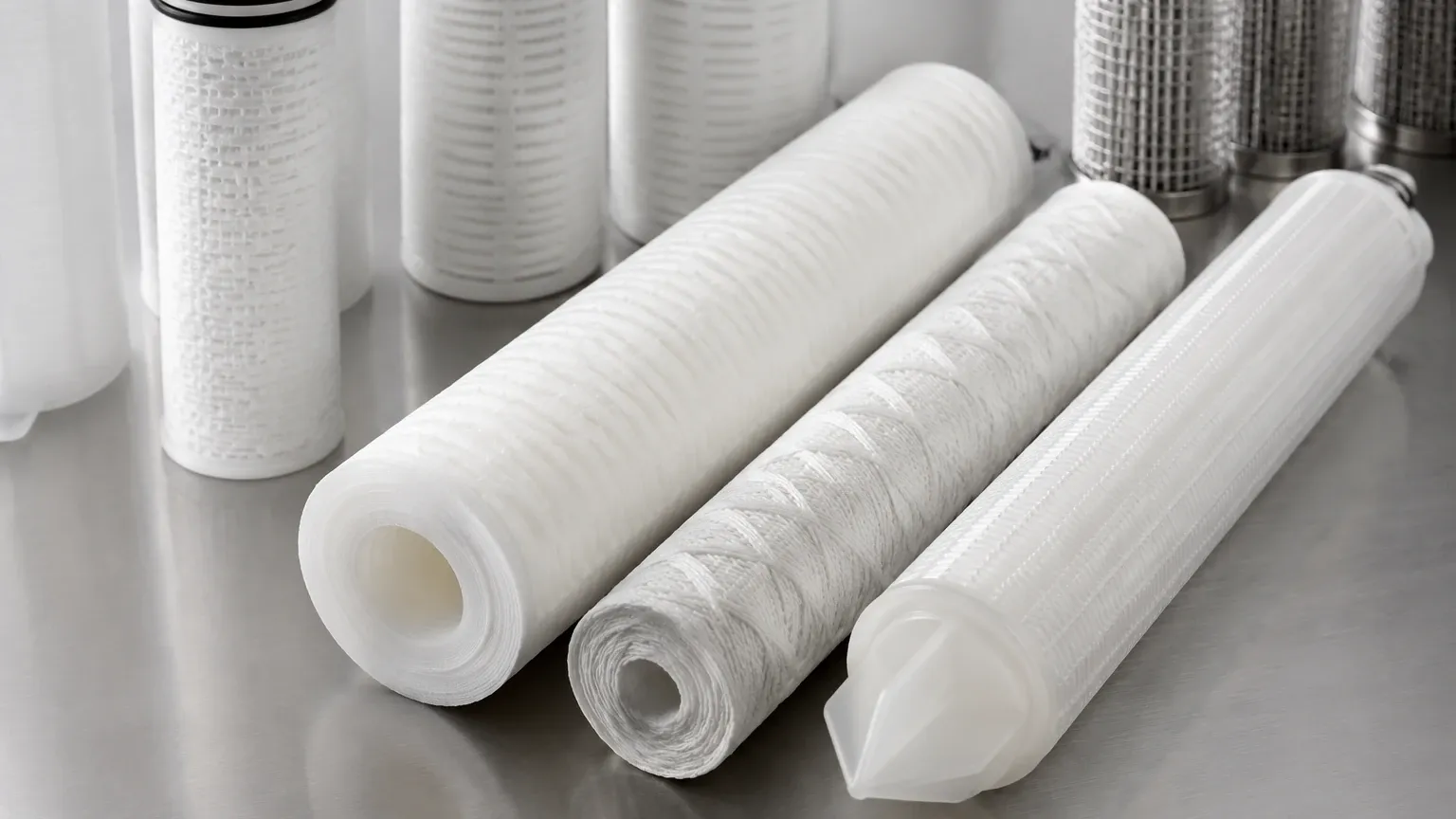
The performance of a filter cartridge polypropylene is determined not just by its material, but by its physical construction. There are three primary designs used in industrial applications: melt-blown, pleated, and string-wound.
Melt-Blown Depth Cartridges
Melt-blown cartridges are produced by extruding molten polypropylene through high-velocity air, creating a dense web of microfibers. These fibers are thermally bonded, meaning no chemical binders or adhesives are used, which is critical for high-purity applications.
* Graded Density: High-quality melt-blown cartridges feature a graded density structure, where the outer layers have larger pores to capture coarse particles, while the inner core has finer pores for final polishing. This structure maximizes the dirt-holding capacity and extends the service life.
* Applications: Ideal for pre-filtration in Reverse Osmosis (RO) systems, wastewater treatment, and general industrial chemical processing.
Pleated Surface Cartridges
Pleated polypropylene cartridges are designed for applications requiring high flow rates and precise particle retention. By pleating the polypropylene membrane or microfiber sheet around a central core, the available surface area is significantly increased compared to a standard depth cartridge.
* High Efficiency: Pleated designs often offer absolute micron ratings, meaning they can achieve 99.9% efficiency at a specific particle size.
* Low Pressure Drop: The increased surface area results in a lower initial differential pressure (ΔP), allowing for higher throughput in a compact footprint.
* Applications: Critical filtration in pharmaceuticals, food and beverage (bottled water, beer, wine), and electronics manufacturing.
String-Wound Cartridges
String-wound cartridges represent a traditional form of depth filtration where polypropylene yarn is wound around a support core (often also PP or stainless steel). The winding pattern creates diamond-shaped chambers that trap particles.
* Robustness: These are often used in heavy industrial applications where high sediment loads are present.
* Limitations: They may be prone to media migration (fibers shedding into the filtrate) if the winding tension is not precisely controlled.
Technical Performance Metrics
When evaluating a filter cartridge polypropylene, engineers must look beyond the material type and focus on specific performance data provided by the manufacturer.
Micron Ratings: Nominal vs. Absolute
* Nominal Rating: An arbitrary value indicating the cartridge's ability to trap a percentage of solids (usually 50% to 85%) of a specific size. Nominal filters are best suited for non-critical pre-filtration.
* Absolute Rating: Refers to the diameter of the largest hard spherical particle that will pass through the filter under specified test conditions. For critical processes, absolute-rated pleated cartridges are required to ensure consistent quality.
Beta Ratio
The Beta Ratio ($\\beta$) is a more precise measure of filtration efficiency. It is the ratio of particles of a given size in the influent (upstream) to the particles of the same size in the effluent (downstream). A Beta Ratio of 1000 indicates 99.9% efficiency for that specific micron size.
Dirt-Holding Capacity
This refers to the total mass of contaminants a filter can retain before the differential pressure reaches its terminal limit (typically 2.0 to 2.5 bar). A higher dirt-holding capacity translates to fewer filter changes and lower operational labor costs.
Industry-Specific Applications
Food and Beverage Processing
In the food and beverage industry, the filter cartridge polypropylene must be manufactured from FDA-compliant materials (CFR Title 21). These cartridges are used for clarifying juices, filtering process water, and protecting sensitive equipment like carbonators and filling valves. Because polypropylene is hydrophobic, it does not absorb moisture or support microbial growth, provided it is regularly sanitized.
Chemical and Petrochemical
The chemical industry utilizes PP cartridges for the filtration of reagents, bulk chemicals, and plating solutions. The absence of metal components in an all-polypropylene construction prevents galvanic corrosion and metal ion leaching, which is vital when handling aggressive acids or high-purity chemicals.
Water Treatment and Desalination
In large-scale water treatment, polypropylene melt-blown cartridges serve as the primary defense for RO membranes. By removing silt, sand, and suspended solids, they prevent the premature fouling of expensive membranes. In these high-volume applications, the cost-to-performance ratio of the filter cartridge polypropylene is unmatched.
Engineering Considerations for Selection
Selecting the right cartridge requires a holistic view of the filtration system. Engineers should confirm the following parameters before procurement:
1. End-Cap Configuration: Cartridges come with various end-cap styles to fit different housings, such as Double Open End (DOE), 222 O-rings with a flat cap, or 226 O-rings with a locking fin. Correct seating is essential to prevent bypass.
2. Sealing Materials: While the filter media is polypropylene, the O-rings or gaskets may be Viton, EPDM, Silicone, or Buna-N. These must be compatible with the process fluid.
3. Flow Velocity: Exceeding the recommended flow rate per 10-inch equivalent (DOE) can lead to premature blinding and structural failure. Typically, a flow of 10-15 liters per minute (LPM) per 10-inch element is recommended for optimal efficiency in aqueous solutions.
4. Sterilization Compatibility: If the process requires sterilization, engineers must verify if the cartridge can withstand autoclaving or in-line steam sterilization (SIP). Pleated PP cartridges are often designed to withstand multiple sterilization cycles.
Total Cost of Ownership (TCO)
While polypropylene cartridges are generally inexpensive compared to stainless steel or fluoropolymer alternatives, the TCO involves more than the purchase price. Factors influencing TCO include:
* Frequency of Change-outs: A cheaper cartridge with low dirt-holding capacity may cost more in the long run due to frequent downtime and labor costs.
* Disposal Costs: Spent PP cartridges are typically incinerated or sent to landfills. In high-volume operations, the waste volume can be significant.
* Energy Consumption: As a filter clogs, the pump must work harder to maintain flow. Monitoring differential pressure and changing filters at the optimal point (rather than waiting for total blockage) reduces energy expenditure.
When to Move Beyond Polypropylene
Despite its advantages, the filter cartridge polypropylene is not a universal solution. Engineers should consider alternative materials, such as those provided by Kaifil, in the following scenarios:
* Extreme Temperatures: For fluids above 80°C, stainless steel wire mesh or sintered metal cartridges are required.
* High Pressure Differentials: In hydraulic systems or high-pressure gas filtration, the structural rigidity of metal is superior.
* Backwashing Requirements: Polypropylene cartridges are generally disposable. If the application allows for cleaning and reuse to reduce waste, permanent stainless steel filtration systems are a more sustainable choice.
Conclusion
The filter cartridge polypropylene remains a cornerstone of industrial filtration due to its balance of chemical resistance, versatile design, and economic viability. Whether utilizing melt-blown depth filters for pre-filtration or pleated membranes for critical clarification, understanding the technical specifications and material limits ensures the integrity of the production process. By carefully matching the cartridge design to the specific demands of the fluid and the environment, technical professionals can achieve reliable, high-performance filtration that meets the rigorous standards of modern industry.
