


Pure Water Filter Cartridges
In industrial environments, the term "pure water" encompasses a broad spectrum of technical standards, ranging from high-quality process water used in food and beverage production to the ultrapure water (UPW) required in semiconductor manufacturing and pharmaceutical compounding. Achieving and maintaining these standards requires a multi-stage approach where Filter Cartridges serve as critical barriers against particulate matter, microbial contaminants, and degraded resin beads.
For engineers and procurement specialists, selecting the appropriate pure water filter cartridges involves more than simply matching a micron rating. It requires a deep understanding of material compatibility, structural integrity under pressure, and the specific cleanliness requirements of the downstream process. This guide examines the technical considerations essential for optimizing filtration performance in pure water systems.
The Role of Filter Cartridges in Industrial Pure Water Systems
Pure water systems typically utilize a combination of technologies, including reverse osmosis (RO), electrodeionization (EDI), and UV sterilization. However, the mechanical filtration provided by cartridges is indispensable at several stages of the water treatment loop.
Pre-filtration for Membrane Protection
Before water reaches sensitive RO membranes, pre-filtration is necessary to remove suspended solids that could cause scaling or fouling. Using robust stainless steel or high-efficiency polymer cartridges at this stage extends the life of the more expensive membrane elements. In high-temperature or high-pressure pre-filtration scenarios, stainless steel wire mesh or sintered metal cartridges are often preferred due to their mechanical strength.
Post-DI and Post-EDI Polishing
In deionization (DI) systems, ion exchange resins can shed fine particles (resin fines) over time. Pure water filter cartridges placed after the resin beds act as "polishing" filters, ensuring that no resin fragments enter the distribution loop. These filters must have absolute micron ratings to guarantee the removal of particles within a specific size range.
Point-of-Use and Vent Filtration
At the point of use, filtration ensures that the water meets the final purity specification. Additionally, storage tanks for pure water require vent filters to prevent airborne contaminants from entering the system as water levels fluctuate. In these applications, the hydrophobicity and sterility of the filter media are paramount.
Material Selection and Engineering Considerations
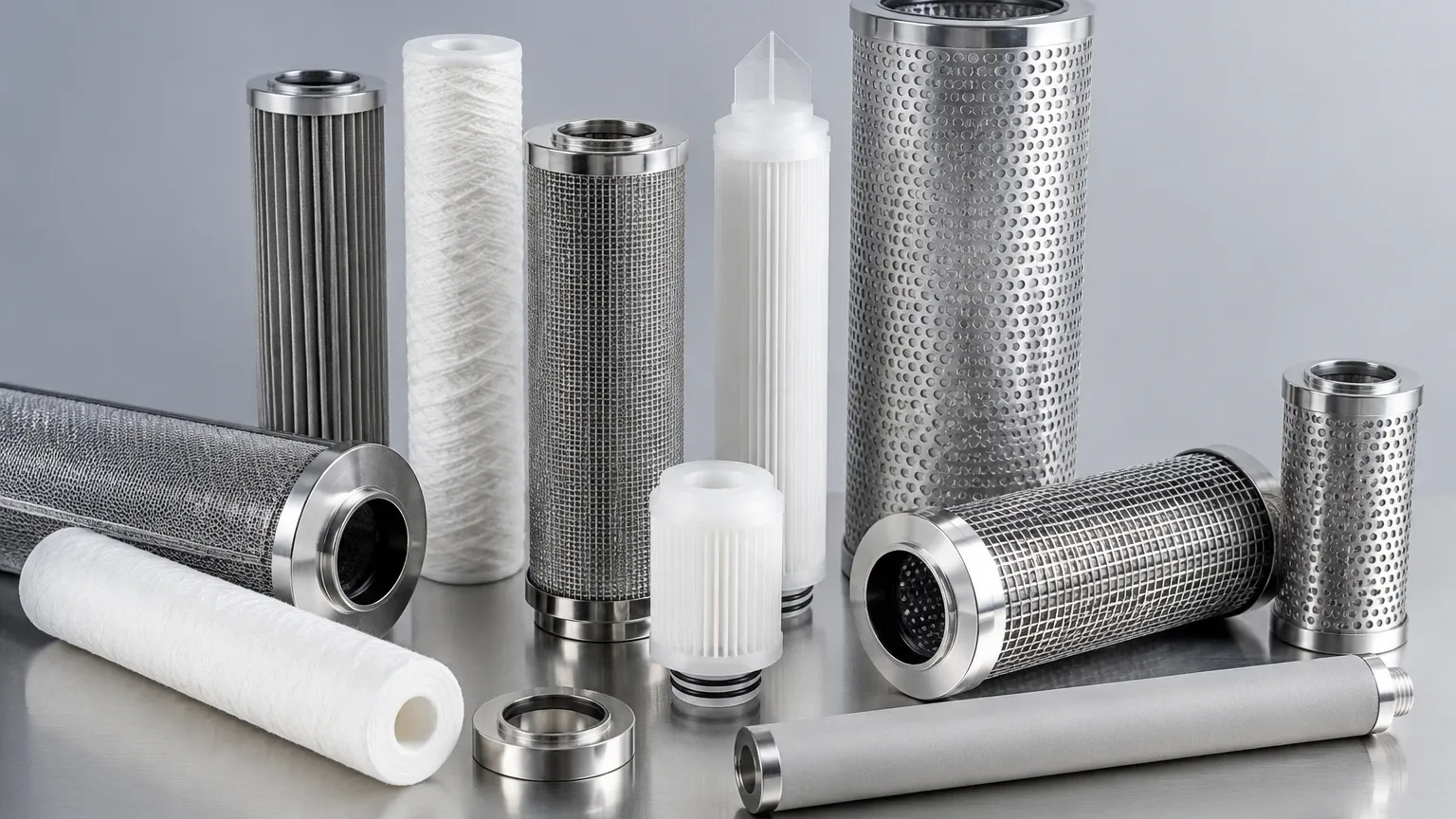
The choice of material for pure water filter cartridges is dictated by the chemical nature of the water and the sterilization protocols of the facility. While polypropylene is common for general-purpose applications, industrial and pharmaceutical sectors often turn to stainless steel for its superior durability and thermal resistance.
Stainless Steel 304 and 316L
For pure water applications, 316L stainless steel is the industry standard due to its high corrosion resistance and low leaching characteristics. Unlike plastic filters, stainless steel cartridges do not release volatile organic compounds (VOCs) or extractables into the water stream, which is critical for maintaining low Total Organic Carbon (TOC) levels. Furthermore, metal filters can withstand Clean-in-Place (CIP) and Steam-in-Place (SIP) procedures, allowing for repeated sterilization without structural degradation.
Mechanical Strength and Pressure Differential
Filter cartridges must maintain their pore structure even under high differential pressure ($ΔP$). As contaminants accumulate on the filter surface, the pressure drop across the element increases. Engineering teams must specify the maximum allowable $ΔP$ to prevent media migration or structural collapse. Stainless steel cartridges, particularly those with a pleated design, offer a high surface area and high collapse pressure, making them suitable for demanding hydraulic environments.
Technical Specifications: Micron Ratings and Efficiency
Understanding the distinction between nominal and absolute micron ratings is vital for pure water applications.
* Nominal Rating: This indicates the filter's ability to retain a majority of particles at a given size (e.g., 90% of 5-micron particles). Nominal filters are generally used for pre-filtration where high precision is less critical.
* Absolute Rating: This refers to the diameter of the largest hard spherical particle that will pass through the filter under specified test conditions. For critical pure water stages, absolute-rated cartridges (e.g., 99.9% efficiency) are required to ensure consistent water quality.
In pure water systems, common micron requirements include:
* 10–20 Microns: General pre-filtration and protection of coarse components.
* 1–5 Microns: Protection of RO membranes and removal of larger microbial clusters.
* 0.22–0.45 Microns: Sterilizing grade filtration, used to remove bacteria and fine particulates in pharmaceutical and electronics applications.
Evaluating Surface vs. Depth Filtration
When selecting pure water filter cartridges, engineers must choose between surface and depth filtration mechanisms based on the contaminant load and the desired flow rate.
Surface Filtration (Wire Mesh and Pleated Media)
Surface filters, such as those made from stainless steel wire mesh, trap particles on the upstream side of the media. These are ideal for applications with a narrow particle size distribution. Pleated surface filters provide a significantly larger surface area within the same cartridge footprint, allowing for higher flow rates and lower initial pressure drops. Because the contaminants are held on the surface, these cartridges are often easier to clean and regenerate.
Depth Filtration (Sintered Metal and Fiber)
Depth filters utilize a thick matrix of media (such as sintered metal fibers or powders) to trap particles throughout the entire thickness of the element. This structure provides a high dirt-holding capacity and is effective at removing irregularly shaped particles or deformable contaminants. In pure water systems, depth filtration is frequently used in the intermediate stages to capture resin fines and smaller suspended solids.
Performance Risks and Quality Control
Implementing pure water filtration is not without risks. Poorly selected or maintained cartridges can lead to system failures or water contamination.
Media Migration and Leaching
One of the primary risks with low-quality polymer filters is media migration, where fragments of the filter material itself break off and enter the pure water stream. In ultrapure water applications, even trace amounts of leached chemicals can ruin semiconductor batches or contaminate pharmaceutical products. Using high-quality, welded (rather than glued) stainless steel cartridges eliminates the risk of adhesive leaching and fiber migration.
Biofilm Formation
In stagnant areas of a water system, bacteria can colonize filter surfaces and form biofilms. Once established, biofilms are difficult to remove and can lead to persistent microbial contamination. Pure water filter cartridges must be compatible with sanitization agents like ozone, hot water, or steam. Stainless steel's ability to withstand high-temperature sanitization makes it a superior choice for preventing biofouling in pharmaceutical water loops.
Integrity Testing
For critical applications, it is essential to verify that the filter cartridge is installed correctly and free of defects. Integrity tests, such as the Bubble Point Test or Pressure Decay Test, are used to confirm that the filter meets its rated efficiency. Manufacturers like Kaifil provide precision-engineered components that are designed to meet these rigorous validation standards.
Maintenance and Total Cost of Ownership (TCO)
While the initial purchase price of a filter cartridge is a factor, the Total Cost of Ownership (TCO) provides a more accurate picture of long-term value. TCO includes the cost of the filter, labor for replacement, system downtime, and disposal costs.
Disposable vs. Cleanable Cartridges
Disposable polymer cartridges have a lower upfront cost but require frequent replacement and generate significant waste. In contrast, stainless steel pure water filter cartridges are an investment in durability. They can be cleaned via ultrasonic baths, backflushing, or chemical cleaning, allowing them to be reused for years. In high-flow industrial systems, the reduction in replacement frequency and disposal volume often results in a lower TCO over the life of the equipment.
Monitoring Pressure Drop
To optimize the replacement cycle, systems should be equipped with differential pressure gauges. Replacing a filter too early results in unnecessary costs, while replacing it too late can lead to reduced flow rates or, in extreme cases, filter failure. Establishing a baseline $ΔP$ for a clean filter and a set limit for replacement ensures predictable system performance.
Key Information to Confirm Before Purchasing
Before finalizing a specification for pure water filter cartridges, engineering and purchasing teams should confirm the following technical details with the manufacturer:
1. Fluid Characteristics: Confirm the temperature, flow rate, and chemical composition (including sanitization chemicals) of the water.
2. Required Retention: Define the absolute micron rating required for the specific application stage.
3. Housing Compatibility: Ensure the cartridge end-cap configuration (e.g., Code 7, DOE, 222/Flat) matches the existing filter housing.
4. Certification Requirements: Determine if the filters need to meet specific standards, such as FDA compliance for food contact or USP Class VI for pharmaceuticals.
5. Cleaning Protocols: Verify that the filter material can withstand the intended cleaning or sterilization methods (e.g., 121°C steam).
Conclusion
Selecting the right Filter Cartridges is a fundamental step in maintaining the integrity of industrial pure water systems. By focusing on high-quality materials like 316L stainless steel, understanding the nuances of absolute vs. nominal filtration, and considering the long-term benefits of cleanable media, engineers can ensure reliable performance and high water quality.
Kaifil specializes in providing customized stainless steel filtration solutions that address these complex industrial requirements. Whether for pre-filtration in chemical processing or polishing in a pure water loop, precision-engineered metal filter components offer the durability and accuracy necessary for demanding environments. For technical professionals, choosing a partner with manufacturing expertise ensures that the filtration system is optimized for both performance and cost-efficiency.
